As the United States approaches its monumental 250th anniversary, historians and maritime enthusiasts are re-evaluating the ingenious, albeit doomed, technological marvels that shaped the nation’s fight for independence. Among these innovations stands a craft shaped like an acorn and built of oak and iron hoops: the Turtle. Developed by Yale University student David Bushnell, the Turtle secured its place in the annals of history during the American Revolution as the world’s first combat-ready submarine.
Nearly 250 years ago, on the dark, restless waters of New York Harbor during the night of September 6–7, 1776, this single-person submersible targeted the pride of the Royal Navy: the 64-gun flagship HMS Eagle. The mission ultimately failed; the pilot was unable to screw the explosive charge into the warship’s metal-clad hull. Yet, despite this tactical setback, the Turtle laid foundational stones for modern undersea warfare, asymmetric combat, and specialized naval operations. Praised by figures like George Washington as an "effort of genius," Bushnell’s trailblazing craft remains a testament to the revolutionary spirit of ingenuity under existential pressure.
Detailed Chronology: From Yale Pubs to New York Harbor
The Genesis of an Undersea Weapon (1771–1775)
The story of the Turtle begins not in a military shipyard, but in the intellectual and spirited crucible of Yale University. As early as 1771, long before the first shots of the American Revolution rang out at Lexington and Concord, students gathered at local New Haven establishments to debate how a fledgling America could possibly confront the dominant Royal Navy.
Historian Mark Jacobson of the International Spy Museum notes that these young intellectuals quickly realized a head-on clash with the world’s most powerful maritime force was a recipe for disaster. The only viable path was to limit the enemy’s capabilities through covert innovation.
David Bushnell, deeply immersed in gunpowder experiments, took up the challenge. He realized that an explosive charge detonated against a ship’s hull underwater would unleash far more devastating hydraulic pressure than a bomb placed casually on its deck. First, he had to prove that gunpowder could ignite and burn effectively while completely submerged. Once he mastered underwater explosives, he turned to the logistical nightmare of delivering them silently to an enemy target.
To bring his vision to life, Bushnell enlisted a collaborative network of family members, mentors, and craftsmen. His brother, Ezra Bushnell, aided in construction, while local clockmaker Isaac Doolittle contributed critical timing mechanisms, valves, and water pumps. As authors Roy R. Manstan and Frederic J. Frese chronicle in Turtle: David Bushnell’s Revolutionary Vessel, the creation of the submarine was a meticulous four-year iterative process of design, testing, and modification.
By the spring of 1775, the wooden hull was complete. Bushnell later described its distinct geometry to Thomas Jefferson, writing that its outer shell "bore some resemblance to two upper tortoise shells of equal size, joined together." Thus, the Turtle was born.
Anatomy of the Turtle
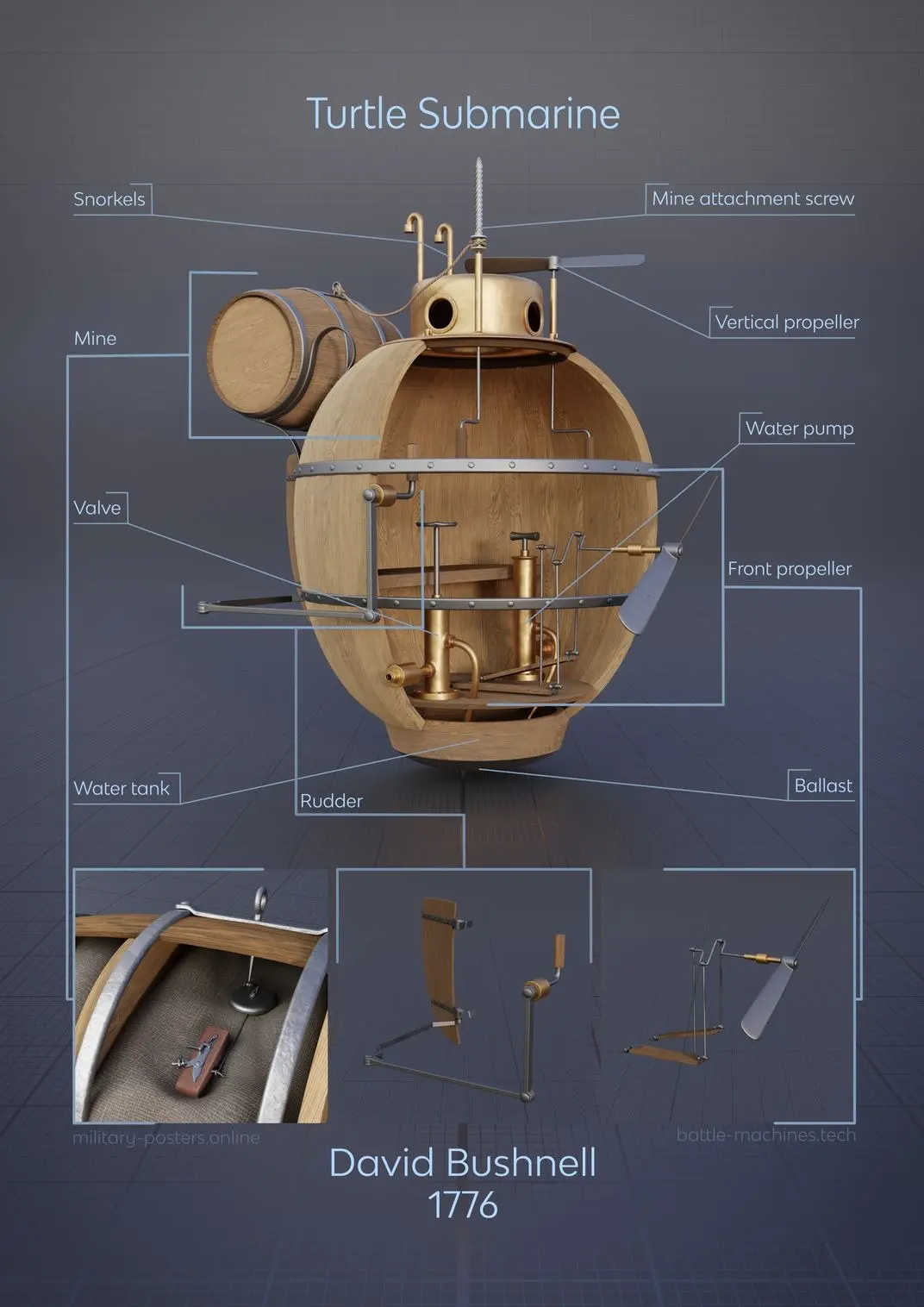
Designed to accommodate a single operator, the Turtle operated on principles that foreshadowed modern submarine engineering:
Propulsion: The pilot used a pedal-operated front propeller to move forward and a hand crank to adjust depth and position.
Buoyancy Control: To submerge, the operator opened a valve to let water flood a central ballast chamber, leaving just enough air space at the top for survival. To surface, the water was expelled using hand-operated bilge pumps.
Navigation and Illumination: Small, inset glass windows provided limited daytime light. For nighttime operations, instruments like the compass and barometer were coated with foxfire—a bioluminescent fungus—though its temperature sensitivity limited its practical use in cold weather.
The Payload: Mounted atop the rudder was a "powder magazine," a timed explosive device equipped with a clockwork mechanism that could be set for up to 12 hours. The pilot was meant to maneuver beneath a ship, use a vertical screw to attach the charge to the hull, release the device, and flee.
The Attack on the HMS Eagle (September 1776)
Originally slated to strike British forces in Boston, the Turtle was relocated to New York City after the British shifted their occupation there. When original pilot Ezra Bushnell fell ill, Continental Army soldier Ezra Lee stepped forward to pilot the dangerous mission.
Around midnight on September 6, 1776, Lee paddled and cranked the Turtle out into the black expanse of New York Harbor toward the HMS Eagle. Reaching the British flagship, Lee later documented the terrifying proximity to the enemy: "I could see the men on deck and hear them talk… I then shut down all the doors, sunk down and came under the bottom of the ship, up with the screw against the bottom, but found that it would not enter."
The Eagle’s hull was likely lined with copper sheathing, which deflected the screw. Exhausted, running low on oxygen, and fighting a swift current, Lee abandoned the charge and retreated. The explosive drifted away and detonated harmlessly in the harbor, startling the British fleet but leaving the flagship untouched. Subsequent attempts by Lee and another pilot, Phineas Pratt, also failed. By October 1776, the British sank the sloop transporting the submarine, though parts of the Turtle were reportedly recovered and seen disassembled as late as 1800.
Supporting Context & Metrics
Evaluating the Turtle requires understanding the profound technological limitations of the 18th century.
Metric / Feature
Specification / Detail
Primary Material
Oak wood reinforced with iron hoops
Capacity
1 operator
Propulsion System
Human-powered (foot pedals for propeller, hand crank)
Weaponry
Timed powder magazine (up to 12-hour clockwork timer)
Cost & Scale
Inexpensive, highly asymmetric, minimal resource expenditure compared to traditional warships
Operational Limit
Severely restricted by physical endurance, oxygen supply, and ambient water temperature (affecting bioluminescent lighting)
Naval historians emphasize that the Turtle was not a "true submarine" in the modern sense—it lacked independent, long-range propulsion and atmospheric generation systems, requiring a surface vessel or shore support to reach its operational zone. Yet, as U.S. Naval War College historian Evan Wilson notes, it stands as an unprecedented leap in tactical thinking.
Official Statements and Expert Analysis
Historians looking back across two and a half centuries view the Turtle through the lens of modern strategic warfare:
"All of Turtle’s attacks failed, and the launching of Turtle did not herald the age of the submarine—that was still more than a hundred years away. A wooden-hulled submersible carrying one person was never likely to be the foundation for a new era of naval warfare. The metallurgical and propulsive technologies necessary to operate underwater were still a long way off."
— Evan Wilson, Hattendorf Historical Center, U.S. Naval War College
Despite these technological gaps, the philosophy behind the craft proved prophetic. Mark Jacobson of the International Spy Museum draws a direct evolutionary line from Bushnell’s invention to the elite units of the modern military:
"The possibility of swimmers and divers being armed with underwater timed explosive devices will eventually evolve into the frogmen of World War II and the Navy SEALs. Military and naval historians think about the Turtle as an asymmetric weapon. The Continental Navy simply couldn’t control the seaboard, but the Turtle offered the promise of sinking a massive 64-gun ship while sowing constant psychological terror among the British fleet."
Future Outlook: The Enduring Echoes of Innovation
As America celebrates its semiquincentennial, the legacy of the Turtle extends far beyond its failure to sink the HMS Eagle. It stands as an archetype of American ingenuity—the willingness to leverage intellect, unconventional tactics, and cross-disciplinary collaboration (involving students, clockmakers, and inventors) to offset overwhelming structural disadvantages.
The mechanical innovations embedded within Bushnell’s craft—from its early screw-propeller designs to its concepts of limpet mines and timed aquatic explosives—foreshadowed the development of Robert Fulton’s Nautilus in 1800, the Confederate submersibles of the Civil War, and ultimately the nuclear-powered submarines and elite special operations units of the 21st century.
Two hundred and fifty years after Ezra Lee wrestled the hand cranks of an oak acorn in the dark waters of New York Harbor, the Turtle is remembered not merely as a failed weapon, but as a bold, brilliant precursor to the modern undersea domain.

/https://tf-cmsv2-smithsonianmag-media.s3.amazonaws.com/filer_public/a5/30/a530c850-32a9-4cf0-a6da-b74e6cfc15f8/turtle-diagram.png)
/https://tf-cmsv2-smithsonianmag-media.s3.amazonaws.com/filer_public/a5/30/a530c850-32a9-4cf0-a6da-b74e6cfc15f8/turtle-diagram.png)
/https://tf-cmsv2-smithsonianmag-media.s3.amazonaws.com/filer_public/9c/8f/9c8fb1a9-28d3-439f-b557-6a841a3079a6/gettyimages-90745770.jpg)
/https://tf-cmsv2-smithsonianmag-media.s3.amazonaws.com/filer_public/9a/43/9a43c29d-9c99-4b16-b4cf-82b0a881ba23/bushnell_turtle.jpeg)

/https://tf-cmsv2-smithsonianmag-media.s3.amazonaws.com/filer_public/13/ae/13aeb9ca-66f8-4cee-b219-d7434591202f/ezralee.jpg)

Comments
Facebook App ID not configured. Please add it in the Customizer.