
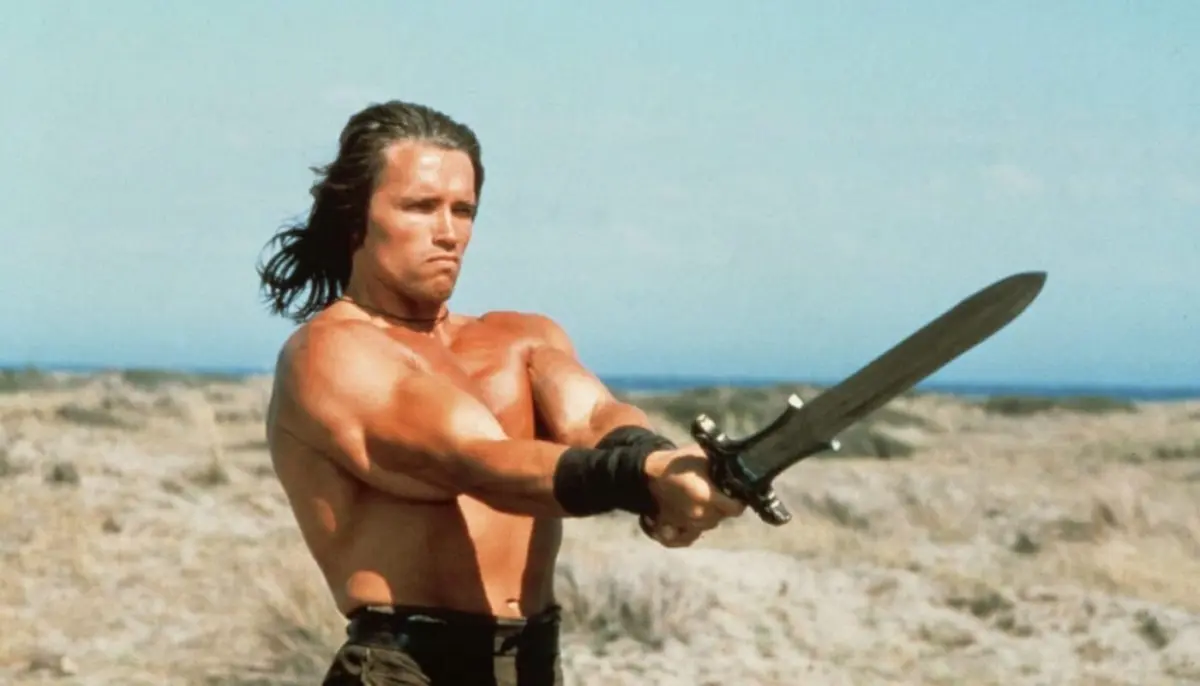
As "Sword and Sorcery September" presses forward, cinematic retrospectives often return to the crucible of 1980s fantasy filmmaking—an era distinct from both the polished CGI spectacles of the 2000s and the gritty, unvarnished cheese of the late 20th century. Spearheaded by the visionary, albeit often hazardous, creative experiments of the decade, 1982’s Conan the Barbarian stands out not merely as a relic of pop-culture machismo, but as the foundational ur-text for modern cinematic fantasy.
Directed by John Milius, co-written by Milius and a pre-fame Oliver Stone, and produced by Dino and Raffaella De Laurentiis, the film propelled a former Austrian bodybuilder—Arnold Schwarzenegger—from international sports stardom into the cultural stratosphere. Yet, decades past its theatrical run, Conan the Barbarian suffers from a curious dissonance. Its contemporary public reputation paints it as a brainless, hyper-violent exercise in lizard-brained power fantasy, embraced by fringe subcultures and parodied by pop culture at large.
However, a forensic re-examination of the film reveals something startlingly distinct: a surprisingly nuanced, emotionally resonant, and thoughtful meditation on grief, loyalty, equality, and the subversion of toxic masculinity. Far from the sleazy sexploitation and hollow brutality that characterized its many cheap imitators (Sorceress, Fire & Ice), Conan the Barbarian remains a remarkably crafted epic—one whose enduring cultural footprint stretches from tabletop roleplaying games to modern geopolitical discourse.
Read Also
Detailed Chronology: The Odyssey of the Cimmerian
The narrative arc of Conan the Barbarian is an epic tapestry stitched together from Robert E. Howard’s diverse short stories, comic adaptations, and original cinematic inventions.
Act I: The Crucible of Servitude
The film opens under the shadow of a heavy metal-inspired Nietzschean maxim: "That which does not kill us makes us stronger." Young Conan’s idyllic life in a Cimmerian blacksmith village is shattered when ruthless raiders—led by the charismatic, unyielding Thulsa Doom (James Earl Jones)—slaughter his parents and destroy his home. Condemned to childhood servitude, Conan survives years of brutal captivity, chained to the "Wheel of Pain." He grows into a monolithic specimen of muscle and misery, transformed eventually from a field laborer into a pit-fighter and breeding stud.
Upon receiving his freedom, Conan is cast into a nomadic existence driven by a singular, consuming obsession: revenge against the cult of Set and the man who murdered his lineage. Along his journey, he encounters a mysterious witch, crosses paths with the stoic archer Subotai (surfing legend Gerry Lopez), and forms a fierce, equal partnership with the fierce brigand and dancer Valeria (Sandahl Bergman). Together, the trio launches a lucrative career as master thieves, successfully looting the tower of the Serpent Cult—an act that cements Conan and Valeria’s deep, mutual romance.
Act II: The Temple of Set and the Tree of Woe
Conan and his companions are soon approached by the aged, desperate King Osric of Zamora (Max von Sydow). Osric’s daughter, Yasmina, has abandoned the crown to fall under the hypnotic thrall of Thulsa Doom’s expanding religious movement. Tasked with her rescue, Conan infiltrates the serpent temple alone, only to be betrayed, captured, and sentenced to public execution.
Thulsa Doom subjects Conan to a horrific crucifixion upon the "Tree of Woe." Left for dead, Conan is miraculously cut down by Subotai and Valeria, who drag his lifeless, broken body to the hut of the wizard Akiro (Mako). Through dark, ancient rites, Akiro resurrects the warrior—though at a heavy, unspecified cost to be paid later.
Act III: Redemption, Sacrifice, and Decapitation
Reinvigorated, the fellowship breaches the cult’s heavily fortified mountain compound. They successfully rescue Yasmina, but the escape exacts a devastating toll: Valeria is struck down by a poisoned arrow. She dies in Conan’s arms, willingly paying the blood-price required for his resurrection.
Following a bittersweet funeral pyre on an ancient barrow, the remaining heroes face down Thulsa Doom’s elite lieutenants. Through combat prowess, tactical trickery, and the spectral intervention of Valeria’s shade, the heroes triumph.
Yasmina, now freed from Doom’s psychological conditioning, aids Conan in slipping back into the heart of the temple during a mass sermon. Confronting the cult leader, Conan listens as Doom claims spiritual paternity over him—framing himself as the architect of Conan’s strength. Unmoved, Conan decapitates the false god. Witnessing the mortal fallibility of their deity, the fanatical cultists immediately disperse. Conan burns the temple to the ground, bringing an end to a dark chapter of the Hyborian Age.
Supporting Context & Metrics: Production, Reception, and Legacy
Financial and Critical Metrics
- Budget: Estimated at approximately $20 million.
- Box Office Gross: An impressive commercial return of nearly $80 million worldwide, proving the financial viability of high-fantasy cinema.
- Accolades: Received multiple Saturn Award nominations, with Sandahl Bergman securing the award for Best Actress.
- Musical Score: Composed by Basil Poledouris, the film’s orchestral score is widely recognized as one of the greatest achievements in fantasy film history, earning universal praise even from contemporary critics who dismissed the picture itself.
Cultural Imprint and Derivative Works
The staggering success of 1982’s Conan the Barbarian unlocked an entirely new commercial avenue for Hollywood. Without it, the sword-and-sorcery boom of the mid-1980s—including the direct sequel Conan the Destroyer (1984), the spin-off Red Sonja (1985), and Ralph Bakshi’s animated Fire & Ice (1983)—would not have materialized.
The film also established the cinematic viability of Robert E. Howard’s broader literary catalogue, paving the way for downstream media like Kull the Conqueror (1997), Solomon Kane (2009), and Jason Momoa’s 2011 Conan reboot. Furthermore, its visual language bled directly into tabletop roleplaying games, board games, and video games—most notably shaping TSR’s classic Dark Sun campaign setting for Dungeons & Dragons.
Official Statements and Critical Re-evaluations
When Conan the Barbarian debuted, critical reception was deeply divided. Mainstream reviewers were often appalled by its visceral violence and primitive narrative structure. Yet, modern retrospective analysis reveals a picture far more sophisticated than 1980s critics realized.
Film historians point to John Milius’s direction and Oliver Stone’s foundational script as the core drivers of this subversion. Rather than relying on constant, bombastic dialogue, the production team made the bold choice to keep Arnold Schwarzenegger relatively silent during the film’s first half. Deprived of the rapid-fire one-liners that defined his later career (Predator, Commando), Schwarzenegger was forced to communicate through physical presence, quiet vulnerability, and grim determination.
Conan is depicted not as an unthinking engine of destruction, but as a man capable of profound sorrow, humor (such as drunkenly face-planting into a bowl of gruel or punching a camel), and deep romantic devotion.
Concurrently, James Earl Jones delivered a masterclass in villainy. Speaking on the character’s motivations, Jones portrayed Thulsa Doom not as a raving lunatic, but as an exhausted, aristocratic manipulator. His performance relied on understated charisma, establishing a blueprint for cinematic cult leaders for generations.
Future Outlook: The Enduring Shadow of Cimmeria
More than four decades after its release, Conan the Barbarian continues to occupy a fascinating intersection of cinematic history, gender discourse, and pop-culture memory. While the broader public memory of the film is often hijacked by the excess of its marketing and the parodies of muscle-bound tropes, the film itself remains a towering achievement of atmosphere, pacing, and visual storytelling.
Its afterlife even stretched into the unexpected realms of modern political history. Most notably, in the wake of the January 6th Capitol riots, Arnold Schwarzenegger delivered a viral, nationally televised address on the sanctity of American democracy. Seated before a replica of the governor’s office, Schwarzenegger drew a direct line between his own childhood trauma under a fascist father and the health of civic institutions, culminating in his lifting of the exact replica sword used in Conan the Barbarian.
Whether viewed through the lens of political symbolism, high-fantasy world-building, or a surprisingly progressive study of equality and non-toxic masculinity, Conan the Barbarian refuses to fade into obscurity. As "Sword and Sorcery September" marches on toward its 1984 sequel, Conan the Destroyer, the original Cimmerian epic stands unbowed—proof that true cinematic mythologies are forged not in polished perfection, but in the fiery, chaotic furnaces of bold artistic ambition.


Comments
Facebook App ID not configured. Please add it in the Customizer.