
Magnolia State: Scott Colom’s Historic Senate Victory and the Long Arc of Mississippi’s Civil Rights Movement
Executive Overview
In a political watershed moment that reverberates far beyond the borders of the Deep South, Democrat Scott Colom’s victory in Mississippi’s United States Senate race was officially called on Wednesday. This historic triumph marks a seismic shift in American politics: Colom becomes the first Black person to represent Mississippi in the US Senate since the Reconstruction era—more than 140 years ago.
For generations of Black Mississippians who endured the violent disenfranchisement of the Jim Crow era, systemic voter suppression, and structural marginalization, this milestone is nothing short of a stunning, long-awaited breakthrough. Chief among those reflecting on this monumental achievement is U.S. Representative Bennie Thompson. Having represented Mississippi’s majority-Black Second Congressional District since 1993, the 78-year-old Democratic stalwart has spent his entire life on the front lines of the struggle for political enfranchisement.
Read Also
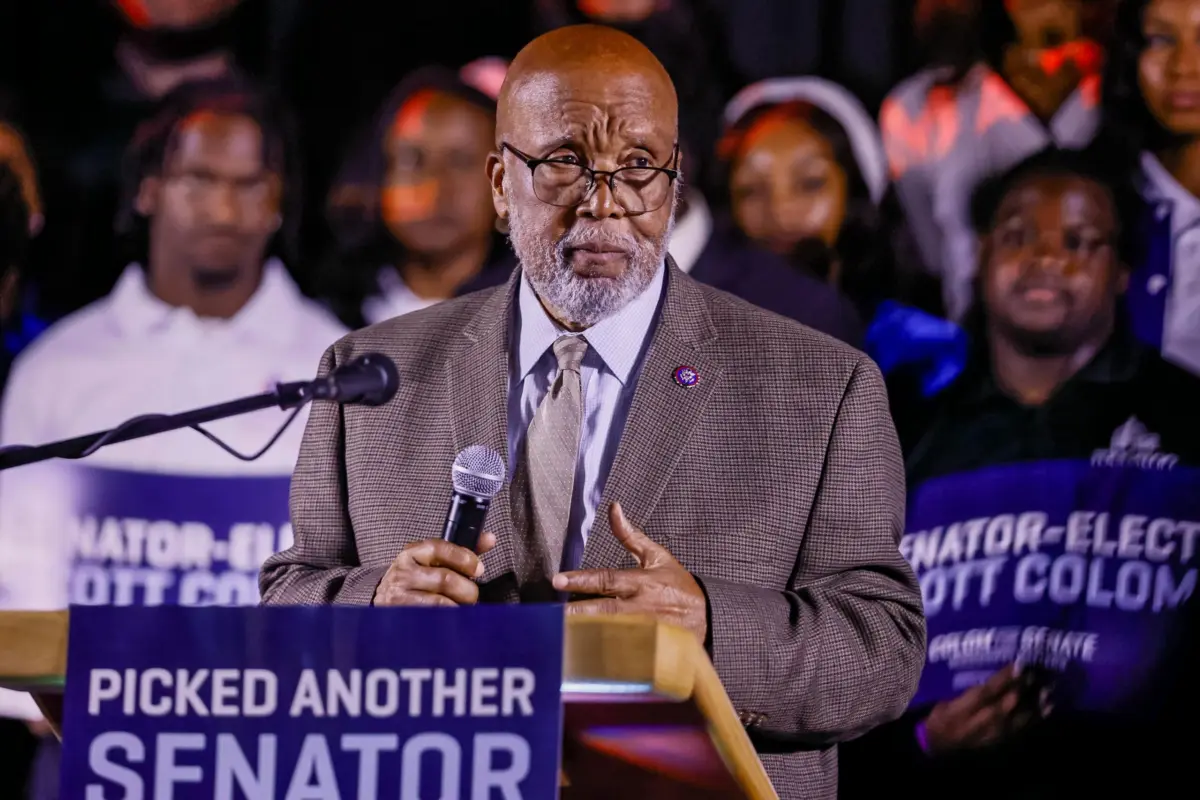
In an extensive interview for the Today, Explained podcast, Congressman Thompson sat down to dissect the gravity of Colom’s ascent, the mechanics of his improbable grassroots campaign, and the deeply personal emotional resonance of watching a protege shatter the ultimate political glass ceiling in a state defined by its complex and painful racial history.
Detailed Chronology: From Reconstruction to a New Dawn
To fully comprehend the magnitude of Scott Colom’s victory, one must examine the profound historical vacuum it fills. The last African American to represent Mississippi in the U.S. Senate was Hiram Rhodes Revels, who took office in 1870 during Reconstruction—a fleeting window of multiracial democracy that was systematically dismantled by white supremacist "Redeemer" governments, followed by the codification of Jim Crow segregation in the late 19th and early 20th centuries.
The Jim Crow Reality
Congressman Thompson’s reflections offer a visceral window into the lived experience of state-enforced apartheid. Growing up in Mississippi, Thompson’s family, like millions of others, was relegated to second-class citizenship.
- Systemic Segregation: Public accommodations, educational facilities, and recreational spaces were strictly partitioned. Thompson recounts how Black children were barred from municipal swimming pools, forced instead to navigate unsupervised creeks and ponds.
- The Veteran’s Betrayal: In a poignant illustration of systemic hypocrisy, Thompson’s uncle returned home after fighting for Allied democracy in World War II, only to be forced to ride on a segregated train behind white German prisoners of war.
- The Economics of Disenfranchisement: Despite paying taxes, Thompson’s parents were systematically denied the fundamental right to vote through arbitrary hurdles such as poll taxes and rigged constitutional interpretation tests—administered, as Thompson notes, by individuals with far less education than the Black professionals attempting to register.
The Crucible of the Civil Rights Movement
The awakening of a new political consciousness in Mississippi began on college campuses like Tougaloo College near Jackson. It was there that a young Bennie Thompson crossed paths with the luminaries of the Civil Rights Movement—Martin Luther King Jr., Stokely Carmichael, Harry Belafonte, and Sammy Davis Jr.
Thompson’s baptism by fire in electoral politics came when he worked on the historic congressional campaign of Fannie Lou Hamer, the legendary activist who co-founded the Mississippi Freedom Democratic Party. Thompson vividly recalls returning to his hometown of Bolton, Mississippi, eager to register Black voters, only to be met with his mother’s sobering assessment: "Well, I don’t know why you way up there… Black people don’t vote here in Bolton."
That realization catalyzed a lifetime of community organizing. Thompson and his peers recognized that true socioeconomic freedom was inextricably linked to political power. They brought Head Start programs to their communities, began local political organizing, and eventually achieved what many thought impossible: mounting successful local campaigns that culminated in an all-Black slate of municipal leaders winning office in a deeply hostile, segregated environment.
Supporting Context & Metrics: The Making of a Senator
Scott Colom’s journey to the U.S. Senate did not happen in a vacuum. It was forged through a deliberate, institutional pipeline designed to cultivate Black political leadership in a state where systemic barriers have historically stymied minority candidates.
The Mississippi Black Leadership Institute
Recognizing that systemic hurdles required deliberate intervention, Congressman Thompson and other regional leaders formed the Mississippi Black Leadership Institute (MBLI). The explicit goal was to build a permanent infrastructure to identify, train, and launch the next generation of public servants.
- First-Class Talent: Scott Colom was a member of the institute’s inaugural cohort. Arriving with a baseline desire to effect change but without a rigid roadmap, Colom identified an open district attorney’s position spanning three counties.
- Defying the Odds Locally: With the backing and strategic counsel of the MBLI network, Colom challenged and ultimately defeated a 28-year incumbent district attorney. Notably, this victory occurred in a majority-white district—proving early on that Colom possessed a crossover appeal anchored in disciplined organizing and a compelling message.
The National Party Chasm
Despite his proven track record at the local level, Colom’s historic Senate campaign faced institutional friction from national Democratic campaign arms. According to Thompson, the Democratic Senatorial Campaign Committee (DSCC) initially declined to invest meaningfully in Colom’s race, reflecting a persistent cultural disconnect and an underlying condescension from national party operatives toward Southern progressive candidates.
"We had a rich message, but a poor campaign. Because we couldn’t get our DSCC to help… Northeasterners were still looking down on Southerners."
— Rep. Bennie Thompson
Despite operating a low-budget campaign heavily reliant on grassroots organizing and social media engagement, Colom built a coalition broad enough to flip the seat. National Democratic leadership offered late, nominal assistance only as the race gained undeniable momentum—a dynamic Thompson dismisses with characteristic candor: "So that’s all right. We’re going to keep doing our low budget, social media-attractive thing."
Official Statements & Reflections
The emotional weight of Colom’s victory cannot be overstated for those who paved the way. For Congressman Thompson, looking back over a career spanning more than five decades of public service, the milestone represents both vindication and the realization of a generational dream.
Reflecting on the psychological toll of decades of political struggle—during which he was routinely targeted and vilified for attempting to elevate minority voices—Thompson’s perspective on Colom’s success is deeply personal:
"For me, having gone through those life experiences and now to see a Scott come along, you know, it not only brings tears to your eye, but it also says that there’s hope. There’s hope for young African Americans that at some point, the choice will be, do I stay or leave? It won’t be, ‘Well, when I get an education, I have to go somewhere else to seek a career.’"
Thompson emphasizes that the ultimate victory is structural: changing the paradigm so that Mississippi’s brightest young minds no longer feel compelled to flee the state to achieve professional and political success.
Future Outlook: A New Era for Mississippi and the Nation
Scott Colom’s seating in the United States Senate fundamentally alters the political landscape of Mississippi and signals a changing guard in Southern politics.
- Redefining Southern Viability: Colom’s victory shatters the long-standing national party orthodoxy that competitive statewide races in the Deep South are unattainable for progressive or Democratic Black candidates without exorbitant national funding. By relying on authentic local messaging and grassroots mobilization, Colom has provided a new playbook for Democratic challengers across the region.
- The Retention of Talent: As Congressman Thompson noted, one of Mississippi’s historic tragedies has been the "brain drain" of educated Black youth leaving for opportunities elsewhere. A visible, high-profile senator of color representing the state on the national stage serves as a powerful psychological anchor for the next generation.
- National Accountability: Colom’s rise also forces a reckoning within national political apparatuses like the DSCC and the Democratic National Committee. The success of a low-budget, locally engineered campaign in the face of national neglect exposes the flaws in top-down resource allocation models and underscores the necessity of investing heavily in homegrown Southern leadership.
As Scott Colom prepares to take the oath of office in Washington, D.C., he carries with him not only the aspirations of a modern, multi-ethnic coalition of voters, but the historic legacy of ancestors like Hiram Revels and the tireless multi-decade crusade of leaders like Bennie Thompson. Mississippi has turned a page, and the echoes of the Jim Crow era are finally meeting their match in a new generation of political architects.





Comments
Facebook App ID not configured. Please add it in the Customizer.