
Executive Overview
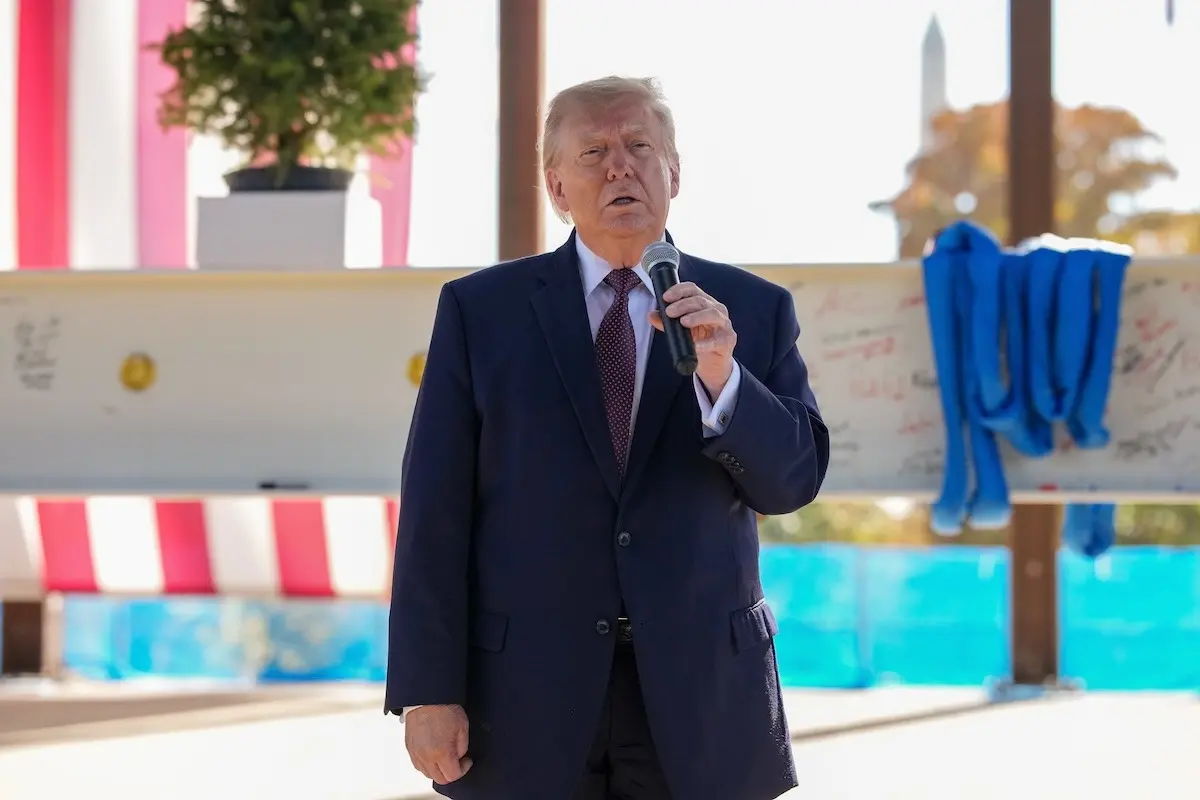
In the immediate aftermath of a bruising midterm election cycle that delivered both chambers of Congress to the Democratic Party, Washington found itself witness to a striking display of political distraction. While political analysts, party strategists, and lawmakers dissected the seismic shift in legislative power on Capitol Hill, President Donald Trump spent his Wednesday entirely detached from the election returns. Instead, he trained his focus on a deeply personal, immensely controversial, and extraordinarily expensive architectural endeavor: the topping-out ceremony for his $400 million White House ballroom project.
The event, marked by the raising of the final structural beam, served as a surreal juxtaposition. Just hours after voters signaled a decisive check on the administration by handing control of the House of Representatives and the Senate to the opposition, the president stood before a crowd of supporters and contractors to champion what he has routinely hyperbolized as "THE GREATEST OF ITS KIND!"
This $400 million undertaking is far from a standard administrative upgrade. From its inception, the project has ignited fierce debates over executive overreach, historical preservation, and the boundaries of architectural propriety within the historic 18-acre executive estate. By demolishing the historic East Wing to clear space for the gargantuan facility—complete with an allegedly subterranean military complex—the administration has courted continuous litigation. Yet, despite stinging rebuffs at the ballot box and ongoing legal challenges from historical preservationists, President Trump remains unyielding. This report provides a comprehensive examination of the ballroom project, tracing its controversial origins, the legal battles that have defined its trajectory, the architectural and financial scope of the undertaking, and the uncertain future it faces under a newly empowered Democratic legislative majority.
Read Also
Detailed Chronology: From Concept to Construction
The Genesis of an Unprecedented Blueprint
The concept of a grand ballroom at the White House is not entirely novel; various administrations over the past century have occasionally floated the idea of a large-scale indoor venue to host state dinners, large conferences, and major galas without the logistical constraints of temporary South Lawn pavilions. However, President Trump transformed this lingering architectural whisper into a high-stakes construction mandate.
Plans for the facility began to crystallize behind closed doors, quickly alarming preservationists and architectural historians. Unlike previous interior updates—which typically adhered to the historical and structural integrity of the complex designed by James Hoban and subsequently modified by generations of architects—Trump’s vision called for sweeping, irreversible alterations. The most shocking blow to the historic estate came with the total demolition of the White House’s East Wing, a foundational section of the complex that had historically housed the offices of the First Lady, social secretaries, and essential administrative staff.
Escalation and the Underground Element
As architectural renderings leaked and public oversight committees attempted to review the blueprints, controversy deepened. Investigative reporting and architectural briefs revealed that the scope of the project extended far beyond a mere social venue. The subterranean specifications included a heavily reinforced military complex beneath the primary ballroom structure, raising immediate security, financial, and jurisdictional questions.
The integration of a below-ground military installation transformed the narrative of the project from a frivolous hospitality upgrade into a complex national security endeavor initiated unilaterally by the executive branch. This added layer provoked fierce pushback from Capitol Hill, where lawmakers from both sides of the aisle questioned how a project of this magnitude and specialized utility could bypass traditional congressional budgeting, appropriation oversight, and historical review boards.
The Legal Quagmire and Supreme Court Intervention
As bulldozers moved in to dismantle the East Wing, legal challenges mounted swiftly. The most formidable adversary to the administration’s timeline was the National Trust for Historic Preservation. In coordination with various architectural advocacy groups, the Trust filed a sweeping federal lawsuit seeking an immediate injunction to halt construction. The core argument rested on the premise that the executive branch had violated federal preservation statutes, overstepped its statutory authority, and failed to adequately consult with oversight bodies such as the National Capital Planning Commission (NCPC) and the Commission of Fine Arts (CFA).
The legal battle wound its way through the federal court system at an accelerated pace, testing the limits of presidential authority over federal lands and historic properties. Past presidents—including public critiques from high-profile figures within the political sphere—and legal scholars weighed in, arguing that the White House belongs to the American public and is not the private property of its temporary occupant to remodel at whim.
Despite these hurdles, the judicial scales tipped decisively in the administration’s favor just weeks prior to the midterm elections. In September, the United States Supreme Court handed down a landmark ruling allowing construction to proceed. The high court determined that the National Trust for Historic Preservation lacked the specific legal standing required to challenge the executive branch’s architectural decisions regarding the White House complex. While the ruling sidestepped the broader constitutional questions of executive overreach, it provided the legal green light the administration desperately needed to push forward with construction unabated.
Supporting Context & Metrics: The Cost, Scale, and Controversy
Financial Breakdown of a $400 Million Enterprise
To fully grasp the magnitude of the White House ballroom project, one must examine the staggering financial and structural metrics involved:
- Total Projected Cost: Estimated at approximately $400 million, making it one of the most expensive capital improvement projects on federal grounds in modern history.
- Funding Mechanisms: While portions of the funding have been heavily subsidized by private donors and aligned political action committees, significant allocations and logistical support have drawn from federal resources, sparking intense congressional scrutiny.
- Square Footage and Capacity: Designed to dwarf the State Dining Room, the new ballroom boasts an expansive footprint intended to accommodate upwards of 1,000 guests comfortably, eliminating the need to erect the massive, climate-controlled tents traditionally used on the South Lawn for state visits.
- Subterranean Complex: The integrated military and logistical command structure underneath the ballroom adds millions to the baseline construction costs and incorporates specialized blast-mitigation engineering.
Historical Preservation Versus Executive Prerogative
The destruction of the East Wing represents a watershed moment in the architectural history of Washington, D.C. For over a century, the East Wing has served as a vital administrative nerve center and a symbol of continuity. Its removal to make way for a modern, neoclassical ballroom has been lamented by architectural historians worldwide as an irreversible loss of cultural heritage.
Critics have repeatedly pointed out the irony of a conservative administration—traditionally aligned with the preservation of institutional norms and historical traditions—dismantling a historic federal landmark to construct a personal monument. Conversely, defenders of the project argue that the White House has continuously evolved since its initial construction in 1800, adapting to the modern logistical demands of the presidency. They contend that a world-class superpower requires a world-class facility to host international heads of state, bypassing the perceived indignity of temporary pavilion tents.
Official Statements and Rhetorical Defiance
The topping-out ceremony on Wednesday offered a masterclass in political theater. Standing before the skeleton of the massive structure with construction workers, foremen, and loyal aides, President Trump delivered remarks that completely ignored the seismic political earthquake that had occurred less than twenty-four hours prior.
The President’s Remarks
Flanked by steel beams and industrial scaffolding, the president exuded characteristic confidence regarding his architectural legacy:
"This is a special structure," Trump remarked to the gathered crowd, in statements highlighted by the New York Times. "It’s going to be not only one of the biggest, but it’ll be the most beautiful ballroom, I think, anywhere in the world."
Addressing the persistent criticism from political opponents and media outlets regarding his fixation on the construction project during a tense national election cycle, Trump offered a candid defense of his priorities:
"You know, it was sort of mentioned a little bit during the campaign: ‘Why does Trump spend time on the White House?’ Well, first of all, it’s very little time. Second of all, I like it. It’s good. For me, it’s relaxing."
Criticisms from Capitol Hill and Preservationists
The administration’s nonchalant attitude toward the midterm losses—and its singular focus on pouring concrete and raising steel—drew immediate condemnation from Democratic leaders. Incoming congressional leaders viewed the speech as a sign of detachment from the economic and social concerns of the electorate.
Meanwhile, representatives from the National Trust for Historic Preservation released a joint statement expressing deep disappointment over the Supreme Court’s earlier ruling and the physical destruction of the East Wing. "The White House is a living museum that belongs to the American people," the statement read. "The unilateral dismantling of its historic fabric sets a dangerous precedent for future executives who may choose to treat national treasures as personal building sites."
Future Outlook: The Ballroom Under a Divided and Hostile Congress
As the dust settles on the midterm elections, the central question shifts from whether the ballroom can be built to how its completion and ongoing maintenance will be managed under a hostile, Democratic-controlled Congress.
Legislative and Oversight Challenges Ahead
With Democrats seizing majorities in both the House of Representatives and the Senate, the political landscape for the remainder of Trump’s term has shifted dramatically. The newly empowered legislative branch holds the ultimate constitutional tool: the power of the purse. While the Supreme Court cleared the immediate judicial hurdles regarding the project’s legal standing, congressional committees possess sweeping subpoena and investigative powers.
Incoming committee chairs have already signaled their intent to launch rigorous oversight investigations into the financing of the $400 million project. Key areas of inquiry will likely include:
- Donor Transparency: A comprehensive audit of the private entities, corporations, and political donors contributing to the construction fund to check for potential conflicts of interest or foreign influence.
- Federal Expenditures: Scrutiny over whether any unauthorized taxpayer funds or diverted agency budgets were utilized to subsidize the subterranean military complex or site preparation.
- Environmental and Safety Compliance: Investigating whether standard federal building codes, environmental impact studies, and D.C. zoning regulations were properly adhered to during the hurried demolition and construction phases.
The Architectural Legacy
Regardless of the impending congressional battles, the physical reality of the ballroom is nearly complete. The raising of the final beam marks the transition from structural framing to interior finishing—a process that will likely consume the coming months.
When the doors finally open to host its first state dinner or inaugural gala, the grand ballroom will stand as a permanent monument to the Trump administration’s tenure: ambitious, unapologetically grandiose, legally contentious, and fundamentally transformative of the American presidency’s physical landscape. Whether history will judge the structure as an overdue modernization of an aging executive mansion or an act of architectural vandalism remains one of the most compelling questions of the modern political era. For now, President Trump has secured his physical imprint on Washington, D.C., choosing the comfort of steel and mortar over the shifting sands of political defeat.





Comments
Facebook App ID not configured. Please add it in the Customizer.