
Executive Overview
In the contemporary cultural landscape, few exhibitions achieve the rare, paradigm-shifting status of a decade-defining intervention. The landmark group show "MONUMENTS," on view across The Geffen Contemporary at MOCA and The Brick in Los Angeles, stands as a masterclass in how institutional spaces can confront, reframe, and actively deconstruct national mythologies. Ten years in the conceptualization and making, the exhibition brought together decommissioned Confederate monuments, stripped them of their elevated pedestals, and placed them directly onto the gallery floor. Retaining their weathered patinas and original graffiti, these controversial objects were transformed from untouchable symbols of white supremacist authority into tangible artifacts of a conflicted American past.
Co-curated by Hamza Walker, Kara Walker, and Bennett Simpson—alongside Hannah Burstein and Paula Kroll—"MONUMENTS" did not merely display relics of the Civil War; it placed them in rigorous, unflinching dialogue with responses from leading contemporary artists. Creators such as Bethany Collins, Julie Dash, Davóne Tines, Cauleen Smith, Torkwase Dyson, Andres Serrano, Martin Puryear, Nona Faustine, and Hank Willis Thomas used a diverse array of stylistic approaches to dissect the architectures of power, memory, and erasure that dictate who and what gets consecrated in public spaces.
Complementing this profound institutional achievement, the ARTnews Awards jury also recognized the groundbreaking Inaugural Hang of the David Geffen Galleries at the Los Angeles County Museum of Art (LACMA) with a Special Citation. Opening its doors on May 4, LACMA’s radical rethinking of its permanent collection—housed within Peter Zumthor’s sprawling, single-floor architectural marvel spanning Wilshire Boulevard—abandoned linear chronology in favor of dynamic cross-departmental collaborations.
Read Also
Together, these milestone exhibitions signal a transformative era for museum curation in the United States. Museums are no longer content to act as passive storehouses of pristine masterworks. Instead, institutions are leveraging their architectural scale and intellectual rigor to foster productive friction between historical traumas and contemporary urgencies. This report provides an in-depth examination of these exhibitions, exploring their curatorial frameworks, public impact, and the broader implications for the future of museum curation.
Detailed Chronology: From Public Squares to Museum Galleries
The trajectory of "MONUMENTS" traces a decade of intense cultural reckoning across the United States. Following years of localized activism, civil unrest, and legislative battles over public memorials, dozens of Confederate monuments were quietly—and sometimes abruptly—dismantled from courthouse lawns, university campuses, and civic plazas. For a long time, the question of what to do with these heavy, politically toxic objects remained unresolved. Many were placed in municipal storage facilities, left to deteriorate in obscurity.
The curatorial team behind "MONUMENTS" recognized that locking these statues away risked sweeping a vital chapter of America’s racial reckoning under the rug. By securing these decommissioned artifacts and transporting them into the controlled, contemplative environments of The Geffen Contemporary at MOCA and The Brick, the curators created a safe yet intellectually charged space for public engagement.
The Geffen Contemporary at MOCA: Grounding Authority
At MOCA, the inversion of traditional viewing hierarchies was immediate and visceral. In public squares, equestrian statues and bronze likenesses of Confederate generals were intentionally engineered to loom over pedestrians, literally and figuratively casting long shadows of authority. By lowering these objects to the gallery floor, the exhibition neutralized their intimidation factor while exposing their material reality. Visitors walked around, rather than gazed up at, statues scarred by spray paint, weathering, and the forceful marks of removal. This spatial shift democratized the viewing experience, encouraging viewers to scrutinize the craftsmanship, propaganda value, and physical deterioration of objects that once commanded unquestioned civic reverence.
The Brick: Metaphors of Fragmentation and Reconstruction
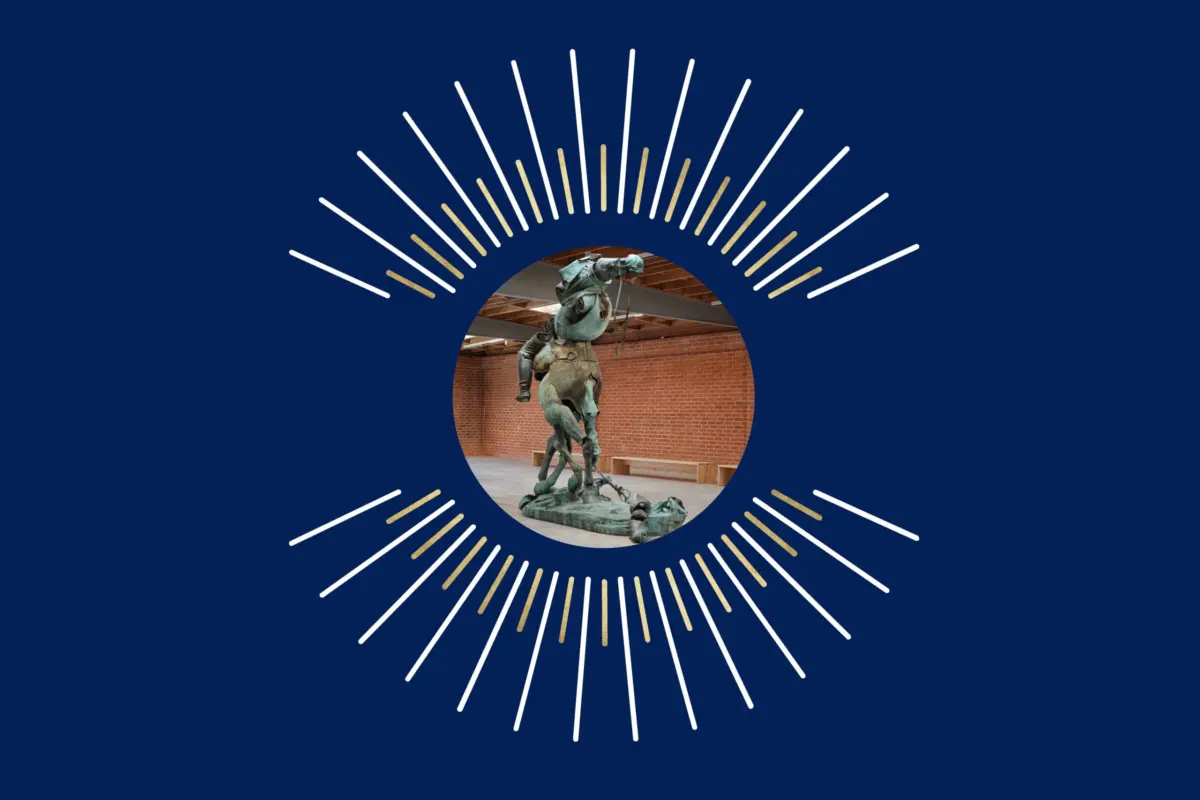
At The Brick, co-curator and renowned artist Kara Walker extended this physical critique with her monumental installation, Unmanned Drone (2023). For this piece, Walker took apart a decommissioned equestrian statue of Confederate General Stonewall Jackson, cutting the bronze body and horse into pieces before welding them back together in a dislocated, fragmented configuration.
Walker’s intervention served as a profound artistic metaphor for the exhibition’s core thesis: history cannot be neatly mended or erased, nor should it remain shattered and unexamined. Instead, contemporary society must actively confront the broken pieces of its past, picking through the fragments to forge a radically different, self-aware future.
The LACMA Paradigm: May 4 and Beyond
While "MONUMENTS" ran from October 23, 2025, through May 3, 2026, the cultural conversation in Los Angeles was simultaneously enriched by the May 4 opening of the David Geffen Galleries at LACMA. Peter Zumthor’s controversial, sprawling architectural design—which bridges across the bustling artery of Wilshire Boulevard—presented curators with a unique spatial challenge: how to organize a massive permanent collection without relying on traditional, predictable art-historical timelines.
Rather than arranging galleries by standard chronological movements (e.g., Renaissance, Baroque, Modern), the inaugural hang broke down institutional silos. Fifteen distinct curatorial departments collaborated to co-create thematic constellations, juxtaposing ancient artifacts with contemporary installations, and non-Western traditions with Western canons. The result is a fluid, dialogue-driven environment that challenges visitors to see familiar masterpieces through unfamiliar lenses while shining a much-needed spotlight on underrepresented works within the museum’s holdings.
Supporting Context & Metrics: The Nominees and Curatorial Excellence
To fully appreciate the scope of the awarded exhibitions, one must examine the broader field of institutional curatorial innovation recognized by the awards jury. The 2026 nominees represent a nationwide shift toward thematic, socially engaged, and materially experimental museum programming.
1. "Into the Time Horizon"
- Venue: Nevada Museum of Art, Reno (November 15, 2025 – January 3, 2027)
- Curators: Apsara DiQuinzio, with Kolin Perry
- Context: Set against the vast ecological and geopolitical backdrop of the American West, this exhibition explored notions of deep time, landscape, and environmental fragility, encouraging viewers to contemplate human impermanence against the geologic scale of the earth.
2. "If the word we: 59th Carnegie International"
- Venue: Carnegie Museum of Art, Pittsburgh, Pennsylvania (May 2, 2026 – January 3, 2027)
- Curators: Ryan Inouye, Danielle A. Jackson, and Liz Park
- Context: As the longest-running North American exhibition of international art, the 59th edition leaned heavily into collective utterances, relational aesthetics, and transnational solidarity, tackling how communities articulate shared futures amidst geopolitical fragmentation.
3. "Let Us Gather in a Flourishing Way"
- Venues: Buffalo AKG Art Museum (March 6 – September 6, 2026); Des Moines Art Center (October 24, 2026 – January 24, 2027)
- Curator: Andrea Alvarez
- Context: Focusing on practices of care, communal sustenance, and ecological kinship, Alvarez’s exhibition highlighted contemporary artists working across diasporic lines to build resilient networks of cultural survival and flourishing.
4. "Several Eternities in a Day: Form in the Age of Living Materials"
- Venue: Hammer Museum, Los Angeles (April 5 – August 23, 2026)
- Curators: Pablo José Ramírez, with Jessi DiTillio
- Context: Venturing into the cutting edge of material science and environmental philosophy, this exhibition examined how contemporary artists and designers utilize living organisms, bio-materials, and organic processes to rethink sculptural form and ecological interdependence.
Curatorial Metrics of Success
Across these nominated shows and the primary winners, several common metrics define excellence in contemporary curation:
- Interdisciplinary Collaboration: Breaking down internal museum departments to foster dialogue across historical eras and geographic boundaries.
- Spatial Justice: Redesigning gallery architectures to alter power dynamics between the viewer and the art object.
- Contemporary Resonance: Directly engaging with pressing socio-political, environmental, and historical traumas rather than offering sanitized, escapist narratives.
Official Statements and Critical Reception
The critical reception of "MONUMENTS" and the inauguration of the David Geffen Galleries underscores a growing public appetite for museums that do not shy away from complexity.
Art historians and cultural critics have widely praised the collaborative courage required to mount "MONUMENTS." In a joint statement reflecting on the decade-long developmental process, the curatorial collective emphasized that the exhibition was never intended to provide easy answers or moral absolution. Instead, it was designed to act as an ongoing civic laboratory.
"We did not want these objects to be re-consecrated, nor did we wish to simply cancel them out of existence," noted co-curator Hamza Walker during the exhibition’s run. "By bringing them into the realm of contemporary art, we expose their theatricality. We reveal how monuments are not neutral reflections of history, but active tools of propaganda built to enforce obedience. By pairing them with living artists who interrogate power, we force a reckoning that civil society has long avoided."
Similarly, the ARTnews Awards Jury highlighted the profound institutional labor behind LACMA’s inaugural hang in their citation:
"While thematic exhibitions traditionally rely on tight, singular theses, LACMA’s David Geffen Galleries achieved something far more daring: an institutional matrix built on radical departmental collaboration. By allowing fifteen curatorial voices to converse across a single, uninterrupted architectural expanse, the museum has redefined the permanent collection display. It is a triumph of institutional listening, proving that art history is not a straight line, but a rich, multi-dimensional web of human expression."
Critics have noted that these exhibitions arrive at a critical juncture for cultural institutions worldwide. As museums face declining public trust, funding pressures, and intense debates over repatriation, provenance, and civic responsibility, the success of "MONUMENTS" and LACMA’s new galleries offers a clear blueprint for survival and relevance. By embracing vulnerability, interdisciplinary dialogue, and unvarnished historical inquiry, museums can transition from quiet storehouses of elite culture into vital public forums for democratic debate.
Future Outlook: The Evolution of Museum Curation
As the art world looks beyond 2026, the ripples generated by "MONUMENTS" and the David Geffen Galleries will likely be felt for decades. Several key trends are emerging as direct results of these curatorial triumphs:
- The Decommodification of Historical Artifacts: The strategy of placing toxic or politically charged civic objects into contemporary art contexts will likely inspire other institutions to tackle difficult regional histories. Rather than hiding or destroying controversial monuments, museums are discovering that contemporary art provides the critical distance necessary to process difficult heritage.
- Eradication of Curatorial Silos: LACMA’s success in orchestrating a 15-department collaboration sets a new benchmark for encyclopedic museums. Future permanent collection reinstallations worldwide will face increased pressure to abandon linear art histories in favor of porous, thematic, and cross-cultural constellations.
- Amplifying Artist-Led Critiques: The integration of living artists—such as Kara Walker, Torkwase Dyson, and Hank Willis Thomas—alongside historical artifacts proves that contemporary creators are indispensable guides through cultural trauma. Museums will increasingly rely on artists to act as co-curators and critical interlocutors.
- Redefining Public Engagement: Exhibitions like "MONUMENTS" demonstrate that museum attendance is heavily driven by programs that speak directly to the urgent social and political realities of visitors’ everyday lives. Cultural institutions that successfully bridge the gap between historical collections and contemporary struggles will secure deeper, more loyal community engagement.
In sum, "MONUMENTS" and the inaugural hang at LACMA have raised the bar for what a museum can and should achieve. They remind us that art is not merely an object of aesthetic contemplation, but a vital instrument for examining who we are, where we come from, and what kind of society we wish to build together.


Comments
Facebook App ID not configured. Please add it in the Customizer.