The nature, boundaries, and ultimate aims of Catholic fiction have been matters of intense literary debate for generations. At the heart of this ongoing discourse lies a fundamental aesthetic tension: What precisely makes a novel "Catholic"? Must the Catholic novelist function primarily as an apologist, bending narrative toward questions of salvation and eternal consequence at the potential expense of artistic integrity? Or must they act strictly as an artist, prioritizing formal composition while risking indifference toward the moral or spiritual transformation of the reader?
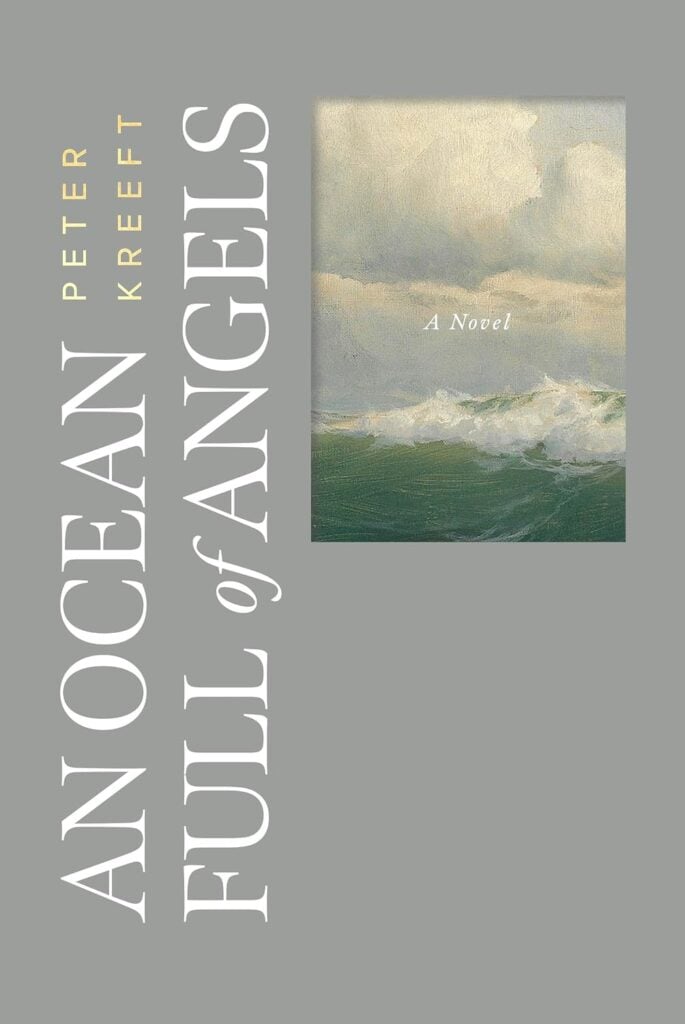
Two recent releases by Catholic authors—Roy Peachey’s The Garden of Perfect Clarity, published earlier this year by Os Justi Press, and the Word on Fire Luminor imprint’s republication of Peter Kreeft’s 2011 novel An Ocean Full of Angels—provide a compelling framework for re-evaluating these perennial questions. Intriguingly, neither novel features a Catholic protagonist. Peachey’s protagonist, an English boy named Acheson raised against the backdrop of China, possesses no formal religion, while Kreeft’s narrator, ’Isa, is and remains a devout Muslim. Catholicism per se is rarely the direct focus of either narrative; neither protagonist ever steps foot inside a church.
Yet, as these works demonstrate, the Catholic novel cannot be neatly categorized by explicit confessional markers alone. Instead, these two books fall neatly into opposite literary camps delineated by Henry James in his preface to The Tragic Muse. James famously contrasted works of strict "composition" and "premeditated art" with those sprawling, accidental masterpieces he dubbed "large, loose, baggy monsters"—works like Tolstoy’s War and Peace or Melville’s Moby-Dick. Kreeft’s An Ocean Full of Angels situates itself amiably among these baggy monsters, prioritizing expansive philosophical and archetypal resonance over narrative economy. Conversely, Peachey’s The Garden of Perfect Clarity exhibits an exquisite, highly premeditated symmetry reminiscent of a saint’s autobiography or a traditional fairy tale.
Examining these two novels alongside the critical theories of Caroline Gordon, Jacques Maritain, and Henry James opens a timely window into the broader landscape of contemporary Christian literature. As independent presses and mainstream literary spaces alike experience a quiet renaissance of faith-informed fiction, these texts remind us that the deepest currents of the creative imagination often operate within the structural patterns of redemption, grace, and spiritual awakening—even when the characters themselves remain resolutely outside the visible boundaries of the Church.
Detailed Chronology of the Literary Debate and Textual Analysis
To fully understand the weight of Kreeft’s and Peachey’s contributions, one must trace the historical lineage of the Catholic novel, which gained international prominence through mid-century masters like François Mauriac, Georges Bernanos, Graham Greene, and Evelyn Waugh. These writers grappled openly with sin, redemption, and the friction between secular desires and divine law. However, mid-century critics like Caroline Gordon began to push back against purely confessional criteria, arguing that a writer’s surface dogma mattered far less than their "patient, passionate portrayal of natural objects"—a reverence for the created order that Gordon termed fundamentally Christian.
Peter Kreeft’s An Ocean Full of Angels (2011/2024)
Peter Kreeft, a distinguished philosophy professor at Boston College known for his rigorous non-fiction works, approaches fiction with a philosopher’s toolkit. Originally released in 2011 and newly revived by Word on Fire’s Luminor imprint, An Ocean Full of Angels is narrated by ’Isa Ben Adam, a young Muslim student at Boston College whose name translates to the Islamic version of Jesus. Introducing himself as a "failed messiah" who has betrayed his calling, ’Isa loses both of his parents and experiences a profound night of despair on Bailey’s Hill on the island of Nahant.
Rescued from suicide by an abbess-like figure known simply as "Mother," ’Isa is taken into a seaside home populated by a vivid cast of eccentric, allegorically resonant misfits. The emotional core of the novel centers on ’Isa’s romance with a Jewish woman named Mara, serving as a symbolic action pointing toward the apocalyptic reconciliation of Judaism, Christianity, and Islam.
Kreeft makes no apologies for the sprawling, undisciplined nature of his narrative. In an introductory note titled "To My Readers," he explicitly disclaims traditional authorship, attributing the book to his fictional student ’Isa:
“I have written more than one hundred books, but never one even remotely like this one. It is far too big for me. It is messy and diverse… If you’re bothered by that, I guess you’re also bothered by the Bible—or the universe.”
Like Melville’s "Cetology" chapters in Moby-Dick, Kreeft’s novel veers into extensive historical and topographical essays about Nahant, wave theory, and the mechanics of body-surfing—which he connects directly to the core Islamic concept of surrender. While the novel’s Socratic dialogues and philosophical explorations of suffering, abortion, and truth are intellectually compelling, the central romance struggles to achieve emotional realism. Mara often reads more like a philosophical trope—a dark shadow of a fallen Mary meant to unify Judaism and Islam—than a fully realized human being. Nevertheless, the novel’s atmospheric grandeur, particularly its treatment of the Atlantic Ocean and the elemental forces of nature, leaves an indelible impression.
Roy Peachey’s The Garden of Perfect Clarity (2024)
In sharp contrast to Kreeft’s sprawling prose, British writer Roy Peachey’s The Garden of Perfect Clarity is a masterclass in premeditated artistic composition. Published by Os Justi Press, the novel is symmetrically structured around a pivotal central passage, reading much like a legendary saint’s life or a Grimms’ fairy tale.
The story follows Acheson, an English boy from Essex who is abruptly cast out by his stonemason father for being "good for nothing" because he can neither shape stone nor farm. Before sending him away, his weeping mother kneels and bites down hard on his little toe—a visceral, unexplained mark that seals his fate.
Acheson makes his way to a port, is conscripted onto a ship, and is befriended by a priest named Jacobus, who teaches him a new language. Unjustly accused of theft by the ship’s captain, Acheson is cast overboard at an unnamed port in China ("the City"). There, he falls in with a Dickensian band of beggar-thieves, is captured by an aristocrat, and is eventually taken into service by a Master who recognizes his intellectual potential.
The narrative reaches a turning point when Acheson is enrolled in the City’s House of Learning under the tyrannical tutor Tangren. Given a new Chinese name, Jiang Liu (meaning "river flow"), which directly explains the loss of his childhood toe, he discovers books, gardens, and the oppressive regime of the mysterious, hooded Puppet Masters. These Puppet Masters eventually overthrow the House of Learning, initiating an ideological revolution reminiscent of the Reign of Terror or the Cultural Revolution.
Ultimately, Acheson survives the cataclysm, returns to his birth name, and becomes a teacher dedicated to the restoration of memory—writing the very text the reader holds.
Supporting Context & Metrics: Defining the Catholic Aesthetic
To evaluate these texts rigorously, critics often turn to the theoretical framework established by Caroline Gordon and Jacques Maritain. Gordon argued that the novelist’s primary duty is to construct a convincing "illusion of life." When an artist relies too heavily on explicit religious messaging rather than patient attention to the natural order, the work falters. Conversely, when an author’s creative intuition operates within the deeper, subterranean currents of Christian symbolism—regardless of their conscious religious alignment—true art emerges.
The character of "Mother" and Catholic communities
Hidden historical figures (e.g., Father Li Xibiao)
Peachey’s integration of Catholic elements is notably subtle. Throughout the novel, Acheson occasionally witnesses a man—initially Jacobus, and later an unnamed figure—performing quiet, private rituals before a silver plate and goblet draped in cloth. In his author’s note, Peachey reveals that Jacobus is based on a real historical figure: Father Li Xibiao, a Chinese Catholic priest ordained in Naples who served as an interpreter aboard the HMS Lion in 1792. Furthermore, the novel’s four major recurring symbols—two combatants, a countrywoman, a farmer with a sickle, and a woman holding an infant—are drawn directly from Jonathan Spence’s The Memory Palace of Matteo Ricci, linking Peachey’s narrative to the legacy of Jesuit missionary work in China.
Official Statements and Critical Perspectives
The release of these two novels has ignited fresh dialogue among contemporary Christian authors and critics regarding the trajectory of faith-based literature.
Katy Carl, an accomplished novelist and editor at Word on Fire’s Luminor imprint, recently offered an optimistic assessment of the global literary landscape:
“We are at the beginning of a wave of renewal in global literary writing to which Catholics are going to contribute unmistakably, vitally, indispensably. That wave is going to crest sometime in the next five to ten years. We’re in the swell of it now.”
Carl points to an encouraging diversification of the literary ecosystem. Independent publishers like Wiseblood Books, Angelico Press, and Word on Fire are actively carving out spaces for literary fiction that engages deeply with spiritual realities. Simultaneously, mainstream North American authors such as Phil Klay, Christopher Beha, and Randy Boyagoda write openly from Catholic perspectives, while globally recognized figures like Nobel laureate Jon Fosse demonstrate that transcendent, spiritually charged literature retains the highest level of international acclaim.
However, literary scholars caution against reducing this cultural moment to mere institutional branding. As Caroline Gordon’s essays remind us, forcing art to serve a narrow confessional agenda can stunt its emotional truth. The most enduring literature often arises not from programmatic apologetics, but from an artist’s radical openness to the "sacred weakness" of creative intuition—where the writer, like the reader, waits in receptive wonder for illumination.
Future Outlook: A Renaissance in Faith-Informed Fiction
As the literary world navigates the mid-2020s, the reception of Kreeft’s and Peachey’s novels signals a broader maturation within the sphere of Catholic and Christian letters. The old dichotomy—forcing writers to choose between didactic religious propaganda and secular artistic autonomy—is increasingly viewed as a false choice.
Writers like Peachey demonstrate that deep historical embedding and rigorous formal symmetry can house profound theological truths without sacrificing narrative integrity. Conversely, Kreeft’s expansive, mythic approach proves that philosophical ambition and archetypal grandeur can still captivate readers willing to journey through a "baggy monster" of ideas and natural imagery.
Looking forward, the health of this literary renewal will depend on the willingness of authors to look beyond conventional boundaries. As critics suggest, the hidden streams of Christian symbolism often flow through unexpected channels, appearing in the works of secular or culturally adjacent writers just as powerfully as they do in explicitly confessional texts. By embracing both the disciplined artistry of Jamesian composition and the untamed grandeur of imaginative intuition, contemporary Catholic fiction stands poised to make an indelible, vital contribution to global literature in the decade to come.



Comments
Facebook App ID not configured. Please add it in the Customizer.