
In an era defined by rapid digital consumption and paywalled academia, a collaborative collective of contemporary philosophers, classicists, and technologists has launched an ambitious initiative to democratize the foundational texts of Western thought. The Open Plato Project has officially debuted its inaugural offering: a completely open-access, richly annotated, and digitally optimized edition of Plato’s classic dialogue, the Alcibiades. Available now at OpenPlato.org, this release marks a significant milestone in digital humanities, marrying rigorous classical scholarship with modern web design and pedagogical innovation.
The primary mission of the Open Plato Project is deceptively simple yet profoundly radical: to widen the audience of individuals capable of finding intellectual joy, existential meaning, and critical clarity in ancient Greek philosophical texts. For centuries, these foundational dialogues have been locked behind expensive university library subscriptions, dense scholarly commentaries that alienate novices, or uninviting formats that prioritize academic pedigree over public accessibility. The Open Plato Project seeks to shatter these barriers by offering multi-tiered translations, interactive scholarly commentaries, integrated glossaries, and flexible bilingual displays tailored to audiences ranging from high school students to seasoned researchers.
The launch of the Alcibiades is not merely the publication of a single digital book; it represents a conceptual blueprint for how classical philosophy can and should be presented in the twenty-first century. Featuring dual translations—one crafted for first-time readers seeking narrative flow and conceptual clarity, and another designed for advanced students pursuing granular philological and philosophical analysis—the platform sets a new standard for open educational resources (OER).
Read Also
Spearheaded by an interdisciplinary team of scholars from institutions such as Boston University, the University of Pennsylvania, Brown University, and the University of Michigan, the Open Plato Project leverages cutting-edge software engineering to make antiquity responsive to the modern digital reader. As the collective prepares to expand its catalogue with additional Platonic dialogues in the coming months and years, this initial release offers a compelling look at the future of classical studies, public philosophy, and digital pedagogy.
Detailed Chronology: The Genesis and Evolution of Open Plato
The realization of the Open Plato Project did not happen overnight; it is the culmination of years of quiet frustration with the accessibility barriers plaguing classical studies, followed by a targeted, collaborative push by a dedicated group of philosophy educators and technologists.
Phase I: Identifying the Pedagogical Gap (Pre-2024)
Long before the code for OpenPlato.org was written, the project’s founding members—including Marc Gasser-Wingate, Sukaina Hirji, Robert Howton, and others—observed a recurring dilemma in their undergraduate classrooms. While introductory students were often electrified by the dramatic flair, ethical urgency, and Socratic interrogation found in Plato’s dialogues, they were routinely stymied by existing pedagogical apparatuses.
Standard academic translations often prioritized literal exactness over readability, resulting in stilted English that obscured the philosophical stakes. Conversely, popular trade translations frequently lacked the precise philosophical commentaries, line-number references, and structural aids required for deep study. Furthermore, students faced steep financial barriers, often forced to purchase individual, copyrighted translations for every assigned text.
Concurrently, digital tools for reading classical texts online remained largely archaic. Most digital repositories offered static text dumps or retrofitted PDFs that failed to leverage the interactive potential of the web. The founding team recognized an urgent need for a native digital platform built from the ground up to support multiple reading levels, seamless English-Greek comparisons, and contextual annotations that invite readers into the text rather than overwhelming them with esoteric jargon.
Phase II: Team Assembly and Technical Architecture (2024–2025)
Recognizing that transforming classical pedagogy required a blend of top-tier philosophical scholarship and advanced software engineering, the team formed organically. The roster brought together a powerful mix of expertise:
- Marc Gasser-Wingate (Boston University) and Sukaina Hirji (University of Pennsylvania) brought specialized expertise in ancient philosophy and ethics.
- Robert Howton (Brooklyn Institute for Social Research), uniquely positioned as both a philosopher and a professional software engineer, took the lead on building the technical infrastructure.
- Scholars such as Emily Kress (Brown University), Patricia Marechal (UNC Chapel Hill), Katy Meadows (Indiana University Bloomington), Evan Rodriguez (Idaho State University), Gabe Shapiro (University of Michigan), Jacob Stump (Northeastern University), and Claudia Yau (University of Michigan) joined to distribute the immense editorial, translation, and annotation workload.
During this intensive development phase, the team selected Plato’s Alcibiades as their inaugural text. Often debated for its authenticity in earlier centuries but widely recognized today as a masterclass in Socratic self-examination, political ambition, and moral psychology, the Alcibiades depicts a young, arrogant, and hyper-ambitious Athenian statesman being systematically humbled and redirected toward the care of his own soul by Socrates. Its dramatic intensity and themes of self-knowledge made it the ideal candidate for an engaging, entry-level digital edition.
Phase III: The Public Launch and Future Roadmap (Late 2025–2026)
Following extensive beta testing and refinement of the site’s modular interface, the Open Plato Project officially went live. The launch introduced the web-based Alcibiades complete with its modular Greek-English toggle, integrated glossary, and distinct dual translations.
As the project enters its post-launch phase in 2026, the team is actively developing secondary features promised in their initial rollout. These include downloadable, printable versions of the scholarly translations and commentaries for offline study, as well as professionally produced audio recordings of the dialogues to accommodate auditory learners and those seeking a performative, dramatic engagement with ancient texts. Beyond the Alcibiades, the collective has laid the groundwork for future editorial cycles, with plans to systematically adapt and publish additional Platonic dialogues.
Supporting Context & Metrics: Transforming Access to Antiquity
To fully appreciate the significance of the Open Plato Project, one must examine the broader landscape of open educational resources, digital humanities, and the historical reception of the Alcibiades within the Platonic corpus.
The Philosophical Weight of Alcibiades
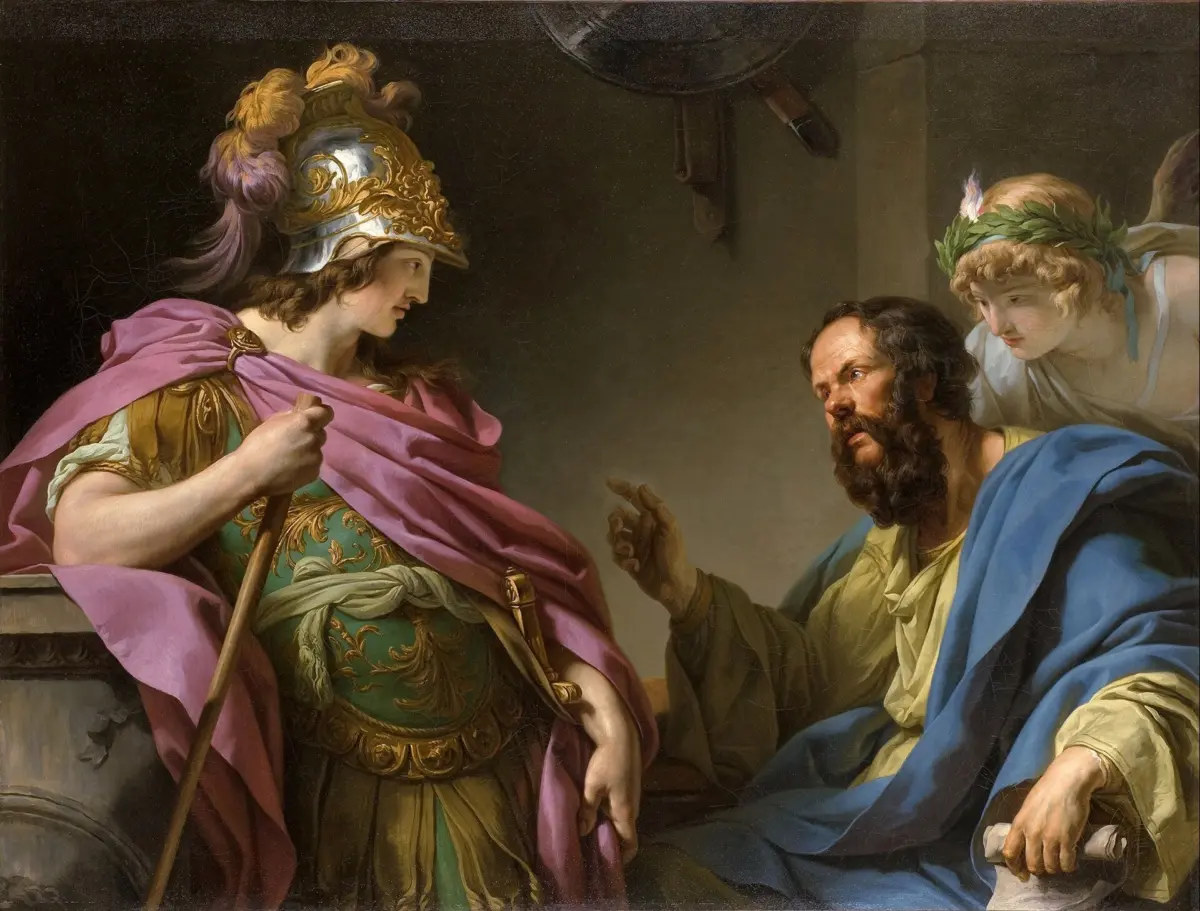
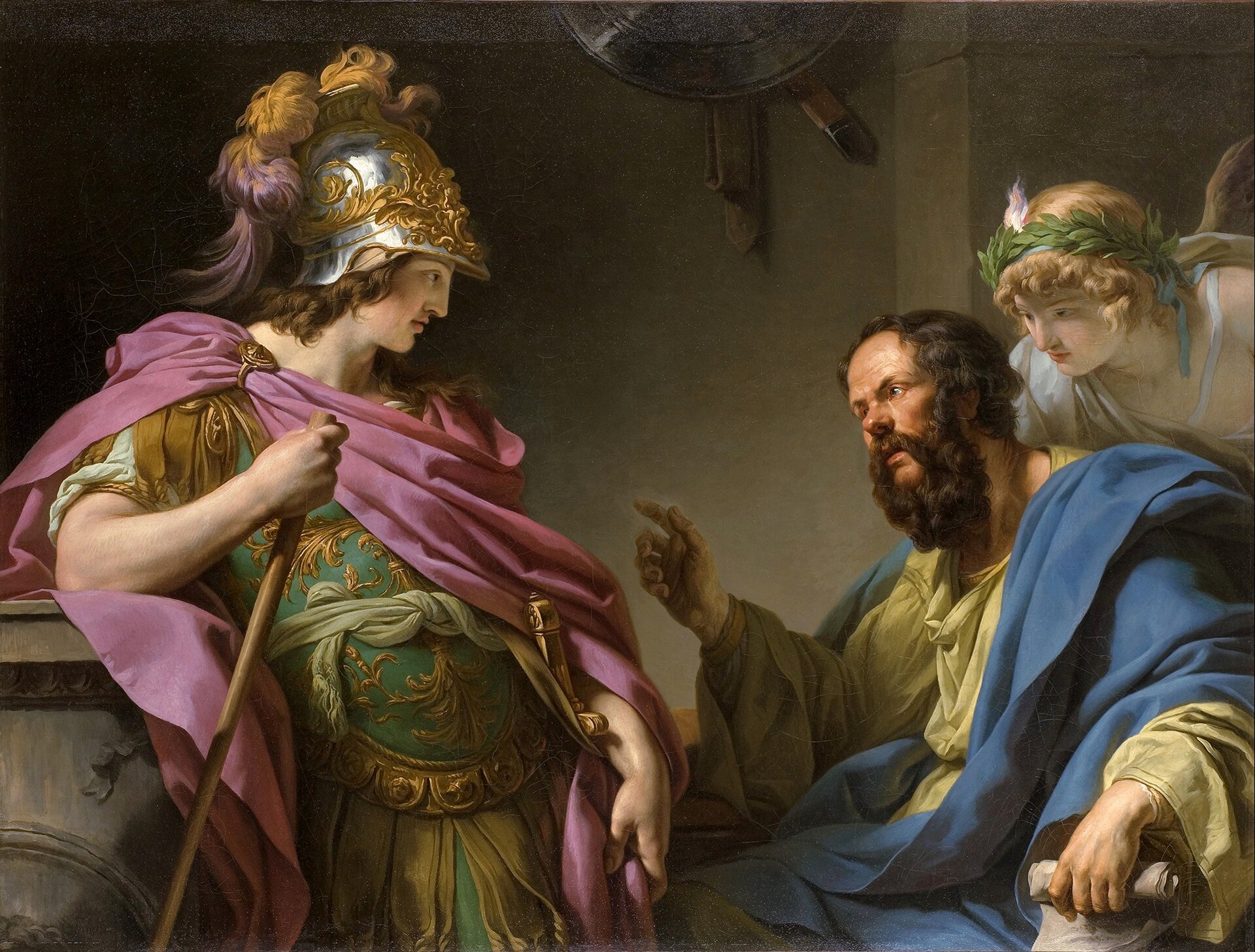
In Françoïs-André Vincent’s famous neoclassical painting Alcibiades Being Taught by Socrates—chosen by the Open Plato team as the visual anchor for their launch—Socrates is depicted gently restraining the dazzling, armor-clad young aristocrat. The painting captures the core tension of the dialogue: the clash between raw political ambition and the quiet, demanding interiority of philosophical self-examination.
In the dialogue, Alcibiades is poised to enter Athenian public life, brimming with confidence about his ability to advise the Assembly on war, peace, and justice. Socrates strips away his pretensions not through cynical mockery, but through affectionate, relentless questioning. Socrates forces Alcibiades to realize that before one can presume to rule a city, one must understand what self actually is.
For modern readers—particularly young adults navigating a high-stakes, hyper-competitive social and professional landscape—the themes of the Alcibiades remain startlingly contemporary. By prioritizing this specific dialogue for their launch, the Open Plato Project chose a text that speaks directly to the anxieties of ambition, identity, and the ethical responsibilities of leadership.
Technical Innovation and Open Educational Resources (OER)
The Open Plato Project arrives at a critical juncture for higher education. Textbook costs have skyrocketed over the past two decades, placing a heavy financial burden on students. Simultaneously, the digital humanities have pushed for the creation of open-access digital critical editions that transcend the limitations of the physical book.
The platform’s technical architecture reflects these modern demands. Key structural features of the site include:
- Modular Dual-Text Display: Readers can view the original ancient Greek alongside English translations, toggling between views depending on their linguistic proficiency.
- Tiered Translation Strategy: By offering a version optimized for first-time readers alongside a more technically rigorous scholarly translation, the project bridges the gap between popular accessibility and academic integrity.
- Integrated Commentary and Glossary: Rather than forcing readers to flip to the back of a physical book or consult external encyclopedias, contextual explanations and definitions are woven directly into the digital reading experience.
By operating as an open-access initiative, the project ensures that anyone with an internet connection—whether an autodidact in a remote town, a high school teacher designing a civics curriculum, or a university professor seeking alternative course materials—can access top-tier classical scholarship completely free of charge.
Official Statements & Scholarly Vision
The philosophy driving the Open Plato Project is best articulated by the scholars themselves. In statements detailing the launch and mission of the collective, the team emphasizes that philosophy was originally an oral, communal, and transformative practice—not an obscure specialty reserved for academic elites.
Marc Gasser-Wingate of Boston University outlined the comprehensive toolkit built into the initial release:
"This digital edition includes two new translations: one aimed at first-time readers, and another at those who might seek a deeper dive into the text. It includes accompanying commentaries, a glossary, and a modular display for both Greek and English text. We are still working on some additional features, including printable versions of the scholarly translation and commentary, and an audio recording of the dialogue."
This multi-layered approach reflects a deliberate rejection of the "one-size-fits-all" model of academic publishing. By acknowledging that a high school senior reading Plato for the first time has different needs than a graduate student writing a dissertation on ancient epistemology, the Open Plato Project creates a flexible intellectual environment.
The overarching ethos of the project—articulated in its foundational mission statement—is "to widen the audience of people who are able to find joy and meaning" in ancient Greek philosophy. This phrasing is telling. It moves away from dry, purely antiquarian historicism and reclaims philosophy as a vital, life-enriching pursuit. The project’s founders argue that Plato’s questions about justice, virtue, love, and the good life are just as urgent today as they were in classical Athens. By stripping away financial and stylistic barriers, the Open Plato Project invites a wider, more diverse demographic of readers to participate in the ancient, ongoing conversation of human inquiry.
Future Outlook: The Next Horizon for Open Plato
The successful deployment of the Alcibiades digital edition is merely the first chapter in a much larger, long-term initiative. As the Open Plato Project looks toward the future, its roadmap points toward institutional expansion, technological refinement, and community engagement.
Expanding the Corpus
While Alcibiades serves as a powerful proof-of-concept, the Platonic corpus contains dozens of dialogues spanning various periods of Plato’s philosophical development—from the aporetic early dialogues capturing the conversational style of the historical Socrates to the sprawling, constructive metaphysical masterpieces of his middle and late periods, such as the Republic, the Phaedo, and the Symposium.
The collaborative team has made clear their intention to scale their model to additional texts. Each subsequent release will undergo the same rigorous editorial process: fresh, accessible translations paired with scholarly commentaries and integrated digital tools. This systematic expansion will eventually create a comprehensive, open-access digital library of Platonic literature, reshaping how the foundational texts of the Western canon are taught and studied globally.
Bridging the Digital and Physical Classroom
As digital pedagogy continues to evolve, the Open Plato Project is well-positioned to integrate into formal curricula worldwide. The upcoming rollout of printable versions of the scholarly commentaries and translations indicates an acute awareness of hybrid learning environments. Educators who prefer physical handouts for classroom discussions will soon be able to pull clean, professionally formatted texts directly from the platform, while digital natives can continue to utilize the interactive website, glossary pop-ups, and audio features.
Furthermore, the integration of professional audio recordings promises to breathe new life into the dialogues. Because Plato wrote his works in dramatic, conversational form—often featuring vivid characters, comedic timing, and intense emotional confrontations—audio interpretations can restore the performative dimension that is frequently lost on the silent printed page.
A New Model for the Humanities
Ultimately, the Open Plato Project offers a beacon of hope for the humanities in the digital age. By demonstrating that rigorous scholarly expertise can be successfully coupled with modern web development and a genuine commitment to public accessibility, the project’s founders have established a viable, inspiring model for academic publishing.
As the platform grows, it promises to cultivate a new generation of readers who discover not only academic instruction, but genuine intellectual joy and existential meaning within the ancient texts of Athens. The digital doors of the Academy are now wide open; how contemporary readers choose to walk through them will shape the future of philosophical discourse for years to come.



Comments
Facebook App ID not configured. Please add it in the Customizer.