
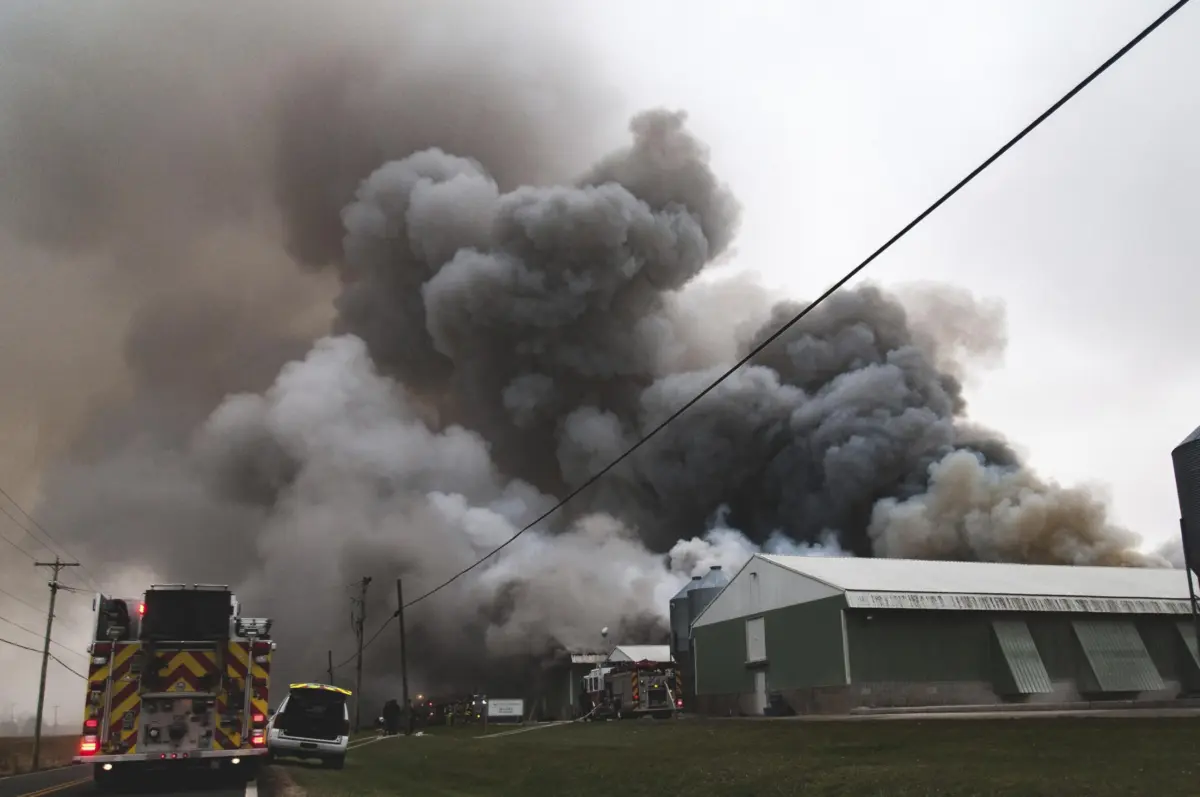
UPSTATE NEW YORK — In the predawn hours of a crisp Thursday morning, a multi-alarm fire tore through Hudson Valley Foie Gras, the largest producer of the controversial luxury delicacy in the United States. While no human casualties were reported, the aggressive blaze reduced multiple massive barns to smoldering rubble.
The incident has delivered a profound blow to the nation’s narrow foie gras supply chain, but it has also thrust a much darker, systemic issue back into the national spotlight: the staggering and largely overlooked frequency of catastrophic barn fires across America’s industrial agricultural landscape.
As animal welfare advocates, local emergency responders, and industry insiders pick through the charred remains of the upstate facility, the disaster serves as a sobering reminder of the hidden human and animal safety crises lurking inside modern agricultural warehouses.
Read Also
Executive Overview
The fire at Hudson Valley Foie Gras erupted quickly, fueled by the complex architecture and high-density housing typical of modern commercial livestock operations. According to Charlie Kalinowski, chief of the Smallwood/Mongaup Valley Fire Department, the blaze spread with a ferocity that rendered initial containment impossible.
"The fire took off so fast, there was no way to get inside to stop the spread," Kalinowski told regional outlet Radio Catskill.
A monumental response effort—mobilizing approximately 200 first responders spanning 37 distinct fire departments—managed to prevent the flames from consuming the entire compound. While hundreds of young ducks and geese managed to escape or were pulled from the path of the flames, the exact death toll remains unconfirmed. Industrial duck and goose barns of this scale routinely house anywhere from several thousand to upwards of 10,000 animals per structure, meaning the loss of life is expected to be devastating.

While company representatives have floated the preliminary suspicion of an electrical malfunction, official investigations by local fire marshals remain ongoing. If confirmed, this cause would align with broader national trends identified by fire safety experts and animal protection organizations, who point out that aging or overtaxed electrical grids in high-density animal housing are a ticking time bomb.
Detailed Chronology and Emergency Response
The emergency began shortly before dawn on Thursday. Due to the rural nature of Sullivan County and the sheer scale of the agricultural facility, dispatchers quickly escalated the response from a standard local call to a massive multi-alarm operation.
The Scale of the Mobilization
- First Responders: Approximately 200 personnel.
- Agencies Involved: 37 local and regional fire departments.
- Assets Lost: Multiple large-scale housing barns completely destroyed.
- Human Casualties: Zero injuries or fatalities reported among workers and emergency personnel.
Chief Kalinowski and his team faced extraordinary tactical hurdles upon arrival. Modern factory farm barns are engineered to maximize interior capacity and environmental control rather than structural egress or interior firefighting accessibility. Lacking interior partitioning designed to slow fire propagation, once flames breach the envelope of a commercial livestock shed, they travel at exponential speeds.
While hundreds of younger birds survived the chaotic evacuation or were sheltered in adjacent, unaffected structures, the high density of the facility makes an immediate, accurate accounting of the dead nearly impossible. Workers, emergency responders, and corporate officials are still conducting recovery and cleanup operations to determine the final toll on the animal population.
Supporting Context & Metrics: America’s Industrial Barn Fire Problem
While the Hudson Valley Foie Gras fire has captured headlines due to the high-profile nature of the product, animal welfare watchdogs note that it is far from an isolated incident. Instead, it represents a routine, catastrophic failure mode within the broader American industrial livestock sector.
According to tracking data compiled by the Animal Welfare Institute (AWI), more than 1.2 million farm animals have already perished in over 80 distinct agricultural fires across the United States. The vast majority of these losses occurred in a single catastrophic event in March, when a massive egg-producing facility in Iowa owned by Versova lost several high-capacity housing units and roughly 1 million birds.

STATISTICAL SNAPSHOT (AWI DATA)
--------------------------------------------------
Total Farm Animals Killed in US Fires Since 2013:  >10 Million
Total Farm Fires Recorded in 2026 (YTD):           >80
Total Animals Killed in 2026 (YTD):                >1.2 Million
Primary Identified Cause:                          Electrical & Heating Malfunctions
The 10-Million Mark and Counting
Since 2013, more than 10 million farmed animals have died in structural fires across the country. Crucially, AWI experts emphasize that this figure is almost certainly a severe undercount. Reporting requirements for agricultural animal mortality vary dramatically from state to state, and commercial operators are rarely mandated to publicly disclose losses resulting from private property fires unless environmental or public health hazards cross municipal thresholds.
The Evolution of the "Barn"
To understand why these fires are so lethal, one must look past the romanticized imagery of traditional red wooden barns scattered across historical pastoral landscapes. Modern factory farming bears little resemblance to nineteenth-century agriculture.
As noted in previous agricultural analyses, today’s meat, dairy, and egg production takes place in sprawling industrial warehouses. These facilities rely on mechanized, high-wattage ventilation, automated feeding systems, and continuous heating units to maintain tight microclimates for thousands—sometimes tens of thousands—of animals crammed into close quarters.
When these complex electrical and mechanical grids malfunction, they instantly ignite the dry bedding, dust, and synthetic insulation typical of these buildings. Once a fire starts, the lack of emergency exits for the animals ensures that survival rates are near zero.
Official Statements and the Safety Debate
Following Thursday’s tragedy, the discourse has quickly pivoted to accountability, building codes, and the ongoing tug-of-war between public safety advocates and industrial farming lobbyists.
The Corporate and Local Response
Hudson Valley Foie Gras has not yet issued a formal, comprehensive written statement regarding the disaster. However, a corporate vice president spoke briefly with Radio Catskill, stating that preliminary internal assessments suggest an electrical malfunction triggered the blaze. Local fire authorities have declined to endorse this theory pending the conclusion of forensic investigations.

Allie Granger, a policy specialist with the Animal Welfare Institute, weighed in on the prevalence of electrical failures in large-scale operations. "The cause of barn fires usually goes unreported," Granger noted in an interview. "But when they are reported, electrical malfunction tends to be among the most common causes at relatively large operations like Hudson Valley Foie Gras."
The NFPA Code Controversy
The regulatory framework governing farm animal housing has long been a battleground. The National Fire Protection Association (NFPA) establishes comprehensive safety guidelines—including NFPA 150, a standard specifically dedicated to animal housing facilities. This standard mandates baseline safety requirements, including advanced smoke detection systems, fire alarm notification networks, specialized building materials, and automated sprinkler installations.
In 2024, the NFPA voted to update its standards to explicitly mandate sprinkler systems in large agricultural barns, arguing that proven water-suppression technologies save lives across virtually every other commercial building sector in America.
However, this push has met fierce resistance. Powerful trade associations representing the nation’s egg, pork, and chicken sectors—such as the United Egg Producers and the National Pork Producers Council—lobbied aggressively against the mandate. Industry groups argue that retrofitting or building sprinkler systems into massive, rural livestock facilities is economically prohibitive, pointing out that many remote farms lack the municipal water infrastructure necessary to feed high-capacity sprinkler systems.
A Patchwork of State Enforcement
Even if safety standards are codified at the national level, their real-world impact remains symbolic due to weak jurisdictional enforcement. According to NFPA data, only nine states have formally adopted NFPA 150 into their state building codes. Furthermore, several of those states explicitly exempt agricultural properties from compliance.
New York State, where Hudson Valley Foie Gras is located, has not adopted the standard, and it remains unclear whether the ill-fated barns were equipped with any advanced fire suppression or early-warning detection systems.

"We require sprinklers in so many different facilities across the United States," Granger emphasized. "They have been proven to be lifesaving."
Future Outlook: Supply Chain Disruptions and Ethical Reckoning
Beyond the immediate human and animal tragedy, the destruction of the upstate facility is poised to send shockwaves through the niche luxury food market. Hudson Valley Foie Gras is one of only two major commercial producers operating within the United States. The sudden loss of multiple production barns will inevitably constrain the domestic supply of the product, driving up prices and forcing restaurants and distributors to look toward international imports or alternative menus.
This operational disruption arrives at a uniquely precarious time for the industry. The fire occurred just weeks after voters in Washington, D.C., and Denver, Colorado, overwhelmingly approved ballot measures banning the sale of foie gras within city limits. These municipal prohibitions follow a domino effect of similar legislative bans in major culinary hubs, including California, Pittsburgh, Portland, and New York City, alongside international restrictions in countries like Brazil and India.
A Broader Legacy
For the general public, the fire at Hudson Valley Foie Gras will likely be remembered through the lens of the intense, decades-long ethical debate surrounding the production of foie gras—a process that involves the gavage (force-feeding) of ducks and geese in the final weeks of their lives to enlarge their livers.
Yet, animal welfare advocates argue that focusing solely on the controversial nature of the delicacy misses the forest for the trees. The ducks and geese housed in those upstate New York barns were, by design, destined for slaughterhouses. But the catastrophic manner of their deaths highlights an uncomfortable truth about modern animal agriculture as a whole: the systemic vulnerability of millions of factory-farmed animals to industrial accidents, structural fires, and regulatory neglect.
As local authorities continue to sift through the ash and investigators work to determine the exact origin of the electrical spark, the disaster leaves policymakers, industry executives, and consumers with a haunting question: How many millions of animals must perish in industrial fires before meaningful, mandatory fire safety and suppression standards are universally enforced across American agriculture?





Comments
Facebook App ID not configured. Please add it in the Customizer.