
Executive Overview
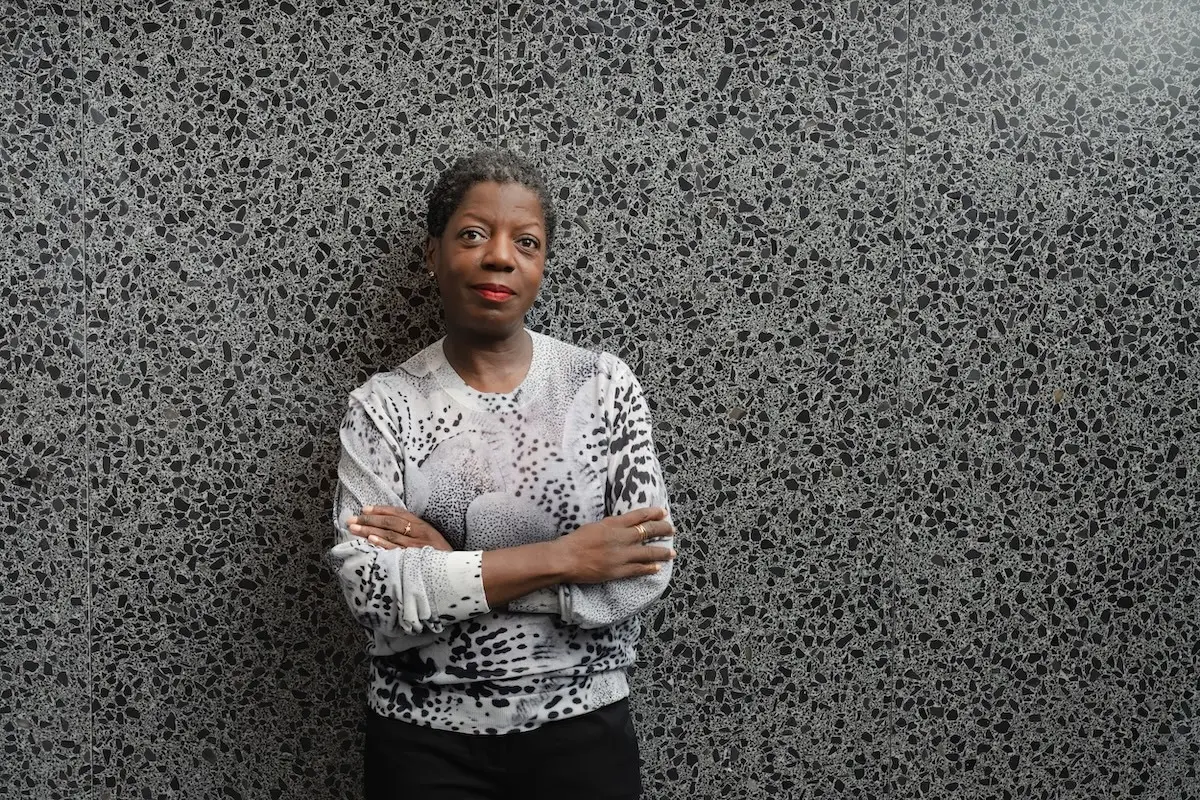
In a monumental announcement that marks the closing of a defining chapter in contemporary arts leadership, Thelma Golden has announced she will step down as the director and chief curator of the Studio Museum in Harlem in late 2027. This transition arrives precisely on the heels of Golden’s 20th anniversary at the helm of the institution, a post she assumed in 2006 following a storied tenure as a curator and deputy director.
The announcement also follows the historic reopening of the museum in a new, state-of-the-art facility—a $125 million, 82,000-square-foot architectural marvel designed by David Adjaye. The seven-story building, which welcomed the public back after a seven-year closure, has garnered widespread critical acclaim for its innovative design, serving as both a neighborhood anchor and an international beacon for Black modern and contemporary art.
Golden’s departure, while not entirely unexpected following the completion of such a massive capital and institutional campaign, signals a familiar cadence in the museum world. High-profile directors frequently orchestrate major organizational renewals before passing the torch to a new generation of leadership. The board of trustees, led by Chair Kathryn C. Chenault, has already mobilized, forming a dedicated search committee and retaining an international executive search firm to identify Golden’s successor. Golden will remain firmly at her post, ensuring operational continuity until a replacement is appointed.
Read Also
This article examines the legacy of Golden’s remarkable two-decade tenure, the deep institutional history that shaped her worldview, her monumental contributions to the visibility of Black artists, and the broader implications for the museum sector as the institution looks toward its next chapter.
Detailed Chronology: From Smith College to the Helm of Harlem
To understand the magnitude of Thelma Golden’s impact on the art world, one must trace a career defined by groundbreaking milestones, institutional stewardship, and an unwavering commitment to elevating the narratives of artists of the African diaspora.
Early Foundations and the Whitney Years
Golden’s journey with the Studio Museum in Harlem began long before she took the director’s chair. As an undergraduate art history and African-American studies double major at Smith College, a 19-year-old Golden encountered Dr. Mary Schmidt Campbell, then the visionary director of the Studio Museum. That early exposure planted the seeds for a career dedicated to institutional equity and artistic excellence. After serving as an early curatorial fellow at the Studio Museum, Golden joined the Whitney Museum of American Art in 1988 as a curatorial assistant.
During her tenure at the Whitney, Golden quickly established herself as a fearless, forward-thinking curator who challenged traditional museum canons. In 1993, she co-organized the historic Whitney Biennial, an exhibition that broke boundaries by centering identity politics, race, gender, and socio-political discourse in contemporary American art. Just a year later, in 1994, she organized the landmark exhibition "Black Male: Representations of Masculinity in American Art." The show sent shockwaves through the cultural establishment, examining how Black male bodies had been historically visualized, marginalized, and commodified in American visual culture. It remains a watershed moment in museum exhibition history.
Returning to the Studio Museum
In 2000, Golden returned to her spiritual and professional home, joining the Studio Museum as deputy director for exhibitions and programs under the pioneering director Lowery Stokes Sims. Working alongside Sims, Golden helped shape the curatorial vision of an institution uniquely dedicated to the
work of artists of African descent. When Sims stepped down in 2005, Golden was the natural, unanimous choice to succeed her, officially taking over as director and chief curator in 2006.
Supporting Context & Metrics: Redefining the Institution and Elevating Generations
Over the past twenty years, Golden’s leadership has redefined what a community-rooted museum can achieve on a global scale. Her curatorial vision transformed the Studio Museum from a beloved neighborhood institution into an internationally renowned powerhouse of contemporary art.
The Power of "Post-Blackness" and the Freestyle Generation
One of Golden’s most enduring intellectual and curatorial contributions came early in her tenure as director. In 2001, alongside co-curator Christine Y. Kim, Golden organized the paradigm-shifting exhibition Freestyle. The exhibition introduced 28 emerging Black artists whose work the curators described as "post-black"—a term denoting artists who were anxious to be anchored as "Black artists" while simultaneously insisting that their work be understood as deeply engaged with contemporary art discourse at large.
The exhibition acted as a career launchpad for an entire generation of creative luminaries who now dominate the global contemporary art market, including:
- Mark Bradford, whose massive, tactile abstract paintings command international acclaim and museum retrospectives worldwide.
- Rashid Johnson, celebrated for his multimedia installations exploring race, philosophy, and art history.
- Julie Mehretu, whose monumental, layered abstract canvases have cemented her status as one of the most important painters of the 21st century.
The $125 Million Architectural Transformation
The defining operational triumph of Golden’s career is undoubtedly the realization of the Studio Museum’s new home. For decades, the museum operated out of converted brownstone spaces on West 125th Street. Under Golden’s stewardship, the institution embarked on an ambitious journey to construct a purpose-built home designed to match the global ambition of its artistic programming.
Partnering with renowned architect David Adjaye, Golden helped conceptualize an 82,000-square-foot, seven-story building that honors the architectural vernacular of Harlem while offering world-class museum infrastructure. Key features of the new facility include:
- A sprawling 139-seat public lobby designed as a "living room" for the Harlem community.
- Expansive galleries dedicated to permanent collections and special exhibitions.
- Dedicated education spaces, a public library, and a community-focused cafe.
- A breathtaking rooftop terrace overlooking the historic neighborhood.
When the building reopened after a seven-year closure, it was met with rave reviews from art critics worldwide, securing a physical legacy that will support the museum’s mission for generations to come.
Accolades and Industry Recognition
Golden’s contributions have been acknowledged across the highest echelons of global culture. In 2023, she was awarded the prestigious Dorothy and Lillian Gish Prize, which carries a $250,000 cash award and honors individuals who have made an indelible, transformative contribution to the arts. She serves on numerous boards, advises international cultural bodies, and is widely regarded as a mentor to a new generation of museum professionals of color.
Official Statements: Reflecting on a Legacy of Partnership and Community
The transition announcement prompted heartfelt reflections from both the museum’s leadership and Golden herself, emphasizing a legacy built on collaboration, mentorship, and deep community roots.
Kathryn C. Chenault on the Search for a Successor
Speaking on behalf of the museum’s board of trustees, Board Chair Kathryn C. Chenault underscored the meticulous approach the institution will take in finding Golden’s successor:
"The board of trustees has formed a comprehensive search committee and has retained an international executive search firm to assist us in identifying the next visionary leader for the Studio Museum. Thelma’s footprint on this institution is indelible. While her shoes will be impossible to fill, we are committed to finding a leader who shares her passion, intellectual rigor, and dedication to Harlem and the global artistic community. We are deeply grateful that Thelma will remain in her post until a seamless transition is secured."
Thelma Golden’s Farewell Reflection
In her official statement announcing her departure, Golden looked back on her two decades of leadership with deep gratitude, framing her departure as a natural evolution for both herself and the institution:
"I know this is the right moment to begin this transition—and as I look ahead to new projects and opportunities, I also look back with gratitude toward the many people whose achievements have been my bedrock. I think of my teachers, mentors, and professional colleagues; the long line of Directors, Trustees, and donors who established the Studio Museum and made it thrive; half a century’s worth of endlessly dedicated staff members, audiences, and beloved Harlem neighbors; and above all the generations of artists who have enlightened us. Together, they are an expansive community I cherish that will continue to inspire and enable the next leader of the Studio Museum."
Golden’s sentiment echoes her philosophy expressed in a 2000s ARTnews interview, where she reflected on the vital importance of mentorship within institutions like the Studio Museum:
"[At the Studio Museum], they begin their careers and are able to not only get real professional experience but to form a mission and get a vision of real museum work. I say this as someone whose career is the result of those early experiences at the Studio Museum. It cannot be overstated how significant it was for me, as a 19-year-old art history/African-American studies double major from Smith College, to encounter Dr. Mary Schmidt Campbell… I can’t tell you what it meant for me, after over a decade as a curator at the Whitney, to become chief curator at the Studio Museum and to work for Dr. Lowery Stokes Sims, a pioneer in the museum field."
Future Outlook: A Broader Trend in Museum Leadership Transitions
Golden’s planned departure in late 2027 is part of a broader, generational shift currently reshaping the leadership landscape of major American cultural institutions. Across the museum sector, a wave of long-serving directors who spearheaded massive capital campaigns, architectural expansions, and institutional reinventions are stepping down, making way for a new leadership paradigm.
Notable recent departures mirror this trend:
- Lisa Phillips, director of the New Museum, announced in September 2025 that she would step down following the institution’s major architectural expansion.
- Janne Sirén, director of the Buffalo AKG Art Museum, announced in April 2026 that he would step down following the completion of the museum’s landmark expansion and campus redesign.
For the Studio Museum in Harlem, the upcoming leadership transition represents both a challenge and an extraordinary opportunity. The incoming director will inherit an institution with a secure physical home, a world-class facility, an endowment built on decades of goodwill, and an unmatched legacy of artistic innovation. Yet, they will also face the heavy responsibility of steering an institution that serves as the cultural heart of Harlem while maintaining its status as an international standard-bearer for equity in the arts.
As the search committee commences its global search over the coming months, the art world will watch closely, celebrating Thelma Golden’s monumental legacy while anticipating the dawn of a new era for the Studio Museum in Harlem. Golden’s departure in 2027 will not mark the end of her influence, but rather the celebration of a titan who permanently altered the topography of American art history.


Comments
Facebook App ID not configured. Please add it in the Customizer.