
Executive Overview
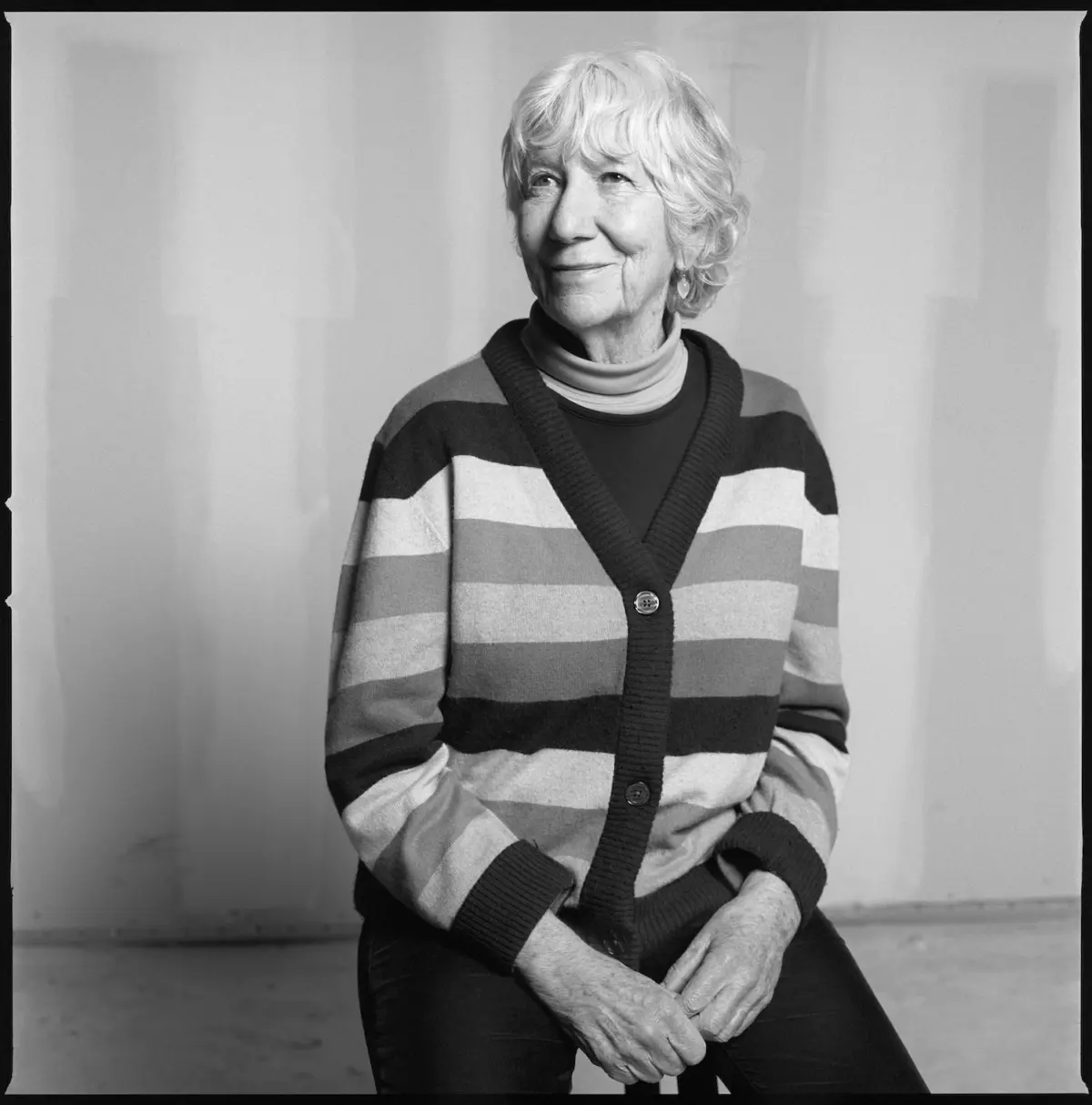
Mary Heilmann, a towering figure in contemporary abstract painting whose vibrant, witty, and structurally subversive canvases bridged the gap between rigorous high-modernist geometry and the freewheeling spirit of American counterculture, has died. She was 86 years old.
Heilmann passed away on Friday in Riverhead, New York, following complications from a fall, according to an announcement issued by her studio via Instagram. Her death marks the quiet closing of a remarkably influential chapter in post-war American art—one defined by an artist who refused to conform to the austere, male-dominated dogmas of mid-century minimalism and color-field painting. Instead, Heilmann infused these traditions with pop-cultural vibrancy, tactile warmth, and an idiosyncratic, joyful humor.
Though her career spanned more than five decades, widespread institutional validation came later in life. It was not until her 60s that Heilmann received her first solo exhibition at a major New York museum—a landmark 2008 retrospective at the New Museum that galvanized critics and cemented her status as an artist’s artist. Renowned luminary Ellsworth Kelly famously declared her “the best of the new abstractionists” around the time of that exhibition, echoing a sentiment shared by legions of younger painters who viewed her work as a vital blueprint for breaking the rules of traditional canvas-making.
Read Also
Throughout her life, Heilmann operated fluidly between the roles of boundary-pushing creator, dedicated educator, and cultural connector. From her formative roots in the surf and Beat cultures of 1960s California to her decades-long tenure shaping young minds as a professor in New York, her legacy remains indelibly stamped onto the landscape of contemporary abstraction. Hauser & Wirth, the international mega-gallery that represented Heilmann for nearly three decades, remembered her as their “first love,” highlighting a professional and personal partnership that helped launch the gallery’s trajectory in the late 1990s.
Detailed Chronology: From the Bay Area to the Avant-Garde
Roots in the Golden State (1940–1967)
Born Mary Ann Heilmann on January 3, 1940, in San Francisco, California, the future artist grew up against a backdrop of rapid postwar American expansion and burgeoning social change. Her mother, Mary Florence Webb, worked as a nurse, while her father, John Sherman Heilmann, was a civil engineer whose career required frequent relocation. Consequently, Heilmann spent her childhood split between the Bay Area and Southern California, residing for a period in El Segundo before her family moved to Los Angeles to accommodate her father’s work building the state’s massive freeway infrastructure.
This early immersion in California geography—the endless stretches of asphalt, the blinding Pacific sunlight, and the kinetic energy of car culture—would profoundly inform her artistic lexicon decades later. As a young adult coming of age in the 1950s and 1960s, Heilmann was directly exposed to the Free Speech Movement, the literary and philosophical upheavals of the Beat Generation, and the countercultural ethos of West Coast surf scenes.
Initially drawn to craft and material arts rather than traditional painting, Heilmann earned her Bachelor of Arts from the University of California, Santa Barbara, in 1962, focusing primarily on ceramics. Seeking to deepen her technical and conceptual mastery, she subsequently enrolled at UC Berkeley to study under Peter Voulkos, a monumental figure who revolutionized ceramics by treating clay through the lens of Abstract Expressionist spontaneity and scale. The fearless, physical approach she learned in Voulkos’s studio left an indelible mark on her artistic philosophy, teaching her to treat materials as active participants in the creative process. She completed her Master of Fine Arts at Berkeley in 1967, ready to test her vision on a larger stage.
Relocation to New York and the Breakthrough (1967–1990s)
Shortly after finishing her MFA, Heilmann made the pivotal move to New York City, plunging headfirst into an art scene dominated by minimalism, conceptualism, and post-minimalist experimentation. Abandoning clay for canvas, she began working with bright acrylic paints and lush, unexpected color palettes. Crucially, she conceptualized her paintings not merely as flat illusions, but as physical "sculptural material," frequently blurring the boundary between the art object and the architectural gallery space.

Heilmann achieved her first major institutional breakthrough when her work was selected for the 1972 Whitney Annual Exhibition, the direct precursor to the modern Whitney Biennial. It was during this experimental early New York period that she developed what Hauser & Wirth would later describe as one of the most critical technical breakthroughs of her career: the intentional collision of opposing painting methodologies.
By laying down a foundational, expressive gestural composition, partially covering it with masking tape, and subsequently overpainting it with a hard-edge geometric configuration, Heilmann forged a formally radical hybrid style. This tension between messy, emotional expression and cool, calculated geometry came to define the rapturous freedom of her oeuvre.
Throughout the 1970s and 1980s, Heilmann translated deeply personal memories—music, ocean waves, California highways, and domestic items—into simplified, iconic visual tokens: circles, squares, grids, and stripes. Her titles often referenced popular songs or visceral experiences (such as her 1979 painting Hyde Street or later works like Driving at Night), serving as bridges of empathy and shared experience between the viewer and the canvas. Despite producing bodies of work that garnered critical respect—including inclusion in the 1989 Whitney Biennial and solo surveys at the Institute of Contemporary Art (ICA) Boston in 1990 and the Vienna Secession in Austria in the late 1990s—commercial and mainstream museum success remained frustratingly modest for decades.
Institutional Recognition and Global Acclaim (2000s–2026)
The turning point for Heilmann’s public profile arrived in the 2000s. In 2008, the New Museum in New York mounted a comprehensive retrospective of her work, marking her very first solo institutional exhibition in her adopted home city. Curated with energy and insight, the exhibition had already traveled to critical acclaim at the Orange County Museum of Art in Newport Beach, California, and the Contemporary Art Museum Houston.
Writing in the catalog for the New Museum retrospective, the celebrated art critic Dave Hickey captured the essence of Heilmann’s revolutionary approach:
"The canons of geometric abstraction, Color Field painting, and Minimalism are honored in the spirit but not in the letter. In Heilmann’s synthesis, they are straightforwardly looted as available precedents."
The New Museum show opened the floodgates to widespread international attention. In the years that followed, Heilmann’s work was featured in a relentless parade of prestigious exhibitions at major international institutions, including the Whitney Museum of American Art, the Bonnefantenmuseum in the Netherlands, the Hamburger Bahnhof in Berlin, the Whitechapel Gallery in London, and Dia Beacon. Her exhibition Mary Heilmann: Long Line at the Whitney Museum served as a triumphant capstone, closing just this past January.
Supporting Context & Metrics
Key Milestones and Career Metrics
- Age at Passing: 86 (Born January 3, 1940; Died February/August 2026).
- First Major Museum Retrospective: 2008 (New Museum, New York), occurring when Heilmann was in her late 60s.
- Whitney Biennial / Annual Inclusions: 1972, 1989, and 2008.
- Key Gallery Partnership: Hauser & Wirth (represented since 1997, marking one of the gallery’s inaugural artist relationships).
- Academic Contributions: Decades spent teaching as a professor at Stony Brook University and later at the School of Visual Arts (SVA) in New York.
- Major Fellowships and Grants: Anonymous Was A Woman Foundation Fellowship, National Endowment for the Arts (NEA) grants, and a Guggenheim Fellowship.
Influential Artistic Lineage
Heilmann occupied a unique space in American art history. While male contemporaries dominated the histories of Minimalism and Color Field painting through rigid intellectual frameworks, Heilmann injected a vital dose of feminist subversion, pop sensibility, and emotional vulnerability into the medium. Younger generations of painters—particularly those seeking to rescue abstraction from academic dryness—found in Heilmann a fearless pioneer who proved that seriousness in art did not require solemnity.

Official Statements and Tributes
The art world reacted with profound grief and immense admiration following the announcement of Heilmann’s passing. Tributes poured in from international galleries, curators, and fellow artists who remembered her not only as a master of color and form, but as a generous mentor and cultural anchor.
Iwan Wirth, president and co-founder of Hauser & Wirth, released an emotional statement reflecting on their decades-long relationship:
"Manuela, Ursula and I met Mary in the spring of 1994. We were introduced to her by the artist Patty Martori and we started to collect her work right away," Wirth reflected. "Mary also introduced us to other artists she knew and admired like Louise Bourgeois. Our first project with Mary was her book The All Night Movie, which is kind of an autobiography as an artist book, and our first show with her came along in 1997, with so many to follow. Mary was really our first love."
Artists and critics alike have noted that Heilmann’s studio on Long Island—where she spent her twilight years residing in Bridgehampton, visiting the area regularly since the 1960s—served as a creative laboratory where younger generations of painters sought counsel, conversation, and community. Though she never married nor had children, she maintained a rich network of familial bonds, survived by her nieces Ann Jaime and Chris Heilmann, her nephew John Heilmann, Jr., and their respective families.
Future Outlook: Securing a Legacy in Abstraction
As the art community processes the loss of Mary Heilmann, discussions regarding her long-term art-historical footprint have already taken center stage. For decades, the narrative surrounding post-war American abstraction was heavily skewed toward male practitioners whose works commanded both immediate critical consensus and skyrocketing market values. Heilmann’s late-career ascent serves as a powerful corrective to this historical oversight, prompting curators, gallerists, and historians to re-evaluate the foundational narratives of late 20th-century painting.
Institutions that have championed her work in recent years—most notably the Whitney Museum and international spaces across Europe—are expected to organize commemorative exhibitions and scholarly symposia to contextualize her contributions. Furthermore, her extensive archive of artist books, notably The All Night Movie, alongside her vibrant sculptural chairs and paintings, guarantees that her distinct voice will continue to inspire new waves of creators.
Mary Heilmann taught generations of artists that abstraction could be playful, autobiographical, radically inclusive, and deeply human. As her canvases continue to hang in public and private collections worldwide, her brilliant chromatic compositions will stand as enduring testaments to a life lived in full, unapologetic color.

Comments
Facebook App ID not configured. Please add it in the Customizer.