By Greg Daugherty History Correspondent | Smithsonian Magazine Special Report
Executive Overview
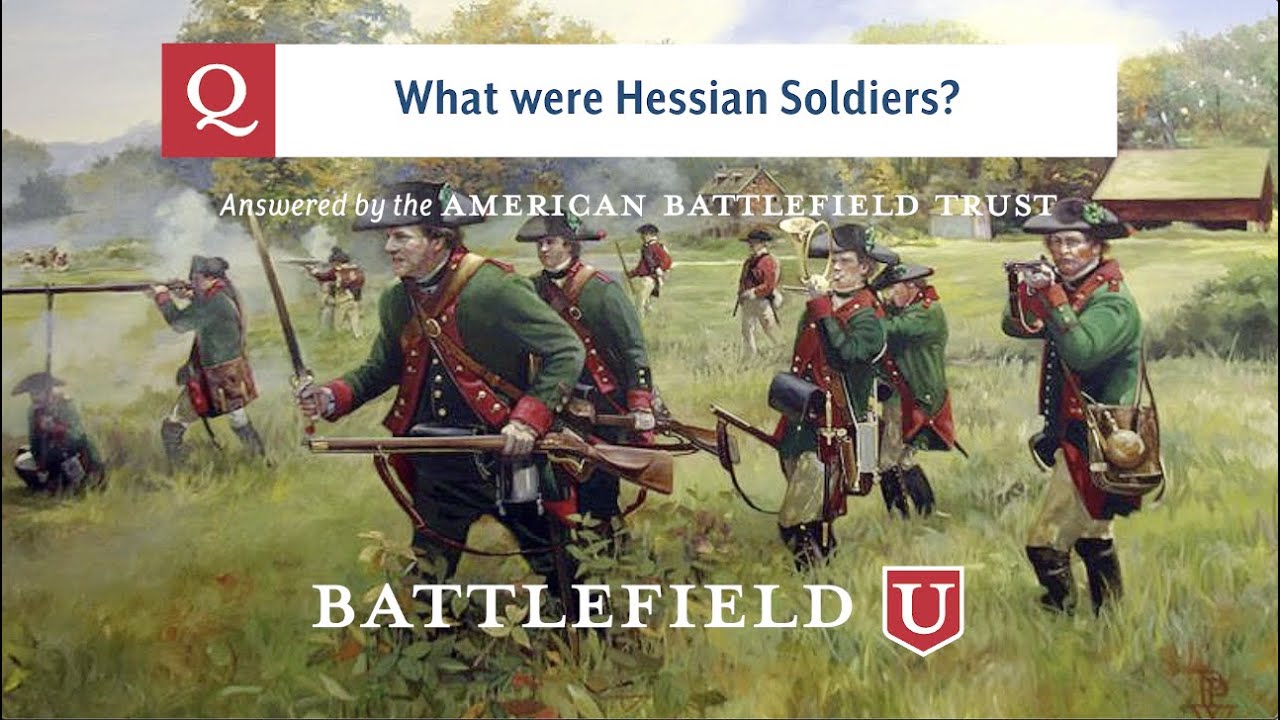
On August 15, 1776, a dense flotilla of British warships dropped anchor off the coast of Staten Island, New York, discharging more than 8,600 foreign troops onto American shores. This formidable landing marked the arrival of the first major contingent of German soldiers tasked with putting down the burgeoning American rebellion. Dressed in striking blue or green coats—and occasionally crowned with tall, sharp brass miter caps—these soldiers instantly became iconic, albeit deeply feared, figures in the unfolding drama of the American Revolutionary War.
For generations, popular history has cast these auxiliary forces as simple "Hessian mercenaries"—bloodthirsty, foreign soldiers rented out to the highest bidder by ruthless European princes. However, contemporary scholarship, led by historians such as Friederike Baer, reveals a far more complex reality. By strict definition, these men were not mercenaries, as they did not independently enlist for personal profit; rather, they were state-sanctioned auxiliaries deployed on loan through multi-territorial subsidy treaties. Furthermore, while the name "Hessian" has stuck in the American cultural lexicon, only a fraction actually hailed from Hesse-Cassel and Hesse-Hanau. The force of roughly 30,000 soldiers who eventually served the British crown originated from a mosaic of independent German principalities.
Far from being the unyielding supermen anticipated by King George III, these men were a mix of volunteers, conscripts, and men press-gang-pressed off European streets. They endured a brutal transatlantic crossing, fought in nearly every major military campaign of the war, and ultimately left a permanent demographic footprint on North America. Millions of modern Americans may unknowingly trace their ancestry back to these foreign soldiers who chose to abandon a lost British cause and build a new life in the nascent United States.
Detailed Chronology: From European Ports to the Battlefields of North America
1775–Early 1776: Treaties, Rejections, and Preparations
As the American colonies pushed toward autonomy, a frustrated King George III resolved in October 1775 to "put a speedy end to these disorders by the most decisive exertions." Having failed to secure troops from Catherine the Great of Russia or the Dutch Republic, British diplomats turned to the fragmented territories of the Holy Roman Empire.
London ultimately signed subsidy treaties with six German rulers. These agreements guaranteed financial compensation and troop replacements for casualties. The first major contingent departed the German port city of Bremerlehe in mid-April 1776. The transatlantic voyage was harrowing. Conscript Johann Gottfried Seume later recorded in his memoirs that the men were packed so tightly into bunks that they had to synchronize their sleep and turns: "when we thus had sweated and roasted enough on one side, the man on the right end called out, ‘Everybody turn!’…" Coupled with rotted bacon, worm-infested bread, and foul water, the crossing tested the troops long before they fired a shot.
August–December 1776: The New York Campaign and the Turning Point of Trenton
The exhausted German troops arrived in New York just as the Continental Congress adopted the Declaration of Independence on July 4, 1776—a document that explicitly listed the deployment of "foreign mercenaries" among its 27 grievances against the crown.
British commander William Howe wasted no time deploying the new arrivals. On August 22, British and German forces executed amphibious landings on Long Island. Outnumbered and outmaneuvered, George Washington’s Continental Army suffered devastating losses at the Battle of Long Island on August 27, ultimately forcing a clandestine retreat across the East River to Manhattan. Subsequent defeats at Harlem Heights, White Plains, and the loss of Fort Washington pushed the Continental Army into a desperate retreat through New Jersey and into Pennsylvania.
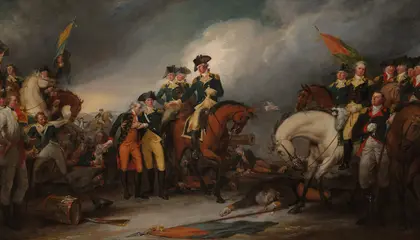
However, the tide turned dramatically on the night of December 25, 1776. Washington led his troops back across the ice-choked Delaware River to launch a surprise attack on the Hessian garrison stationed in Trenton, New Jersey. Following a fierce two-hour engagement, the German forces surrendered, resulting in nearly 900 prisoners. The Battle of Trenton shattered the myth of British-German invincibility and revitalized American revolutionary morale.
1777–1783: Protracted Conflict and Demographic Shift
Despite the setback at Trenton, German auxiliary forces remained central to British military strategy, participating in virtually every major campaign of the war until the signing of the Treaty of Paris in September 1783.
Over time, interactions between American colonists and the German troops began to transform public perception. Rather than the cannibalistic monsters depicted in early patriot propaganda, colonists discovered that many German soldiers were ordinary individuals caught in geopolitical crossfires. General George Washington himself noted in early 1777 that American prisoners consistently reported receiving far kinder treatment from German troops than from British regulars.
Supporting Context & Metrics
The mobilization of German auxiliary forces represents a massive logistical and demographic undertaking of the 18th century. Historical analysis reveals the following key metrics regarding their deployment and ultimate fate:
Total Deployment: Approximately 30,000 German soldiers served under the British flag throughout the American Revolutionary War.
Geographic Origins: Soldiers were drawn from six principalities, including Hesse-Cassel, Hesse-Hanau, Brunswick, Ansbach-Bayreuth, Waldeck, and Anhalt-Zerbst.
Casualties and Losses: According to historical estimates by Edward J. Lowell:
Roughly 1,200 soldiers died directly in combat.
Nearly 6,400 perished from disease, accidents, or exposure.
Approximately 5,000 soldiers deserted the ranks.
The Aftermath: Out of the 30,000 deployed, just over 17,300 returned to their native German lands. Between 5,000 and 6,000 chose to remain in North America, with up to 3,500 permanently settling within the United States.
Official Statements and Historical Perspectives
The introduction of foreign troops into domestic conflicts provoked profound political reactions among the American founding figures. John Jay, who initially favored reconciliation with Great Britain, cited the deployment of German forces as the catalyst for his conversion to the patriot cause. In a widely distributed public address, Jay challenged his countrymen:
"Why are the mercenaries of Germany transported near 4,000 miles to plunder your houses, ravish your wives and daughters?"
Similarly, the Continental Congress recognized the strategic value of cleaving these foreign auxiliaries away from the British military machine. On August 14, 1776, Congress passed a landmark resolution offering deserters sanctuary, civil rights, and 50 acres of unappropriated land. Later, a committee composed of John Adams, Benjamin Franklin, and Thomas Jefferson expanded these incentives for officers, offering up to 1,000 acres depending on rank.
Historian Friederike Baer, author of Hessians: German Soldiers in the American Revolutionary War, notes that neither side anticipated a protracted conflict:
"None of the soldiers that went to America in 1776 anticipated that the war would last more than a year or two."
Instead, the miscalculation of American resolve turned a localized colonial uprising into a grueling international war of attrition.
Future Outlook: Legacy in Modern American Heritage
As the United States approaches its 250th anniversary, historical reassessments of the Revolutionary War increasingly highlight the nuanced role played by these foreign participants. Moving past wartime propaganda has allowed historians to appreciate the complex socio-economic forces that drove thousands of German subjects across the Atlantic.
Today, the legacy of the German auxiliary troops extends far beyond military history books. With thousands of soldiers choosing to lay down their arms, desert the British military, or remain in North America after the cessation of hostilities, millions of modern Americans likely carry a "Hessian" ancestor within their family lineage. Ultimately, while King George III deployed these soldiers to suppress a revolution and preserve an empire, their enduring footprint became woven into the diverse cultural and demographic fabric of the very republic they were sent to destroy.

/https://tf-cmsv2-smithsonianmag-media.s3.amazonaws.com/filer_public/15/6a/156a4923-bf80-47e0-8353-584546bf7130/hessians.png)
/https://tf-cmsv2-smithsonianmag-media.s3.amazonaws.com/accounts/headshot/greg2.png)
/https://tf-cmsv2-smithsonianmag-media.s3.amazonaws.com/filer_public/15/6a/156a4923-bf80-47e0-8353-584546bf7130/hessians.png)
/https://tf-cmsv2-smithsonianmag-media.s3.amazonaws.com/filer_public/0e/80/0e80db64-b989-4e83-80ed-6e306678c4d4/gettyimages-1397980674.jpg)
/https://tf-cmsv2-smithsonianmag-media.s3.amazonaws.com/filer_public/38/a7/38a79759-383b-4869-bf46-c6f855ad30df/compleat.jpg)
/https://tf-cmsv2-smithsonianmag-media.s3.amazonaws.com/filer_public/cf/14/cf14d00d-fa37-4406-8eb7-00a46f9e314d/johanngottfriedseume_frommeyersgroschenbibliothek.png)
/https://tf-cmsv2-smithsonianmag-media.s3.amazonaws.com/filer_public/34/d2/34d2d403-ec4f-4001-a857-090886ae1d34/johann_koch.png)
/https://tf-cmsv2-smithsonianmag-media.s3.amazonaws.com/filer_public/b2/78/b278a463-3906-404b-831c-0ed376cce92a/battle_of_trenton_by_charles_mcbarron.jpg)




Comments
Facebook App ID not configured. Please add it in the Customizer.