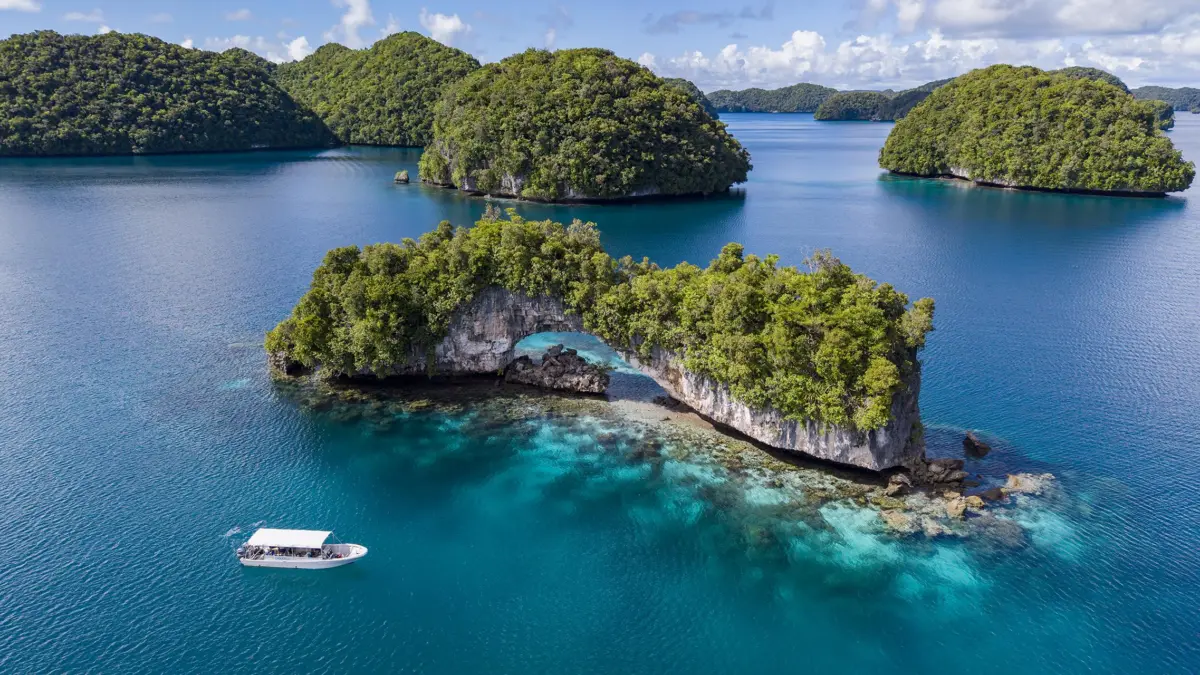
The coastal waters of Palau—an isolated archipelago of more than 300 islands scattered across the western Pacific—are legendary for their electric-blue transparency and mesmerizing biodiversity. Yet on a stormy morning in July, as Super Typhoon Bavi churned violently north in the Philippine Sea, the journey out to sea was anything but postcard-perfect. As the research vessel seesawed through heavy swells and unrelenting rain, the author headed toward a modest "coral garden" sitting two miles offshore.
Planted over the preceding years by marine scientists attempting to rebuild a severely damaged local reef, this submerged plot represents a critical frontier in modern conservation. Beneath the waves lie star-shaped metal structures studded with branching and boulder corals resembling neon-blue antlers, fluffy green mittens, human vertebrae, and miniature pine forests.
For the past two decades, governments, non-profits, and the hospitality sector have funneled hundreds of millions of dollars into global reef restoration initiatives. These efforts are driven by stark ecological reality: rising ocean temperatures, pollution, and severe marine heatwaves have killed off an estimated 50 percent of live coral globally since the 1950s. However, traditional restoration faces a fundamental, almost fatal flaw. Replanting coral without addressing the root cause of warming oceans is akin to planting trees in a forest primed for catastrophic wildfires. When severe heatwaves strike, the painstakingly cultivated corals often bleach and die within months or years.
To combat this vulnerability, Stanford University marine ecologist Steve Palumbi and researchers at the Palau International Coral Reef Center (PICRC) are pioneering a deceptively simple, low-tech intervention: stress-testing wild corals inside store-bought plastic picnic coolers. By identifying heat-tolerant "champion" colonies, these scientists hope to shift reef restoration from a futile cycle of replanting and dying to a proactive strategy of targeted climate reengineering.
Detailed Chronology & Field Expedition
The expedition to Palau’s northwestern and eastern reef sites highlighted both the fragility and resilience of the region’s marine ecosystems.
Stepping Into the Field: Weather and Water
On the July morning marked by the looming presence of Super Typhoon Bavi, the journey to the Ngaraard state coral garden proved grueling. Arriving wet, cold, and nauseated, the research team quickly donned masks and plunged into roughly ten feet of water. Despite the meteorological chaos above, the underwater environment remained an active nursery.
Days later, as the weather cleared ahead of the typhoon’s approach, a second dive took place at a shallow reef alongside Steve Palumbi and PICRC researchers. The seafloor was densely packed with life—a bustling marine apartment complex populated by silvery fish, giant clams, spiky starfish, sea cucumbers, furry crabs, sea turtles, and sharks.
The Low-Tech "Fitness Test"
Rather than relying exclusively on million-dollar laboratory setups, Palumbi’s team collected coral fragments using wire cutters, snapping off branches from individual colonies in a manner akin to taking plant clippings. These samples—spanning three species of branching corals within the genus Acropora (such as Acropora hyacinthus)—were placed in plastic bins and transported back to PICRC’s headquarters.
At the lab, the outdoor experimental setup combined standard marine pumps with an unceremonious array of red and blue plastic Coleman picnic coolers equipped with small heaters.
Baseline Conditions: The water inside the coolers began at 30°C (86°F), matching the average high temperature for regional waters.
Escalating Stress: Over a four-day period, the water temperature in half of the coolers was incrementally dialed up—reaching 34°C on day one, 35°C on day two, and ultimately scaling to 37°C (nearly 100°F) by the final morning.
Visual Evaluation: Each morning, researchers evaluated the fragments on a white grid, scoring them from one (no bleaching) to five (fully bleached).
While early tests revealed resilient, orange-brown coloration, the extreme heat of the final day caused most fragments to expel their symbiotic algae, turning bone-white like cauliflower florets. Yet, a small handful of fragments retained their brown pigmentation, proving entirely resistant to the thermal shock.
"Those are the champions," Palumbi declared.
Supporting Context & Metrics: The Economics and Ecology of Coral
The desperation driving these low-tech experiments stems from the staggering ecological and economic value tied to coral reefs globally.
Economic and Protective Value
Economic Impact: A 2024 study estimated that coral reefs in the Asia-Pacific region—encompassing Palau, Australia, Indonesia, and surrounding nations—contribute approximately $25 billion annually to local economies through fisheries and tourism. In Palau specifically, fisheries and tourism account for more than a quarter of the national GDP.
Natural Seawalls: Beyond economics, coral reefs serve as self-regenerating breakwaters. Research indicates that healthy reefs reduce wave energy from tropical storms and hurricanes by an average of 97 percent. In the United States alone, reefs save more than $1.8 billion annually in avoided flood damages.
Global Restoration Scale: The Coral Restoration Consortium tracks more than 900 reef restoration projects worldwide, managed by over 350 organizations. Over the past decade, groups have poured more than $250 million into global reef restoration efforts.
The Mechanism of Bleaching
To understand why standard restoration fails, one must examine the biology of coral. A "coral" is not a single organism, but a colony of hundreds or thousands of genetically identical polyps that clone themselves to build massive calcium carbonate structures.
Polyps form a symbiotic relationship with microscopic algae (zooxanthellae) residing within their cells. These algae photosynthesize, providing the coral with solar energy, food, and its iconic coloration in exchange for shelter and basic nutrients.
When ocean waters become too warm due to marine heatwaves, this metabolic partnership breaks down. Malfunctioning algae produce toxic compounds, forcing the polyps to expel them. This process, known as coral bleaching, leaves the coral starving and translucent. Without a timely drop in water temperature, bleached corals inevitably die.
Official Statements & Scientific Debate
Despite the enthusiasm surrounding targeted heat testing, the scientific community remains divided over whether low-tech methods can scale effectively or predict real-world survivability.
The Scale of Failure vs. The Urgency of Action
Many large-scale restoration projects have suffered catastrophic setbacks. In Florida, decades of planting tens of thousands of endangered staghorn (Acropora cervicornis) and elkhorn (Acropora palmata) corals across the Florida Keys were undone by the record-breaking marine heatwave of summer 2023. Nearly all replanted colonies across the third-largest barrier reef perished, rendering the species functionally extinct in many local areas. Similar mass-mortality events have been documented in Colombia, Costa Rica, Indonesia, and the Seychelles.
Reflecting on the scale of these losses, Steve Palumbi noted candidly:
"Show me a square mile of reef that has been successfully restored. There isn’t one."
The Sprint vs. The Marathon: Evaluating Test Validity
Critics argue that short, rapid heat tests fail to replicate the complex, multi-week endurance required to survive an actual marine heatwave.
Ilan Bubb (University of Amsterdam): Comparing short heat tests to long-term warming events is "like trying to predict a person’s marathon time based on how well they perform in a sprint." While a correlation exists, its predictive power remains scientifically unquantified.
Liam Lachs (University of Queensland): Emphasized that thermal tolerance is only one piece of the puzzle. Focusing exclusively on heat resistance might inadvertently sideline colonies possessing vital immunities against coral diseases.
James Guest (Newcastle University): Acknowledged that while the long-term solution requires curbing global carbon emissions, practical interventions remain essential to prevent total extinction. "Coming up with these practical approaches makes sense… It’s quick, it’s easy to do, people can apply it relatively straightforwardly, and it offers some kind of test."
Field Validation and Hope
Countering these doubts, Courtney Klepac, who leads the Coral Futures Academy at Stanford, highlighted encouraging empirical data. In Palau’s Ngaraard state coral garden, researchers planted both heat-test winners and control groups. During subsequent marine heatwaves in 2024, the short-test "champions" exhibited significantly higher survival rates than their non-tested peers.
"I am probably one of the few people that you will talk to that kind of low-key gets a little excited for bleaching events," Klepac admitted. "It is a very true test of what we’ve been doing."
Future Outlook: Reengineering for an Uncertain Tomorrow
As global carbon emissions continue to test planetary boundaries, the philosophy driving marine conservation is undergoing a profound philosophical shift. Merely protecting pristine environments or restoring ecosystems to a historical baseline is no longer sufficient.
Practical Democratization of Conservation
By demonstrating that rigorous genetic screening can be conducted using $1,000 worth of Coleman coolers, Palumbi and his collaborators are democratizing conservation science. Poorer island nations and underfunded local environmental groups across the Global South can now execute heat-tolerance screening within a single work week, bypassing the prohibitive costs of traditional marine laboratories.
The Ultimate Caveat
Yet, every scientist involved agrees that local reengineering is a stopgap measure. As Newcastle University’s James Guest succinctly noted:
"If we don’t reduce carbon emissions and we don’t deal with climate change, nothing we do is going to help corals."
Ultimately, the mission of modern reef restoration is no longer an idealistic attempt to recreate pristine, centuries-old ecosystems. Rather, as scientists like Palumbi and Lachs frame it, the goal is far more urgent and somber: buying time. By identifying and propagating climate-resilient coral strains, conservationists hope to build an ark of genetic diversity—ensuring that when and if global society finally stabilizes the climate, there will still be living reefs left to reclaim the oceans.








Comments
Facebook App ID not configured. Please add it in the Customizer.