
On August 5, 1944, deep within the pastoral expanse of New South Wales, Australia, the Cowra prisoner-of-war camp became the crucible for the largest and bloodiest prison break in the history of World War II. Over 900 Japanese prisoners, operating under an ideological framework that viewed surrender as an unforgivable moral failure, launched a coordinated, desperate uprising against their Allied captors. Armed with improvised weapons—baseball bats, sharpened cutlery, and gardening tools—and protected by blankets thrown over razor wire, the prisoners stormed the perimeter in the dead of night.
By the time the gunfire ceased at dawn, 234 Japanese men and four Australian soldiers lay dead, with another Australian soldier losing his life days later during the subsequent manhunt. Despite dwarfing the scale of the famous March 1944 "Great Escape" immortalized in popular culture, the Cowra breakout remains largely obscure outside of Australia and Japan. More than eight decades later, the event serves as a harrowing window into the clashing worldviews of the Pacific War: a collision between Western military norms, which recognized honorable surrender under hopeless odds, and the fierce dictates of Imperial Japan’s Senjinkun field service code, which demanded death before dishonor. Today, the remnants of the Cowra camp, alongside its solemn Japanese War Cemetery and sprawling cultural gardens, stand as lasting monuments to the complex reconciliation between former enemies.
/https://tf-cmsv2-smithsonianmag-media.s3.amazonaws.com/filer_public/93/b2/93b2606a-1623-4018-8a40-5857fe0dd865/gettyimages-453574876.jpg)
Detailed Chronology: The Night of the Uprising
The roots of the Cowra breakout were planted months before the first shot was fired, fueled by overcrowding, anxieties over shifting frontlines, and hard-line agitation within the camp. However, the immediate catalyst arrived on August 4, 1944, when camp administrators announced a contentious relocation plan. To alleviate overcrowding, authorities ordered that all Japanese prisoners below the rank of lance corporal be transferred to another facility.
Read Also
Camp leaders vehemently objected, arguing that younger, enlisted soldiers relied on older officers as surrogate father figures and would suffer psychologically if separated. Their protests were dismissed by the Australian camp command. Later that evening, Compound B—housing enlisted Japanese personnel—convened a tense meeting. The most radical faction hijacked the discourse, framing a mass breakout not merely as a bid for freedom, but as a mandatory act of ideological redemption to erase the profound social stigma of having been captured alive. Approximately 80 percent of the prisoners voted in favor of the uprising, though subsequent survivor accounts revealed that peer pressure compelled many to acquiesce against their personal inclinations.
/https://tf-cmsv2-smithsonianmag-media.s3.amazonaws.com/accounts/headshot/meilan_headshot2.png)
At approximately 2:00 a.m. on August 5, a distraught Japanese prisoner scaled the compound fence, weeping and expressing intense fear before guards fired warning shots. Instantly, a bugle call—sounded by naval pilot and prisoner Hajime Toyoshima—pierced the dark. More than 900 men burst from their huts, setting fire to their quarters and charging the perimeter.
The breakout unfolded across distinct tactical objectives:
:focal(2492x1638:2493x1639)/https://tf-cmsv2-smithsonianmag-media.s3.amazonaws.com/filer_public/93/b2/93b2606a-1623-4018-8a40-5857fe0dd865/gettyimages-453574876.jpg)
- The Machine Gun Assault: A dedicated team of prisoners rushed a Vickers machine gun post manned by privates Benjamin Gower Hardy and Ralph Jones. The two Australians scrambled to their positions in their pajamas, managing to disable the gun’s breechblock before being overwhelmed. Jones was stabbed to death, and Hardy was fatally clubbed, successfully preventing the weapon from being turned on their comrades.
- The Compound D Incursion: A contingent of 50 men breached Compound D, where Japanese officers and conscripted Korean and Taiwanese laborers were quartered, remaining there until daybreak.
- The Wire Run: The vast majority of escaping prisoners sprinted for the outer perimeter fences. Using thick wool blankets, mattresses, and baseball mitts to shield themselves from the razor wire, hundreds surged forward directly into the arc of guard fire.
By 6:20 a.m., the chaotic melee had subsided. While hundreds escaped into the surrounding countryside, a swift, nine-day dragnet coordinated by the Australian military recaptured every single escapee. The human toll was devastating: 183 Japanese prisoners died from gunshot wounds during the assault, 31 died from self-inflicted injuries or violence perpetrated by their peers, 12 perished in the fires of the burned barracks, and several others succumbed to their injuries in the days that followed, bringing the total Japanese fatalities to 234. On the Australian side, four soldiers—Benjamin Hardy, Ralph Jones, Charles Henry Shepherd, and Harry Doncaster—were killed during the breakout, while a fifth, Thomas Roy Hancock, was accidentally shot and killed by a fellow volunteer during the recapture operations on August 7.
Supporting Context & Metrics: Ideology, Culture, and Camp Realities
To comprehend the sheer scale of the tragedy at Cowra, historians must examine the radically divergent wartime cultures of the Western Allies and Imperial Japan.
/https://tf-cmsv2-smithsonianmag-media.s3.amazonaws.com/filer_public/14/29/1429fe5b-958d-477f-ac5c-ca00faa46df6/baseball.png)
The Stigma of Surrender
During World War II, Western military tradition held that service members who fought valiantly against hopeless odds could surrender honorably without compromising their personal or national reputations. Consequently, approximately 35 million soldiers surrendered across the European and Pacific theaters combined, including nearly 8 million Germans and hundreds of thousands of Italians and Western Allies.
Conversely, Imperial Japan’s military ethos viewed surrender as an absolute moral catastrophe. Governed by the Senjinkun (Field Service Code) issued in January 1941, soldiers were explicitly commanded: "If alive, do not suffer the disgrace of becoming a prisoner; in death, do not leave behind a name soiled by misdeeds." Captivity meant permanent social excommunication. Families of captured soldiers often faced intense public shame, and the Japanese government frequently classified POWs as officially dead, paying death benefits to their relatives while omitting any record of their survival. Fearing this disgrace, only an estimated 35,000 Japanese service members were captured by Western Allies throughout the entire conflict.
/https://tf-cmsv2-smithsonianmag-media.s3.amazonaws.com/filer_public/b3/5e/b35e1338-7998-4cdd-abd9-6ffb122a1be8/bats.png)
The Cowra Camp Environment
Established in New South Wales, the Cowra POW camp was originally constructed to house Italian prisoners before absorbing its first Japanese arrivals in 1943. Under the guidelines of the 1929 Geneva Convention—which Japan had signed but never officially ratified—the Australian government maintained a strict commitment to humane treatment.
The camp featured extensive recreational amenities, including:
/https://tf-cmsv2-smithsonianmag-media.s3.amazonaws.com/filer_public/9d/9d/9d9d2c0e-3274-4a17-9268-52ea4284eef8/statelibqld_1_80019_japanese_prisoners_arriving_at_brisbane_from_new_guinea_ca_1945.jpg)
- Canteens, theater stages, and hobby huts.
- Tailor, barber, and comprehensive dental and medical facilities.
- Organized sports leagues, including soccer and baseball.
- Dedicated plots for prisoners to cultivate vegetable and flower gardens.
For many prisoners, the humane conditions created a psychological paradox. While former prisoners like Teruo Murakami later described the camp as "almost heavenly" compared to the brutal realities of the battlefield, hard-liners interpreted Australian kindness as a sign of weakness. As news of imperial military defeats filtered into the camp, nationalist agitators convinced their peers that remaining passive in a comfortable prison was a dishonorable betrayal of their homeland.
Official Statements and Archival Insights
The post-breakout investigations conducted by the Australian government and subsequent historical analyses provide critical context regarding the camp administration’s preparedness and the emotional aftermath experienced by the survivors.
/https://tf-cmsv2-smithsonianmag-media.s3.amazonaws.com/filer_public/66/24/6624772d-17c7-44a5-9afe-c87dc664c2a2/japanese_pows_guam_aug_1945.jpeg)
Official military boards and contemporaneous documents highlighted a profound cultural blind spot among Allied guards. As author Mat McLachlan notes, Australian authorities simply could not fathom that prisoners would willingly trade comfortable conditions and life itself for a suicidal breakout attempt. Despite receiving a vague warning in June 1944 from a Korean prisoner who had overheard whispers of unrest, the camp command maintained standard security protocols, ultimately leaving them vulnerable to the sheer psychological intensity of the Japanese resolve.
In his post-war analysis, The Anguish of Surrender, former U.S. diplomat Ulrich A. Straus addressed the profound dread that accompanied the repatriation of Japanese POWs:
/https://tf-cmsv2-smithsonianmag-media.s3.amazonaws.com/filer_public/0d/2e/0d2ebc7e-5e5a-4451-9732-65d655352ef0/hajime.png)
"No other prisoners of war have ever returned to their homeland with as much uncertainty about how they might be received as the Japanese. These men believed that they had committed the most heinous lapse imaginable by allowing themselves to be captured, and that they would never be able to return to the home they had known, except to be executed."
Despite these fears, the vast majority of repatriated Cowra survivors were met not with execution or scorn, but with stunned relief. When Teruo Murakami returned to his family home after the war, his relatives greeted him with the bewildered remark that "a ghost had returned from the war."
/https://tf-cmsv2-smithsonianmag-media.s3.amazonaws.com/filer_public/53/c2/53c2bf20-3a22-4f67-8730-68cb9d67a094/japanese-pows.png)
Future Outlook: Memory, Reconciliation, and Legacy
Eighty-two years after the predawn chaos of August 5, 1944, the legacy of the Cowra breakout has undergone a remarkable transformation from a site of wartime trauma into an international beacon of peace and reconciliation.
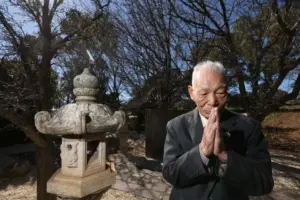
The physical landscape of the tragedy reflects this evolution. The Cowra Japanese War Cemetery—where the 234 Japanese men who died during and after the breakout are interred alongside other Japanese service members—stands just kilometers away from the separate burial sites of the fallen Australian soldiers. Established and maintained through decades of cooperative diplomacy between Australia and Japan, these hallowed grounds are complemented by the sprawling Cowra Japanese Garden and Cultural Centre, constructed in the 1970s.
/https://tf-cmsv2-smithsonianmag-media.s3.amazonaws.com/filer_public/82/c2/82c2344c-9b4f-4f81-bc1c-db9141287768/blankets.jpg)
Modern historians, educators, and diplomats view Cowra as a vital case study in transitional memory. By openly confronting the darkest moments of their shared wartime history, Australia and Japan have forged a enduring bilateral friendship rooted in mutual respect, historical transparency, and cultural exchange. The annual commemorative ceremonies held at Cowra ensure that the lessons of the Pacific War’s largest prison break continue to resonate, transforming a night of senseless bloodshed into an enduring global testament to peace and reconciliation.


Comments
Facebook App ID not configured. Please add it in the Customizer.