
Executive Overview
In the landscape of historical fiction, few moments capture the complex intersections of voyeurism, migration, and survival quite like the true story of Afong Moy. Brought to New York in 1834 by an American merchant company as a living exhibit of Chinese goods, she quickly became a nationwide media sensation—a woman reduced to a spectacle, gazed upon by thousands yet understood by virtually no one.
Enter Bo Wang, a debut author whose upcoming novel, The Chinese Lady (slated for publication by HarperVia on September 8, 2026), seeks to restore humanity and interiority to a historical figure long obscured by the archive. Raised in Cincinnati by Taiwanese American parents and now residing in Boston, Wang brings a rigorous academic background—holding an A.B. in history and literature from Harvard College—to her fiction. Represented by literary agent Natalie Edwards, Wang’s debut is more than a historical retelling; it is an excavation of lost narratives, an interrogation of entrenched literary tropes, and a deeply personal exploration of what it means to transition from "stranger" to belonging across generations.
This feature explores the genesis of The Chinese Lady, tracing Wang’s winding three-year journey from archival discovery to publication. It examines the intricate technical hurdles of historical linguistics, the structural evolution of the manuscript under editorial guidance, and the broader cultural implications of writing against reductive Asian stereotypes in contemporary literature.
Read Also
Detailed Chronology: From Archival Rabbit Hole to HarperVia
The Spark of Inspiration (Pre-2020)
The genesis of The Chinese Lady began as an unexpected encounter with the archives. Despite studying American history and literature at Harvard College, Bo Wang found herself confronted with a glaring omission in her own education: the vast, largely unmapped expanses of early Chinese American history.
When Wang first stumbled across the historical footprint of the young girl brought over in 1834, she experienced a dual sensation of surprise and acute curiosity. How was it possible that a figure who had once commanded nationwide media attention in the United States had slipped into historical obscurity?
As Wang plunged down the archival rabbit hole, she encountered the frustrating limits of the historical record. The sparse documentation that survived treated the subject almost exclusively as a commodity—an exhibit, a spectacle, a functional novelty within the burgeoning trade and cultural exchange of 19th-century America. Driven by a novelist’s intuition and a historian’s rigor, Wang realized that to understand this life, she would have to step beyond the dry ledgers and newspaper clippings of the era. She would have to use imagination to fill in the profound, systemic gaps left by a society that recorded the spectacle but ignored the human being.
The Writing Process and the Interruption of Motherhood (2020–2023)
Wang officially began drafting the novel in 2020, at a time of unprecedented global disruption. However, the early momentum of the project was soon met with the transformative, all-consuming demands of new motherhood.
The writing process evolved into a fragmented, start-and-stop endeavor spanning three years. It was not until 2023 that Wang was able to return to the manuscript with renewed focus and sustained momentum. This rhythmic pause, far from stalling her creative output, allowed her to approach the narrative with the accumulated maturity and emotional resonance of her new lived experiences.
The Structural Pivot: Finding the Protagonist’s Voice
One of the most significant milestones in the book’s development occurred during the drafting and revision stages, driven by critical feedback from early readers and mentors.
Initially, Wang’s authorial vision was strictly tethered to the historical reality of her subject’s external existence. She was deeply committed to crafting a narrative that faithfully reflected the tragic confinement of a life in which no voice was granted. However, recurring feedback complicated this approach: readers consistently yearned for interiority; they wanted the protagonist to speak for herself.
In response to this feedback, Wang executed a bold structural pivot. She rewrote the final section of the book to shift the narrative perspective directly to the Chinese Lady herself. This creative choice transformed the novel from a detached historical observation into an intimate, urgent act of reclamation, granting agency to a historical figure who had been denied it in life.
Supporting Context & Metrics: The Mechanics of Historical Authenticity
Writing historical fiction set in the early 19th century demands rigorous adherence to material culture, linguistic accuracy, and cultural nuance. For Wang, the research process uncovered unexpected complexities—ranging from the subtle mechanics of historical dialects to the lethal realities of 19th-century consumer goods.
Navigating Linguistic Layers: Pinyin, Cantonese, and Hanzi
One of the most arduous hurdles Wang encountered during the writing process involved the integration of the Chinese language into an English-language text. What initially seemed a straightforward stylistic choice unraveled into a complex linguistic puzzle:
- The Regional Correction: At the outset, Wang utilized pinyin—the romanized system commonly used to transliterate Mandarin. However, she quickly realized a glaring historical discrepancy: while Mandarin is her own first language, the historical characters in her novel would have spoken Cantonese. A course correction was urgently required.
- The Medium of Thought vs. Speech: Wang established a structural rule for her bilingual characters. Those who thought and spoke in Chinese would utilize traditional hanzi characters when expressing Cantonese, whereas characters who primarily thought and spoke in English would utilize pinyin for their Cantonese dialogue.
- Historical Script Accuracy: The final layer of linguistic precision required historical dating of the characters themselves. Wang realized that simplified hanzi, which is widely utilized today, was not popularized until the 1950s. To maintain absolute historical integrity, the novel required the implementation of traditional hanzi characters reflective of the 1830s.
Material History and 19th-Century Toxins
Beyond linguistics, Wang’s deep dive into the period exposed her to the fascinating and often lethal material conditions of the era. In constructing the world of 1834 New York and the domestic spaces inhabited or observed by her characters, Wang conducted extensive research into historical consumer products. This research revealed the shocking prevalence of poisons woven into everyday life—unwittingly consumed or applied through contemporary patent medicines, beauty cosmetics, and aggressive acne treatments of the period. These historical details ground the novel in a visceral, sensory reality that elevates the prose beyond standard historical tropes.
Official Statements & Authorial Insights
In discussions surrounding her debut novel, Wang has been candid about her artistic motivations, the surprises of the publishing industry, and her ultimate aspirations for her readership. Below is a synthesized overview of her core reflections on the journey of The Chinese Lady:
On the Publishing Journey and Editorial Collaboration
For many aspiring writers, securing representation is viewed as the final hurdle before the finish line. Wang admits that this was a significant misconception in her own publishing education:
"I always thought finding an agent would mean my book was done. I didn’t realize that my agent would be a critical part of my revision process, and after that, my editor would also help me improve my craft and structure."
This collaborative ecosystem—stretching from Natalie Edwards’ early literary guidance to the rigorous editorial oversight at HarperVia—transformed an isolated draft into a finely tuned work of historical fiction, proving that the genesis of a book extends far beyond the solitary desk.
Deconstructing Harmful Tropes
Wang’s work is explicitly positioned as a counter-narrative to reductive cultural depictions that have dominated Western literature and media for generations. She notes:
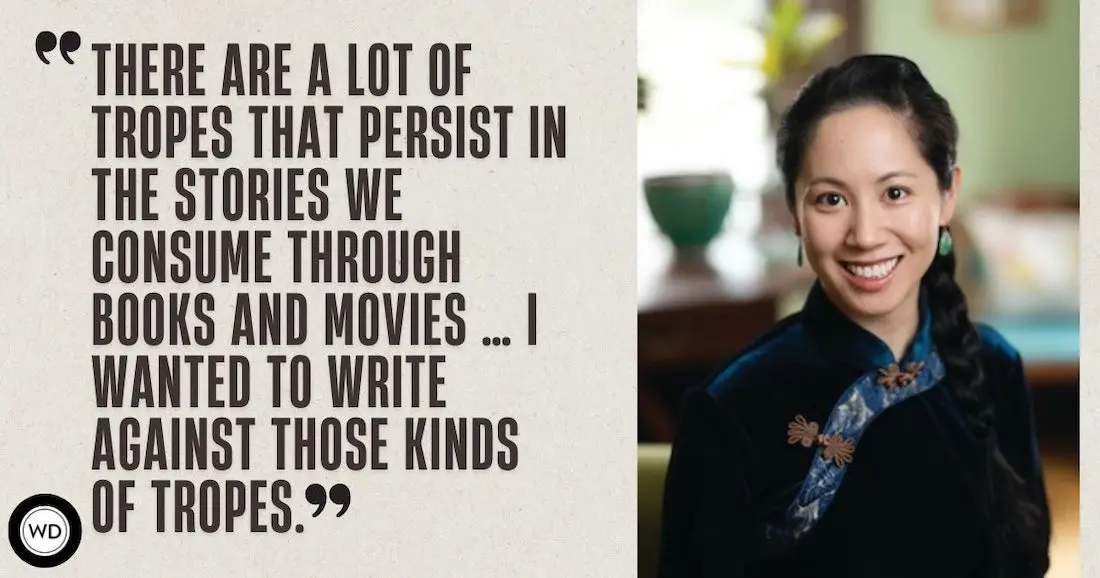
"First, there are a lot of tropes that persist in the stories we consume through books and movies—for example, Chinese mothers are self-sacrificing. I wanted to write against those kinds of tropes. All four women in my novel are individuals in their own right."
By refusing to flatten her characters into monolithic archetypes, Wang insists on the messy, multifaceted individuality of her historical and fictional subjects, restoring their psychological complexity.
The Arc of Belonging
Beyond historical reclamation, Wang’s work serves as a meditation on the immigrant experience across generations. Drawing from her own bicultural upbringing in Cincinnati—where her childhood was populated by stories of the Monkey King alongside Frog and Toad—she reflects on the broader human condition of displacement and assimilation:
"Second, almost all of us were strangers to this land once, and sometimes we forget that the transition from strangeness to belonging happens over generations. I hope this book captures that transition."
Wang’s Golden Rule for Aspiring Writers
When asked about the practical discipline required to bring a manuscript to fruition across the interruptions of life, Wang offers a concise, uncompromising imperative:
"Write every day. Make it a habit and a routine."
Future Outlook: The Cultural Impact of The Chinese Lady
As the publishing world looks toward the September 8, 2026 release of The Chinese Lady by HarperVia, anticipation is mounting for what promises to be a landmark debut in historical fiction.
The novel arrives at a critical juncture in contemporary literature, where readers and critics alike are actively demanding more nuanced, structurally complex explorations of marginalized histories. By breathing life into the archival silence surrounding Afong Moy, Bo Wang has done more than rescue a 19th-century figure from historical oblivion; she has mapped out a blueprint for how historical fiction can correct the historical record through empathy, rigorous research, and imaginative courage.
For booksellers, academics, and historical fiction enthusiasts, The Chinese Lady represents an essential addition to the American literary canon. It challenges our assumptions about who gets to be remembered, who gets to be viewed as a spectacle, and whose voices ultimately define the historical narrative. As Wang’s daily writing routine continues to yield new intellectual and creative endeavors, her debut stands as a powerful testament to the enduring necessity of looking backward in order to better understand the long, generational arc of belonging.




Comments
Facebook App ID not configured. Please add it in the Customizer.