
Executive Overview
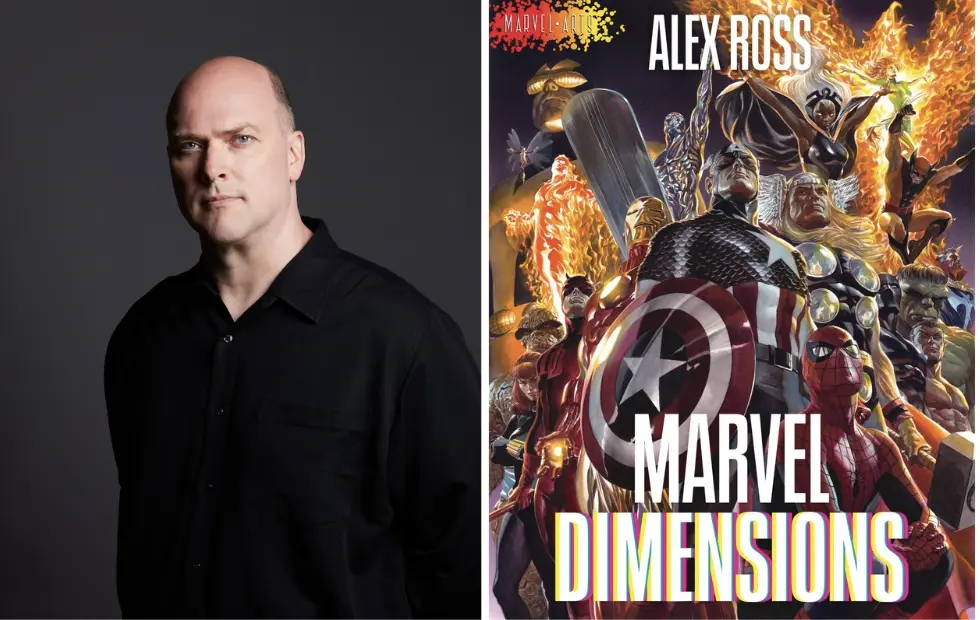
In the ever-expanding universe of comic book publishing, few names carry the legendary weight of Alex Ross. Renowned for his hyper-realistic, fully painted watercolor and gouache aesthetic, Ross has long stood as a pillar of traditional craftsmanship in an industry increasingly dominated by digital workflows. Now, the celebrated writer and artist is once again breaking the mold with his latest passion project, Marvel Dimensions. Scheduled for publication this September, the graphic novel marks Ross’s second major collaboration with Abrams ComicArts, following their highly successful 2022 release, Fantastic Four: Full Circle.
Like its predecessor, Marvel Dimensions bypasses traditional distribution channels within Marvel Comics, finding its home instead under the specialized Abrams imprint, MarvelArts. Curated by Abrams editorial director Charles Kochman, the MarvelArts line was designed specifically to tackle ambitious, high-end graphic literature that falls outside the standard superhero publishing schedule or requires specialized physical formats.
Marvel Dimensions is not merely an art book or a standard anthology; it is a structural experiment. The hardcover volume defies traditional conventions by combining two distinct artistic mediums and formats: a first half composed of sweeping, fully painted two-page origin spreads that strip away decades of modern retcons, and a second half featuring a 32-page, black-and-white pen-and-ink narrative comic bound directly into the book as an insert. Inspired by the classic "Super Specials" of Mad magazine, Ross and Kochman have engineered a book where physical format directly serves narrative purpose.
Read Also
This deep dive examines the genesis of Marvel Dimensions, exploring how Ross is directly pushing back against modern cinematic and literary revisions of classic characters, why the partnership with Abrams ComicArts is revolutionizing prestige-format comic books, and how this unique publishing venture challenges our very understanding of how graphic novels should be built, experienced, and collected.
Detailed Chronology: The Evolution of Marvel Dimensions
The road to Marvel Dimensions began shortly after the completion of Fantastic Four: Full Circle. For Ross, the creative process is rarely linear; it is driven by persistent ideas, thematic hungers, and leftover concepts that demand a physical home.
From Concept to Jerry-Rigged Reality
In recent interviews detailing the book’s creation, Ross admitted that Marvel Dimensions was born out of leftover narrative impulses. Rather than forcing disparate concepts into a traditional, serialized multi-issue arc, Ross decided to jerry-rig two separate creative urges into a singular, cohesive publishing event.
The first core component of this vision involved revisiting the foundational beginnings of Marvel’s iconic heroes. Ross observed that over decades of serialized storytelling—compounded heavily by the narrative pressures of the Marvel Cinematic Universe (MCU) and modern comic book retcons—the primal, elemental roots of characters like the Hulk, the Human Torch, and the Silver Surfer had become obscured.
The second component stemmed from a lifelong ambition that Ross had long struggled to integrate into his professional portfolio: traditional pen-and-ink illustration. While universally celebrated for his lush, painterly style, Ross sought a way to utilize black-and-white ink work organically. The solution arrived through structural disruption: shifting artistic mediums and contexts precisely halfway through the book.
The Mad Magazine Inspiration
The physical architecture of the book took a decisive turn during early editorial discussions between Ross and Charles Kochman. Initially, Ross envisioned the narrative comic as an internal sequence within the binding. However, drawing on his professional tenure at Mad magazine, Kochman proposed an homage to the classic Mad "Super Specials," which famously featured bound-in, removable comic supplements.
This editorial decision transformed Marvel Dimensions from a standard graphic novel into a tactile artifact. Though Abrams’ marketing team eventually convinced the creators to spotlight the insert as a major selling point rather than keeping it an absolute secret, both Ross and Kochman have deliberately kept plot details regarding the insert under wraps, allowing readers to experience its storytelling justification organically upon turning the pages.
Supporting Context & Metrics: Pushing the Boundaries of Prestige Comics
To understand the industry significance of Marvel Dimensions, one must examine the operational model of the Abrams MarvelArts line. Launched with Fantastic Four: Full Circle in 2002, the imprint was conceived to solve a structural limitation within modern comics publishing: major superhero publishers like Marvel often lack the operational bandwidth, production budgets, or risk tolerance required to execute unconventional, prestige-format graphic novels.
The MarvelArts Publishing Model
Abrams ComicArts has carved out a lucrative niche by treating comic books not merely as serialized periodicals or standard trade paperbacks, but as high-end design objects. Charles Kochman has frequently reiterated a core editorial philosophy for the imprint: content must dictate format.
| Book Title | Publication Year | Publisher | Primary Artistic Medium | Unique Structural Feature |
|---|---|---|---|---|
| Fantastic Four: Full Circle | 2022 | Abrams ComicArts | Full Painted Style | Oversized, continuous narrative format mimicking classic 1960s annuals. |
| Marvel Dimensions | 2024 (Sept) | Abrams ComicArts | Painted Spreads & Pen-and-Ink | Split-format featuring a 32-page bound-in black-and-white comic insert. |
By stepping outside the traditional comic shop direct-market ecosystem—while still maintaining deep institutional synergy with Marvel—Abrams and creators like Alex Ross are able to court both traditional collectors and bookstore literary graphic novel readers.
The Aesthetics of Unpredictability
The unconventional nature of Marvel Dimensions extends down to its page layouts. In a medium rigidly governed by vertical storytelling and standardized grid systems, Ross and Kochman deliberately courted aesthetic whiplash.
A prime example occurs in the book’s final painted spread, dedicated to Jean Grey as the Phoenix. Eschewing the vertical orientation used throughout the rest of the book, Ross rendered the spread horizontally. This choice was initially a point of playful contention between the artist and his editor. Kochman, who humorously admits to a long-standing editorial aversion to forcing readers to physically turn a hardcover book sideways, ultimately conceded to Ross’s instincts. The result is a deliberate disruption of reader expectation—an unpredictable design choice that mirrors the chaotic cosmic power of the Phoenix character itself.
Official Statements & Creative Philosophy
At the heart of Marvel Dimensions is a fierce ideological debate over canon, historical revisionism, and character accountability. In joint interviews with trade publications, Ross has been candid about his frustrations with how modern media has sanded down the sharp edges of classic comic book origins.
Reclaiming the Nuclear Age and Personal Accountability
For decades, contemporary writers and cinematic adaptations have altered the genesis points of Marvel’s pantheon to fit modern psychological frameworks or sci-fi rationalizations. Ross’s Marvel Dimensions actively pushes back against this trend, stripping away decades of retcons to return characters to their mid-century roots.
Consider the origin of the Hulk. In the MCU and 21st-century "Ultimate" comic continuities, Bruce Banner’s transformation into the jade giant is frequently attributed to chemical serums, military weaponized formulas, or genetic experimentation. Furthermore, modern trauma narratives often focus heavily on Banner’s abusive childhood to explain his psychological fracturing. Ross forcefully rejects these modern additions as narrative distractions:
"Bruce Banner was a bomb maker, and so everything that happened to him is a side product of his own invention," Ross explains. "When people want to talk about how he was an abused child and had a bad relationship with his father, that’s beside the point. He was a person doing a thing that led to a certain suffering, and that’s his own burden to carry. Hold the person accountable, which is the whole original crux of the story of the Hulk that’s gotten lost over time. He’s a product of the nuclear age, which is frankly true of a lot of the original Marvel characters."
By re-anchoring the Hulk to the catastrophic fallout of his own gamma bomb, Ross reclaims the Cold War paranoia and moral culpability that defined Stan Lee and Jack Kirby’s original 1962 conception.
Resolving Creator Discrepancies: The Silver Surfer
Ross’s commitment to historical accuracy extends even to the earliest conflicting visions of the creators themselves. In Marvel Dimensions, certain characters receive unique treatments that reflect behind-the-scenes historical friction.
A striking example is the Silver Surfer. When Jack Kirby originally conceived the cosmic herald in the pages of Fantastic Four, he envisioned him as an utterly alien entity devoid of human empathy or emotional warmth. However, when Stan Lee subsequently spun the character off into a dedicated solo series, he established the tragic origin of Norrin Radd—a humanoid alien burdened by deep guilt for serving the planet-devouring Galactus.
Rather than choosing one version as the definitive canon, Ross dedicates his Silver Surfer spread to presenting both foundational interpretations, honoring the dualistic creative DNA that birthed the character.
Future Outlook: The Reshaping of Graphic Literature Formats
As the comic book industry continues to navigate shifting retail landscapes, the success of imprints like Abrams’ MarvelArts signals a lucrative and critically vital path forward for master creators.
Marvel Dimensions proves that veteran creators do not need to remain tethered to the constraints of monthly floppy comic books or predictable collected editions. By leveraging high-end production values, tactile book design, and uncompromising artistic vision, Alex Ross and Charles Kochman are demonstrating that graphic novels can function as high-art literary objects.
The release of Marvel Dimensions this September will undoubtedly spark intense critical discussion among longtime fans and industry analysts alike. More importantly, it challenges major publishers to rethink their approach to archival storytelling. By treating comic history not as a fluid canvas to be endlessly updated for modern cinematic synergy, but as a sacred text worthy of rigorous preservation and structural experimentation, Ross has crafted a work that looks backward to the atomic dawn of the Marvel Universe while boldly charting a fresh, unpredictable future for the graphic novel medium.





Comments
Facebook App ID not configured. Please add it in the Customizer.