
By Michael Kozlowski
Published October 2026
Executive Overview
The publishing industry is undergoing a profound structural evolution, characterized by a decisive divergence in consumer reading and listening habits. Fresh data tracking trade sales for August 2026 reveals a fascinating paradox: while digital audiobooks continue an aggressive, double-digit march upward, traditional e-books are experiencing a mild yet notable contraction. Concurrently, physical print formats—specifically paperbacks and hardbacks—are enjoying a robust, unexpected renaissance, driven by robust consumer demand, collector enthusiasm, and shifting retail dynamics.
As publishers navigate this dynamic environment, the overarching financial health of the sector remains strong. However, the internal composition of revenue streams is shifting. Digital audio has firmly established itself as an economic powerhouse, easily outpacing electronic text formats in growth velocity. Meanwhile, mass-market paperbacks continue a long, structural decline, effectively displaced by trade paperbacks and specialized bindings. This comprehensive analysis explores the August 2026 publishing metrics, dissects the year-to-date (YTD) trajectories, and contextualizes what these numbers mean for authors, publishers, and consumers alike.
Read Also
Detailed Chronology: The August 2026 Performance Breakdown
To understand the trajectory of modern publishing, one must examine the specific month-over-month shifts that occurred during August 2026. The late-summer publishing window—traditionally a period of transitional book releases leading into the crucial fourth-quarter holiday shopping season—yielded distinct financial winners and losers across formats.
The Digital Split: Audio Ascendant, E-Books Pull Back
The digital landscape showcased a stark contrast between audio and text formats in August.
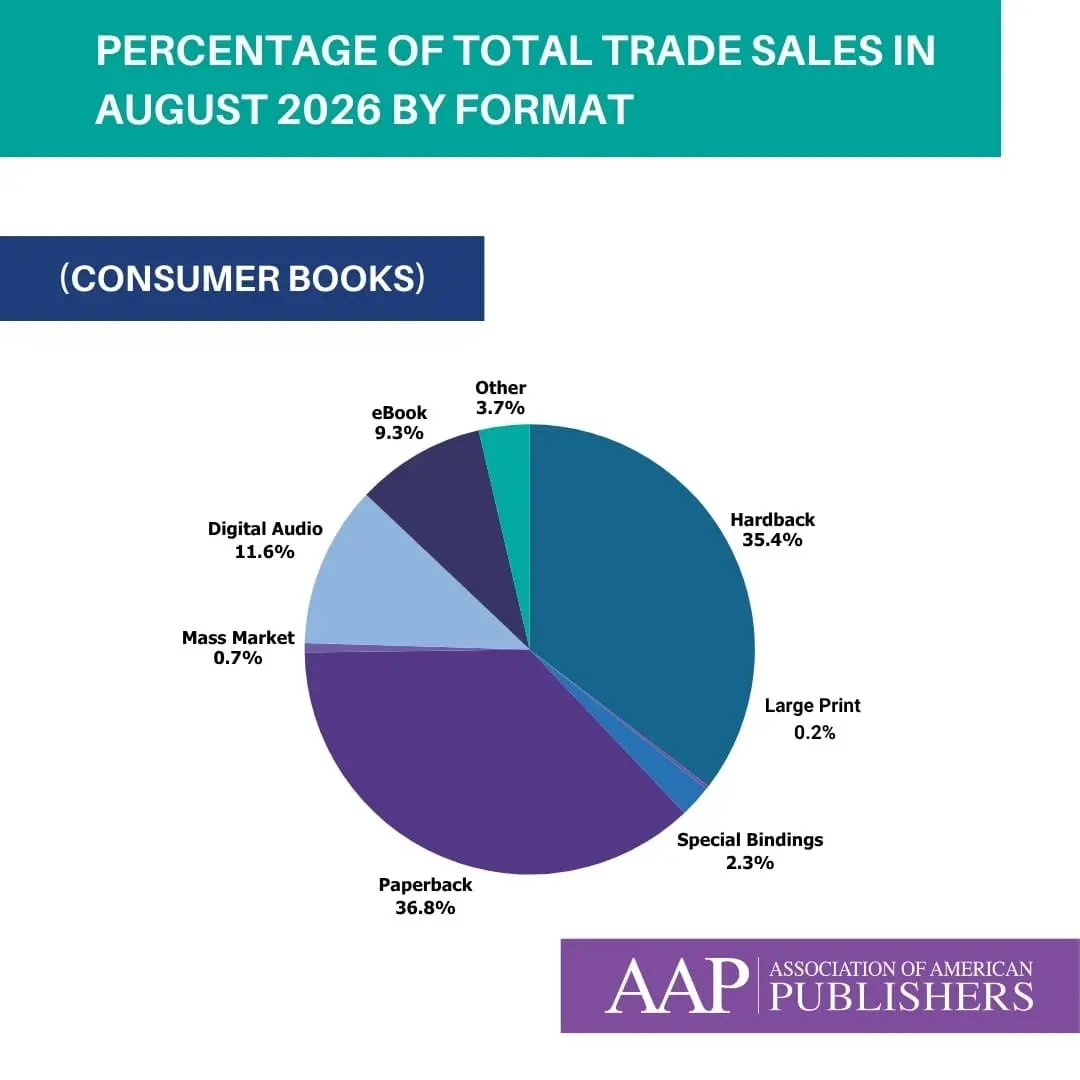
- Digital Audiobooks surged ahead with an impressive 12.6% increase in revenue, bringing in $105.4 million for the month. This performance underscores the enduring consumer preference for ear-read content, fueled by subscription services, smart-device integration, and multitasking lifestyles.
- E-Books, conversely, experienced a contraction. Revenues fell 5.7% to $83.9 million compared to the same period in the previous year. While electronic texts remain a multi-million-dollar pillar of the industry, their monthly decline suggests that readers are increasingly splitting their digital consumption time with spoken-word audio.
- Physical Audio, a legacy format that has long occupied a micro-fraction of the market, fell 35.2%, generating a negligible $400,000.
Physical Print: Hardbacks and Paperbacks Shine
While digital formats capture much of the tech-centric headlines, physical books experienced an extraordinary month of growth in August 2026, defying prognostications of a total digital takeover.
- Paperbacks led the physical charge, surging 17.6% to capture $333.3 million in monthly revenue. Trade paperbacks continue to serve as the sweet spot for fiction and non-fiction buyers alike, offering an optimal balance of affordability and tactile reading satisfaction.
- Hardbacks followed closely behind, registering a 13.8% increase with $320.2 million in revenue. High-profile fiction releases and heavily anticipated non-fiction titles drove strong bookstore traffic and online ordering.
- Special Bindings—which include collector’s editions, sprayed edges, deluxe box sets, and leather-bound classics—climbed 3.7% to $20.4 million.
- Mass Market paperbacks, however, continued their steep historical decline, dropping 14.6% to $6.2 million.
Supporting Context & Metrics: Year-to-Date (YTD) Financials
A single month of data can occasionally be skewed by blockbuster book releases or supply chain anomalies. However, when viewed through a year-to-date (YTD) lens spanning the first eight months of 2026, broader structural trends crystallize with undeniable clarity.
Comprehensive YTD Revenue Table (Jan–Aug 2026)
| Format | August 2026 Revenue | August YoY Change | YTD 2026 Revenue | YTD YoY Change |
|---|---|---|---|---|
| Paperback | $333.3 Million | +17.6% | $2.3 Billion | +11.8% |
| Hardback | $320.2 Million | +13.8% | $2.1 Billion | +3.1% |
| Digital Audio | $105.4 Million | +12.6% | $806.3 Million | +12.6% |
| E-Book | $83.9 Million | -5.7% | $685.1 Million | -3.4% |
| Special Bindings | $20.4 Million | +3.7% | $152.6 Million | +14.5% |
| Mass Market | $6.2 Million | -14.6% | $26.9 Million | -57.2% |
| Physical Audio | $0.4 Million | -35.2% | $3.5 Million | -11.9% |
Analyzing the YTD Metrics
- The Print Dominance: Combined, paperbacks and hardbacks account for the lion’s share of the publishing economy. YTD paperback revenues have climbed 11.8% to reach an astounding $2.3 billion, while hardbacks are up 3.1% to $2.1 billion. This proves that tactile reading experiences are not merely surviving but expanding.
- The Digital Audio Milestone: Digital audiobooks are closing in on the billion-dollar mark for the year, sitting comfortably at $806.3 million (a solid 12.6% YTD growth). At this growth rate, digital audio will decisively eclipse e-books in annual market share, cementing its status as a core pillar of modern publishing revenue.
- The E-Book Correction: E-books have pulled back slightly on a year-to-date basis, dropping 3.4% to $685.1 million. While far from a crisis, this retraction indicates that the post-pandemic digital reading boom has settled into a mature, stable plateau.
- The Death of Mass Market: The most staggering metric in the YTD report is the performance of mass-market paperbacks. Plunging 57.2% to just $26.9 million, this format is rapidly disappearing from retail shelves, as publishers and retailers pivot shelf space toward higher-margin trade paperbacks and specialized editions.
Official Statements and Industry Perspectives
Publishing executives, literary agents, and industry analysts have weighed in on what these shifting figures mean for the broader ecosystem. According to leading trade organizations, the August data reflects a more discerning and diversified consumer base.

"We are witnessing a fascinating bifurcation in how stories are consumed," notes an executive analysis from the Association of American Publishers (AAP) tracking metrics. "Consumers are increasingly curating their media diets. When they want portability and immersion during commutes or chores, they turn to digital audiobooks. When they want an intentional, tactile escape, they are investing in beautifully crafted paperbacks and hardbacks."
Furthermore, the surge in special bindings and trade paperbacks highlights the growing influence of "BookTok" and online reading communities. Younger demographics, in particular, treat physical books not merely as vessels for stories, but as aesthetic lifestyle objects and collectibles. The skyrocketing popularity of special editions—featuring sprayed edges, custom endpapers, and author signatures—has breathed new life into backlist titles and hardback sales alike.
Meanwhile, the slight dip in e-book revenues has prompted strategic internal reviews among digital-first presses. While e-books remain an essential, low-overhead entry point for independent authors and genre fiction, major traditional publishers are realizing that digital readers are shifting their discretionary entertainment budgets toward serialized audio platforms and subscription-based listening models.
Future Outlook: Where is the Publishing Industry Headed?
As the industry looks past the horizon of late 2026 and prepares for the decade’s twilight years, several key trends will dictate publishing strategies:
1. The Consolidation of Audio Investment
With digital audio revenues hovering just below the $1 billion mark YTD, major publishers are aggressively expanding their audio production pipelines. We can expect to see increased investment in full-cast audio productions, immersive soundscapes, and celebrity narrators. Furthermore, artificial intelligence (AI) voice narration trials will continue to be a subject of intense negotiation between publishers, authors, and labor unions as companies seek cost-effective ways to bring backlist and niche titles into the audio format.
2. The Resilient Print Supply Chain
Despite rising paper and manufacturing costs over recent years, the physical book market has proven remarkably elastic. Retailers have adapted by refining inventory management, reducing over-printing of low-tier mass-market titles, and reallocating square footage to high-demand trade paperbacks. This disciplined approach to physical distribution is likely to keep print margins healthy moving forward.
3. The Reimagining of E-Books
To reverse the minor YTD slump, e-book platforms will need to innovate beyond simple text-to-screen conversions. Enhanced e-books featuring integrated multimedia, seamless cross-device syncing with companion audiobooks (Whispersync-style models), and interactive community features may provide the catalyst needed to re-engage digital readers.
Conclusion
The August 2026 publishing metrics serve as a powerful reminder that the book market is not a zero-sum game. Print and digital formats are carving out distinct, sustainable niches that cater to evolving consumer lifestyles. While mass-market formats fade into history, the concurrent booms in trade paperbacks, hardbacks, and digital audio signal a vibrant, adaptive, and financially robust future for the global literary trade.





Comments
Facebook App ID not configured. Please add it in the Customizer.