
Executive Overview
In the contemporary cultural landscape, the genre of horror is too frequently reduced to cheap thrills, predictable jump scares, and standardized cinematic iconography. Yet, in the hands of artist and curator Jill Mulleady, horror emerges as something infinitely more complex, psychological, and pervasive. Running from November 21, 2025, through February 14, 2026, the landmark group exhibition simply titled "Horror" at Sprüth Magers in Los Angeles dismantled conventional definitions of the genre. Rather than anchoring the exhibition to a singular historical moment, medium, or set of visual tropes, Mulleady curated an expansive, atmospheric exploration of human dread, treating horror as a catch-all container for everything humanity fears, represses, and struggles to articulate.
Spanning more than half a century of artistic production, "Horror" brought together paintings, sculptures, photographs, sound recordings, and multimedia installations. The chronological breadth of the exhibition was breathtaking, reaching as far back as the mid-20th-century origins of Surrealism—highlighted by a haunting archival recording of Antonin Artaud—and extending straight through to the present day with contemporary contributions by luminaries such as Anne Imhof, Henry Taylor, and Jordan Wolfson.
Rather than functioning as a didactic thesis-driven display, the exhibition functioned as a meticulously orchestrated "vibe"—an immersive sensory and psychological environment. Within the white cube of Sprüth Magers, visitors were confronted with the visceral realities of body horror, xenophobia, societal abjection, and the quiet terrors of domestic repression. By juxtaposing historical pillars of the grotesque with urgent contemporary interventions, Mulleady established a vital curatorial framework: horror as a vital, cathartic strategy for confronting chaotic, real-world forces that are otherwise too overwhelming to digest directly.
Read Also
Detailed Chronology and Curatorial Architecture
The architecture of "Horror" relied heavily on audacious, cross-generational pairings that dissolved temporal and stylistic boundaries. Mulleady’s curatorial vision refused to adhere to linear art-historical narratives, choosing instead to let works converse across decades through shared emotional wavelengths and psychological tics.
Juxtaposition and Spatial Dialogue
Entering the gallery space felt akin to stepping through the membrane of a collective subconscious. One of the exhibition’s most striking visual pairings placed an enigmatic painting by Andra Ursuta—featuring a mysterious, isolated skeleton suspended within a pulsing, purplish void—directly adjacent to a sculpture by Bruce Conner. Conner’s piece encased a fragile human skull within an ornate, shrine-like setting, instantly bridging the gap between existential dread and sacred ritual.
This thematic friction was maintained throughout the galleries. A vibrant, emotionally heavy painting by Pol Taburet depicting two brown figures lying together in a stark bed was positioned in unsettling proximity to a sculptural work by Precious Okoyomon, which incorporated a historically fraught, racist doll. These pairings did not merely shock the viewer; they forced an active reckoning with the intersections of racial trauma, domestic vulnerability, and historical ghosts.
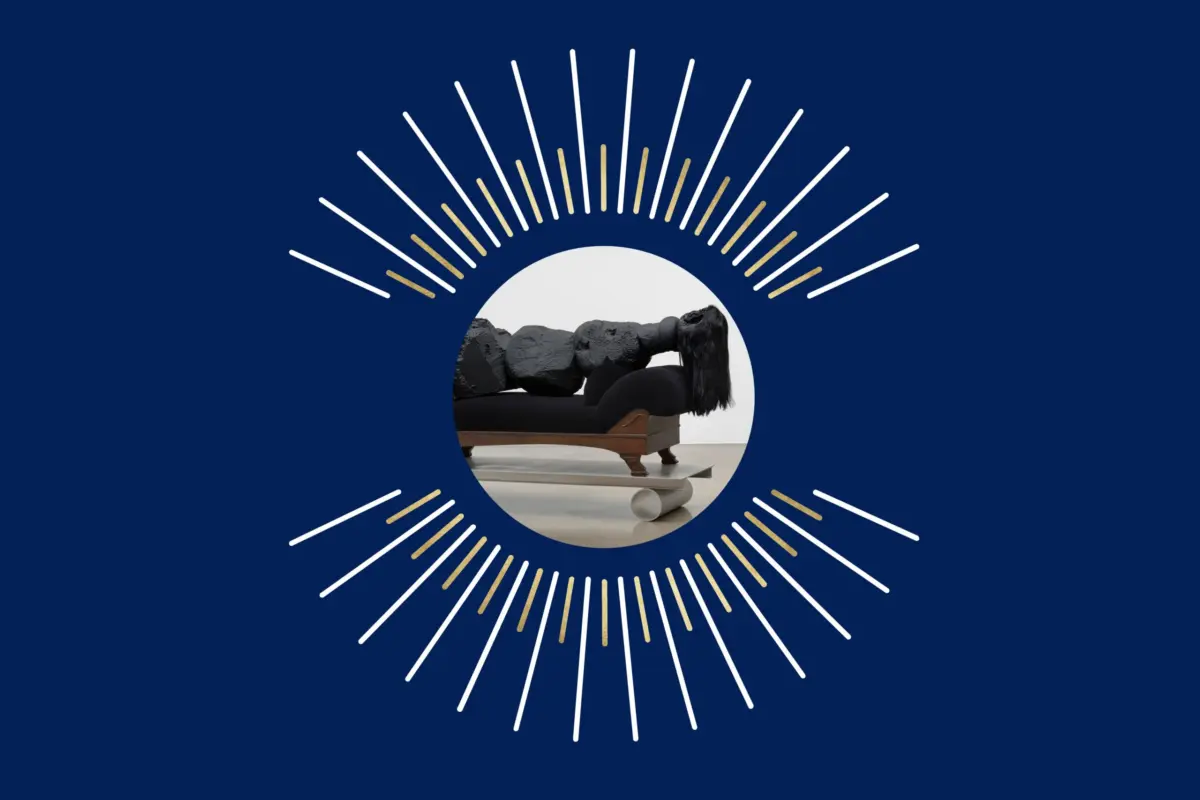
Further deepening the sensory weight of the exhibition was the strategic placement of Mike Kelley’s monumental 1993-era sculpture Odalisque—a hulking, melancholic black mass draped over a traditional divan.
Positioned directly before this heavy, grotesque form was Sondra Perry’s Flesh on Flesh (2021), a digitally rendered video work derived from a high-resolution 3D scan of the artist’s own facial skin. The dialogue between Kelley’s abject, fabric-heavy lump and Perry’s digitized, hyper-proximate flesh interrogated how technology and materiality can equally serve as vessels for bodily alienation.
The Spectral Thread of Historical Avant-Garde
Mulleady’s own artistic practice—known for invoking spectral figures and mystical, uncanny phenomena—informed the spectral spine of the exhibition. By including historical touchstones like the voice of Antonin Artaud, the French avant-garde visionary whose theories of the "Theatre of Cruelty" sought to strip away civilization’s veneer to expose visceral human truths, Mulleady anchored contemporary fears within a century-long lineage of artistic subversion. This historical depth prevented the exhibition from feeling like a trendy, superficial engagement with horror aesthetics, grounding it instead in a serious philosophical inquiry into the nature of human suffering and psychological distress.
Supporting Context & Metrics: The Lodestar of Mike Kelley and The Uncanny
To truly understand the intellectual scaffolding of Mulleady’s "Horror," one must look to its foundational lodestar: the late artist Mike Kelley. Kelley’s monumental 1993 exhibition "The Uncanny"—initially staged at the Stedelijk Museum Bureau Amsterdam and later reconfigured—left an indelible mark on generations of artists dealing with psychological residue, discarded objects, and repressed memories.
In an accompanying curatorial essay for Sprüth Magers, Mulleady explicitly cited Kelley’s exploration of "the unsettling psychological tension created when the familiar is revealed to be disturbingly strange—a repressed domesticity surfacing in unsettling form."
Quantifying the Scope of the Exhibition
- Temporal Span: Over 50 years of artistic production, ranging from mid-century avant-garde audio works to brand-new, site-specific contemporary commissions.
- Medium Diversity: Encompassing paintings, freestanding sculptures, photographic prints, conceptual installations, historical sound recordings, and multi-channel video art.
- Artist Roster: A tightly curated, cross-generational cohort featuring both canonical figures (Mike Kelley, Bruce Conner, Antonin Artaud) and leading contemporary voices (Andra Ursuta, Pol Taburet, Precious Okoyomon, Sondra Perry, Anne Imhof, Henry Taylor, and Jordan Wolfson).
- Exhibition Run: 85 days of public engagement from November 21, 2025, to February 14, 2026, capturing the winter cultural season in Los Angeles.
The exhibition successfully quantified how trauma and fear morph across generations. While 20th-century manifestations of the uncanny often dealt with the psychological fallout of industrialization and institutionalized domesticity, 21st-century contributions in the show—such as Perry’s digital skin mapping and Imhof’s sleek, melancholic framing of contemporary alienation—demonstrated how fear has migrated into the digital ether and systemic sociopolitical structures.
Official Statements and Critical Philosophy
Though "Horror" was remarkably restrained in its political signaling, its curatorial intent was profoundly socio-political in its psychological honesty. Mulleady crafted an environment designed not to lecture, but to liberate through confrontation.
In an interview with Wallpaper, Mulleady articulated the core philosophical driver behind the exhibition, noting that her fascination with horror stems from its capacity to offer "a controlled confrontation with chaos."
"There’s a sense of catharsis that comes through viewing work of this kind," Mulleady explained. She further described the genre as "a strategy to talk about real-life forces that are too hard to digest directly."
This perspective re-frames horror not as a pathology to be avoided, but as an essential coping mechanism. In an era dominated by hyper-connectivity, ecological crises, and political volatility, direct engagement with reality can induce paralysis. Mulleady’s exhibition proposed that art functions as a pressure valve. By funneling systemic dread, bodily decay, and psychological alienation into aesthetic forms, viewers are granted a safe, enclosed arena within which they can stare directly into the abyss—and emerge transformed, if not entirely comforted.
Future Outlook: The 2026 ARTnews Awards Context
Jill Mulleady’s "Horror" arrived during a fiercely competitive period in the international contemporary art calendar, standing out as a masterclass in artist-curated group exhibitions. Its profound conceptual rigor and emotional resonance have positioned it as a bellwether for curatorial excellence, earning widespread critical acclaim and contributing to broader dialogues regarding how contemporary spaces process collective trauma.
As the international art world looks toward the spring and summer exhibition seasons of 2026, Mulleady’s project serves as a standard-bearer among a slate of notable, highly anticipated institutional presentations recognized across the cultural sector. Alongside "Horror," several other curated projects have captured critical attention for their distinct explorations of material, ecology, and human psychology:
- “How Beautiful This Living Thing Is” at Ortuzar, New York (April 22 – May 30, 2026), curated by Andrew Durbin, exploring delicate states of existence and vulnerability.
- “Snake, Turtle, Alligator” at David Peter Francis, New York (January 10 – February 7, 2026), co-organized with Interrobang, delving into primal ecosystems and mythologies.
- “Statics of an Egg” at David Zwirner, New York (May 8 – June 27, 2026), curated by Martin Germann, investigating fragility, balance, and sculptural tension.
- “What We Hold On To” at Black Cube Nomadic Art Museum, Englewood, Colorado (September 5 – December 12, 2025), focusing on site-specific resilience and memory.
These exhibitions, much like Mulleady’s triumph at Sprüth Magers, signal an ongoing curatorial shift away from dry, academic categorization and toward immersive, psychologically resonant environments. As artists increasingly turn to visceral and uncanny aesthetics to make sense of a fractured world, "Horror" will undoubtedly be remembered as a pivotal moment—a dark, necessary mirror held up to the anxieties of our time.
(For further insights into the landscape of contemporary curation and criticism, read more about the 2026 ARTnews Awards.)


Comments
Facebook App ID not configured. Please add it in the Customizer.