In an era of intense media scrutiny, public relations crises, and shifting national identities, modern royal families often turn to high-priced communications strategists to manage their public image. Yet, long before the advent of 24-hour news cycles and digital press offices, European monarchs understood that narrative control was essential to survival.
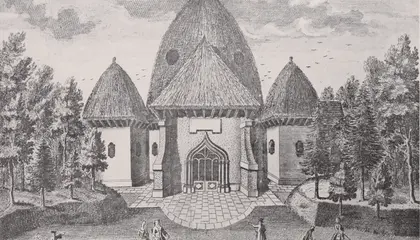
In 1735, Queen Caroline of Brandenburg-Ansbach orchestrated one of the most sophisticated, eccentric, and politically potent public relations campaigns in British history. Faced with the monumental challenge of anchoring a foreign, German-born dynasty into the bedrock of British culture, Caroline bypassed traditional political maneuvering. Instead, she commissioned a fantastical, thatch-roofed grotto in the royal gardens of Richmond known as “Merlin’s Cave.”
Populated with wax figures of the legendary wizard Merlin, historic prophets, and figures from Britain’s distant past, the attraction was ostensibly a garden folly. In reality, it was a high-stakes geopolitical instrument. By invoking the Arthurian mythos, Caroline sought to forge a shared British identity, legitimize the House of Hanover, and quell domestic unrest—proving that royal legitimacy relies less on ancestral bloodlines and more on the cultural stories a sovereign chooses to tell.
Detailed Chronology: The Rise of Hanover and the Birth of Merlin’s Cave
To understand the audacity of Queen Caroline’s 1735 project, one must examine the geopolitical and dynastic precariousness of Great Britain during the early Georgian era.
The 1714 Succession and the Foreign Monarchy Crisis
When Queen Anne died in 1714 without a surviving Protestant heir, the British crown passed under the Act of Settlement 1701 to her closest Protestant relative, George Louis, Elector of Hanover. Ascending the throne as King George I, he inherited a nation deeply fractured by religious schisms, political factionalism, and the lingering threat of civil war.
George I was a German prince who spoke little English and notoriously preferred his native electorate to his new realm. His reign—and that of his son, George II, who took the throne in 1727—was plagued by accusations that the House of Hanover constituted an alien, unsympathetic foreign occupation.
The Jacobite Threat and Domestic Instability
Adding to the monarchy’s vulnerability was the persistent threat of the Jacobites. Supporters of the exiled Stuart dynasty—displaced when the Catholic King James II was deposed during the Glorious Revolution of 1688—viewed the Hanoverians as usurpers. The Jacobites rallied around James Francis Edward Stuart (the "Old Pretender") and launched bloody, albeit ill-fated, uprisings in 1715 and 1719.
By the mid-1730s, the political landscape was further poisoned by a bitter, highly public feud between King George II and his eldest son and heir, Frederick, Prince of Wales. This dynastic fracture threatened to destabilize a nation that had barely begun to recover from decades of internal strife.
1735: The Commission of Merlin’s Cave
It was against this volatile backdrop that Queen Caroline stepped into the vacuum of statecraft. Cultivated in the intellectually vibrant courts of Berlin and Hanover, Caroline possessed a deep appreciation for literature, history, and the arts—qualities notably absent in her husband.
In 1735, Caroline commissioned the landscape architect and painter William Kent to construct Merlin’s Cave on the grounds of Richmond Lodge. Unlike conventional classical temples or monuments typical of 18th-century English landscape gardens, Merlin’s Cave was styled as an ancient, Gothic, thatched grotto. Inside, visitors encountered an elaborate tableau of life-sized wax figures, including Merlin, British queens, and historic seers.
The installation was immediately controversial. Contemporaries struggled to categorize the exhibit, with critics dismissing its inhabitants as “a great many strange puppets.” Yet, beneath the veneer of theatrical oddity lay a brilliant ideological strategy: the wholesale appropriation of Arthurian legend to cement a foreign dynasty’s indigenous credentials.
Supporting Context & Metrics: Myth as Statecraft
Queen Caroline’s deployment of Arthurian iconography represented a radical shift in royal propaganda. Previous English monarchs, such as Henry II and Edward I, had directly appropriated King Arthur as a personal model of martial kingship to legitimize their conquests and rule. Caroline, however, focused her narrative on Merlin—the wizard, genealogist, and visionary interpreter of Britain’s destiny.
The Power of Shared Myth
Unlike the Jacobite claim, which relied strictly on hereditary right and divine lineage, Arthurian legend offered access to something far more unifying: a shared, transcendent British past. Arthur and Merlin belonged to no single reigning house; they were pan-British figures deeply embedded in the national consciousness.
By centering Merlin, Caroline drew a direct line from Britain’s mythical antiquity to the contemporary Hanoverian regime. The grotto visually and conceptually linked the past, present, and future, arguing that the House of Hanover was not an interruption of British history, but its intended destination.
Contemporary Reactions: Satire, Poetry, and Resistance
The political potency of Merlin’s Cave is best measured by the intensity of the backlash it generated. Observers quickly realized that the grotto was not merely an aesthetic whim.
The Call for Reconciliation: Sympathetic intellectuals seized on the installation to promote dynastic healing. In a 1735 poem, Anglo-Welsh writer Jane Brereton interpreted Merlin’s presence as a direct plea for the estranged Prince Frederick to fulfill his filial duties and “perpetuate Brunswick’s race,” thereby securing the Hanoverian succession.
Tory and Opposition Satire: Conversely, the political opposition—including Whig dissidents and Tories—recognized the grotto as aggressive royal propaganda. Nicholas Amhurst, writing under the pseudonym Caleb D’Anvers in the satirical journal The Craftsman, relentlessly mocked Merlin’s Cave as an eccentric absurdity.
Association with Robert Walpole: Opposition writers went further, weaponizing the figure of Merlin against Caroline’s chief political ally, Prime Minister Robert Walpole. As scholar Amanda S. Meixell noted, the wizard inside the cave was frequently caricatured as Walpole himself—a duplicitous “wizard” pulling strings behind the throne.
These fierce counter-attacks underscore a fundamental truth of 18th-century political culture: Caroline’s critics were not confused by the grotto’s messaging; they understood it all too well and sought to undermine its effectiveness through ridicule.
Official Statements & Historical Analysis
While formal press releases did not exist in the 18th century, the intentions and intellectual framework of Queen Caroline’s project can be reconstructed through contemporary correspondence, poetry, and modern historical scholarship.
Historians specializing in British cultural mythologies emphasize that Caroline’s strategy anticipated modern public relations by centuries. In her analysis of the grotto, Dr. Amy Louise Blaney notes that Caroline understood a timeless political reality:
"Legitimacy depends not on inheritance, but on the stories people tell about who belongs to the nation and who should shape its future."
By fusing German dynastic ambitions with Welsh and English Arthurian lore, Caroline effectively rewrote the cultural pedigree of the House of Hanover. She transformed an imported political liability into the rightful heirs of Camelot.
Furthermore, intellectual historians point out that Caroline’s access to the extensive libraries of Berlin and Hanover familiarized her not only with British romance traditions but also with genealogical texts connecting the House of Guelph (the Hanoverian dynasty) to medieval English royalty. Merlin’s Cave was the physical manifestation of this deep historical research, translated into a public-facing spectacle designed to awe and persuade visitors to the Richmond estate.
Future Outlook: The Legacy of Royal PR
Queen Caroline’s 1735 experiment at Richmond Lodge remains a watershed moment in the evolution of political communication. Long before the invention of broadcast media, polling, or image consultants, the queen recognized that cultural artifacts could shape public perception just as effectively as legislation or military force.
As modern monarchies continue to navigate crises of relevance, public trust, and institutional modernization, Caroline’s playbook offers enduring lessons. The challenges faced by the House of Hanover in the 18th century—marked by questions of national identity, generational divides within the family, and deep-seated public skepticism—echo remarkably through the corridors of contemporary constitutional monarchies.
Merlin’s Cave did not survive structurally into the modern era, but its ideological blueprint endures. It stands as a historical testament to the power of narrative management, demonstrating that when a ruling house needs to prove its belonging, it must weave itself into the foundational myths of the nation it serves.

/https://tf-cmsv2-smithsonianmag-media.s3.amazonaws.com/filer_public/13/70/1370f852-7dce-4a95-839d-a51ca90c6d55/merlins-garden.png)
/https://tf-cmsv2-smithsonianmag-media.s3.amazonaws.com/filer_public/13/70/1370f852-7dce-4a95-839d-a51ca90c6d55/merlins-garden.png)
/https://tf-cmsv2-smithsonianmag-media.s3.amazonaws.com/filer_public/f8/0d/f80d2f09-9af7-4c9c-9361-314934fcdd31/caroline-and-george-ii.png)



Comments
Facebook App ID not configured. Please add it in the Customizer.