
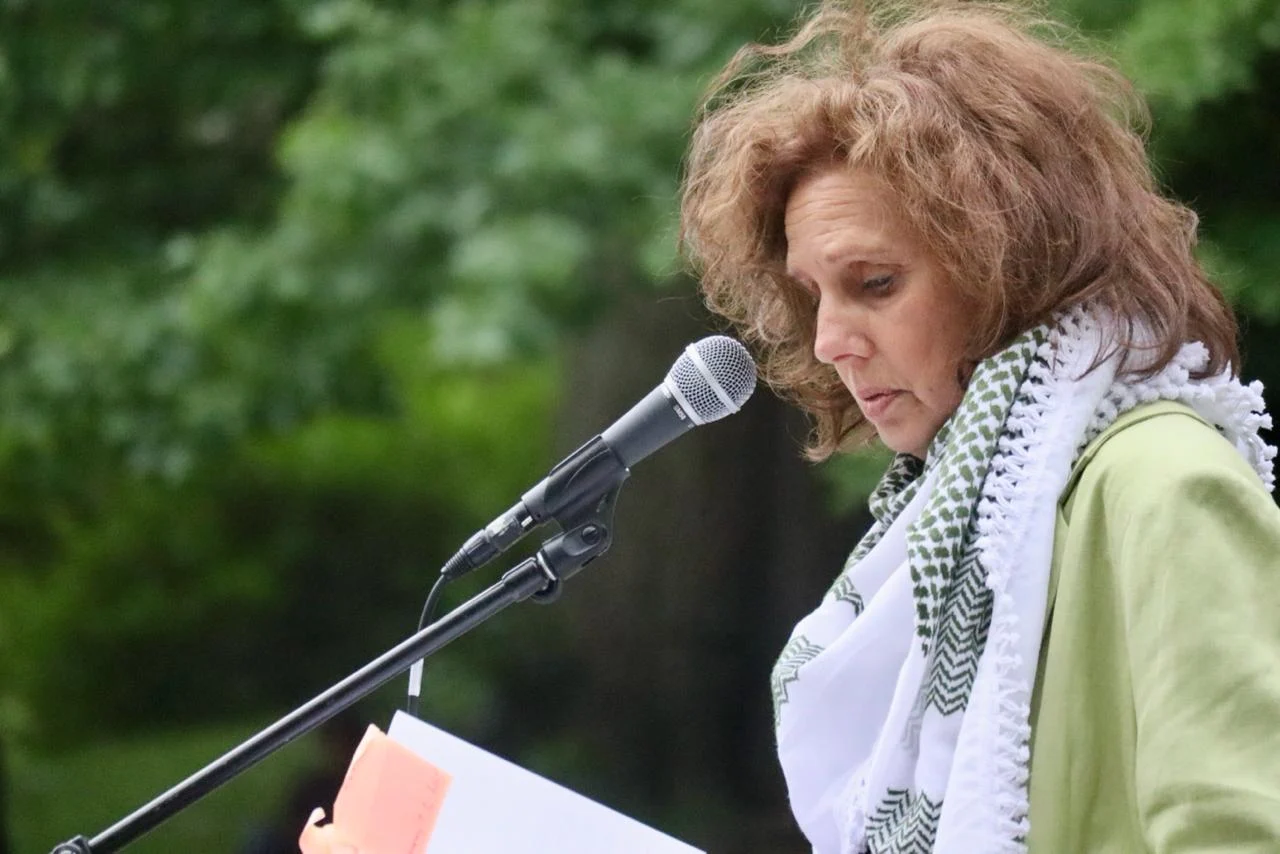
For over five decades, poet, activist, and human rights organizer Kathy Engel has maintained a steadfast position at the intersection of creative expression and political resistance. In a literary landscape often pressured to compartmentalize aesthetic beauty from systemic oppression, Engel has consistently rejected the artificial division between the personal and the political. Her life’s work—spanning anti-nuclear occupations, the co-founding of the international human rights organization MADRE, and decades of poetry dedicated to Palestinian liberation, Indigenous solidarity, and social justice—stands as a living blueprint for artists seeking to enact real-world change.
This comprehensive profile examines Engel’s enduring legacy through an extended conversation with writer Tyler Barton, recorded in July 2025. Tracing her trajectory from an introspective young writer in New York City to a foundational voice in transnational solidarity movements, the article explores how Engel weaves the natural world—horses, trees, oceans, and animals—with unyielding political clarity. Furthermore, it highlights the profound mentorship of literary icons like June Jordan, the professional and personal fallout of radical solidarity, and Engel’s ongoing crusade to dismantle hierarchical barriers in art, activism, and leadership.
Detailed Chronology: Five Decades of Poetry and Resistance
Early Influences and Politicization (1960s–1970s)
Born into a family deeply rooted in education and the arts, Engel’s early development was shaped by an environment that valued social consciousness. Her mother, a social worker turned progressive educator, helped start an experimental school that fostered student-led spaces. Her father, a documentary filmmaker, produced the influential 1973 film Dr. Spock and his Babies, centering on pediatrician Dr. Ben Spock’s radicalization during the Vietnam War. Participating in her father’s work exposed Engel early to the intersection of art and political agitation.
Read Also
Despite writing poetry from a young age, Engel initially viewed her artistic impulses as distinct from organized politics. However, a seismic shift occurred in the late 1970s while she was working as a bookkeeper and program associate at the Academy of American Poets. A phone call from her father inviting her to join an anti-nuclear occupation at the Seabrook Nuclear Power Plant in New Hampshire propelled her into direct-action organizing. Walking among the dusty, bug-infested tents, she encountered poet Denise Levertov reading verse in a circle. The epiphany was immediate: “This is it. This is where it is. These are my people.”
The Watershed of "Moving Towards Home" (1982)
In November 1982, amidst Israel’s second invasion of Lebanon and the horrific massacres of Palestinians at Sabra and Shatila, Engel and fellow organizers—including June Jordan and Kamal Boulatta—orchestrated a landmark poetry benefit at the New York City Society for Ethical Culture. Titled Moving Towards Home, the event aimed to amplify Middle Eastern voices, notably featuring the exiled Palestinian poet Mahmoud Darwish. When Darwish was denied a US entry visa, the organizers refused to let his absence pass in silence, reading a co-authored statement asserting that the poem continues even when the poet is barred.
The evening concluded with June Jordan reading her searing indictment of the Sabra and Shatila massacres. The aftermath, however, brought intense backlash. Right-wing attendees hurled racist attacks at the stage, and sponsor PEN America faced internal turmoil, with certain board members moving to disavow the event. For Engel, then just twenty-five, the fallout included the rupture of her relationship with teacher and mentor Galway Kinnell. Yet, rather than deterring her, the crucible of 1982 solidified her commitment to international solidarity.
Transnational Solidarity and the Birth of MADRE
The momentum generated by Moving Towards Home caught the attention of Michael Ratner at the Center for Constitutional Rights. Seeking to broaden public awareness regarding US-backed Contras kidnapping, raping, and torturing civilians in Nicaragua, Ratner asked Engel, Jordan, and Sara Miles to develop a cultural program.
This collaboration birthed Talking Nicaragua, a dramatic presentation featuring prominent actors such as Susan Sarandon and Giancarlo Esposito. When PBS executives suppressed the recorded broadcast for being too critical of US foreign policy, Engel and her colleagues accepted an invitation to travel to Nicaragua. That 1983 delegation led directly to the founding of MADRE, an international human rights organization dedicated to partnering with women-led movements in global conflict zones. Engel served as MADRE’s Founding Director, channeling her administrative and creative energies into tangible material support for oppressed communities.
Supporting Context & Metrics: Integrating Art, Nature, and Politics
Engel’s literary output—comprising seven poetry collections, including Dear Inheritors and the co-edited anthology We Begin Here: Poems for Palestine and Lebanon—challenges the neoliberal impulse to wall off nature poetry from protest literature. Throughout her career, she has resisted the mandate to censor her political convictions for the sake of marketability or academic comfort.
The Geography of the Page and the Natural World
A defining hallmark of Engel’s work is her insistence on maintaining wonder alongside witness. Whether writing about the systematic erasure of Indigenous children in Canadian "reform" schools or the bureaucratic cruelty of UN vetoes blocking Gaza ceasefires, her poems remain grounded in the sensory details of the natural world: mimosa trees, horses, geese in democratic flight, and the relentless coastal winds of Eastern Long Island.

+-----------------------------------------------------------------------+
                THE PILLARS OF ENGEL'S POETIC PHILOSOPHY
+--------------------------+--------------------------------------------+
| Core Tenet               | Description                                |
+--------------------------+--------------------------------------------+
| Radical Integration      | Refusing to separate nature, family, love, |
|                          | and joy from political resistance.         |
+--------------------------+--------------------------------------------+
| Relational Accountability| Writing about marginalized communities     |
|                          | only through established trust and shared  |
|                          | experience ("It's how you do it").         |
+--------------------------+--------------------------------------------+
| Democratic Interspecies  | Viewing humans as animals capable of       |
|                          | learning democratic rhythms from geese,    |
|                          | horses, and trees.                         |
+--------------------------+--------------------------------------------+
Sustaining the Movement: Daily Rituals Against Burnout
Sustaining a fifty-year trajectory of activism requires active psychological replenishment. Engel maintains a rigorous morning practice designed to counteract despair and ground her in community and ecology:
- Listening and Observation: Spending quiet time near trees and sea, opening windows wide even in winter.
- Releasing Limiting Beliefs: Starting the day by replacing self-critical internal narratives with affirmations.
- The Morning Haiku: Writing a daily haiku, a discipline adopted decades ago from poet Sonia Sanchez.
- Gratitude and Reading: Compiling a gratitude list, engaging in physical running as meditation, and reading works by fellow poets before beginning daily tasks.
Official Statements & Reflections
During her July 2025 interview with Tyler Barton, Engel offered critical insights into the modern state of political discourse, the responsibility of the artist, and the mechanics of solidarity:
-
On the Role of Political Poetry in Contemporary Culture:
"Actually, you should come… because I do want people whose minds are made up to hear a poem they might not know they need to hear, something true, beautiful, and heartbreaking and that makes them feel… To show them it isn’t scary to hear words. To prove persuasion and empathy are still possible."
-
On Moving Past Artificial Separations:
"Who gets some power from that? That domination that says, ‘Put the mind here, and the heart over here.’ English is here, but history is over there… But I think the answer is in the integration."
-
On the Legacy of June Jordan:
"June taught me to believe in my writing… She taught me to read the headlines and then read the article and understand verbs and nouns and accountability, and to read it in terms of power and race and gender… ‘You know, the writer of the article doesn’t get to write the headline,’ she used to remind me."
Future Outlook
As fascist rhetoric and nationalist polarization find renewed prominence across the United States, Kathy Engel’s philosophy offers a vital corrective for contemporary artists and human rights defenders. Rather than looking toward rigid, top-down structures of authority, Engel champions a horizontal model of leadership—one where every individual acts as a spark, a guide, and a contributor to collective liberation.
Her ongoing local organizing—such as the weekly Sunday vigils for Palestinian sovereignty held in Sag Harbor despite targeted harassment—proves that resistance is sustained not merely by grand national campaigns, but by what the late Shinnecock leader Princess Elizabeth Thunderbird Hale termed "small, brave projects." As Engel continues to write, teach, and stand alongside movements for justice, her legacy remains a testament to the fact that while poetry cannot stop a falling bomb, it can refuse to let humanity forget the victims, keeping the blueprint for a just world alive until it is finally realized.


Comments
Facebook App ID not configured. Please add it in the Customizer.