
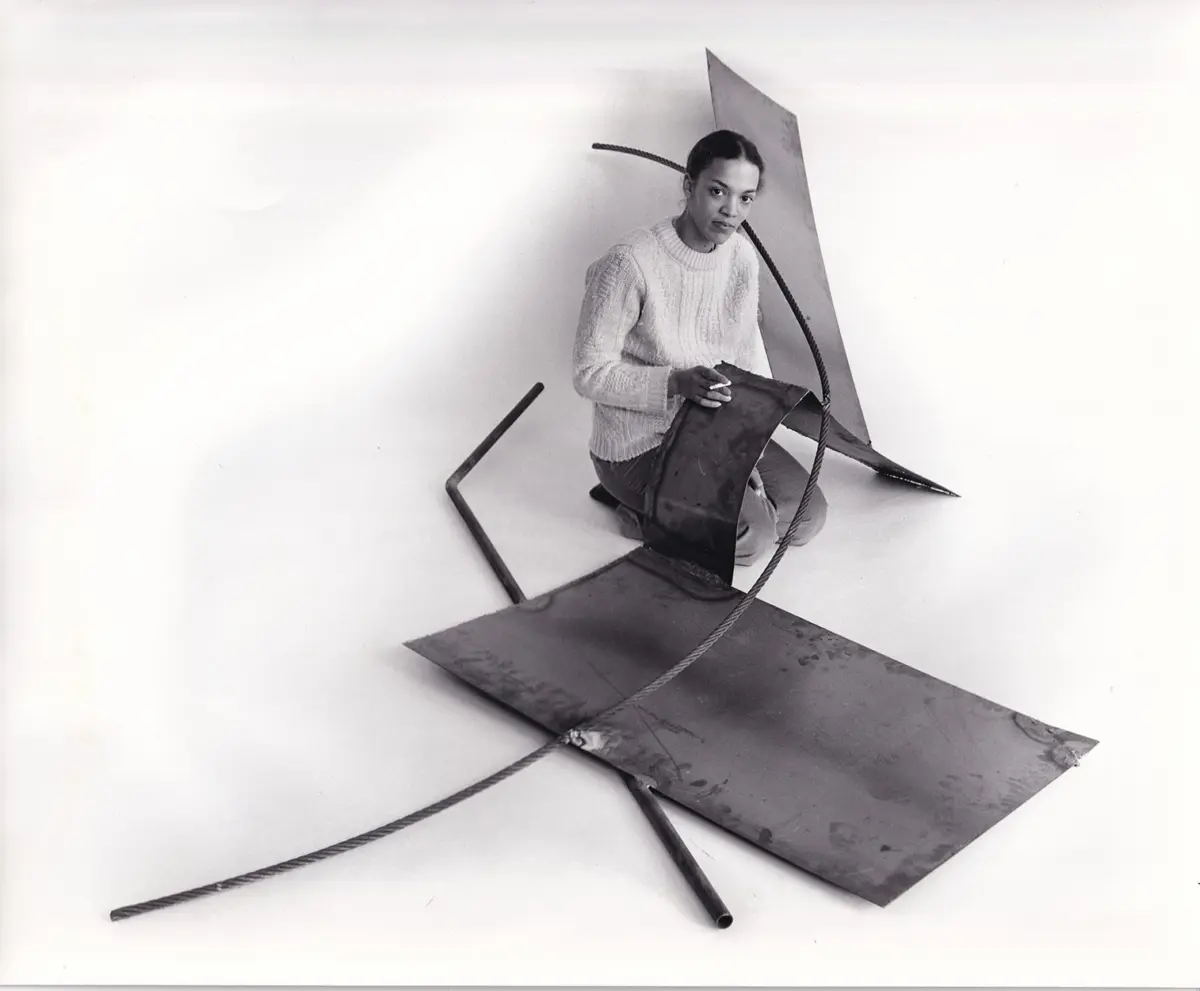
Materiality and Joy of Maren Hassinger
Executive Overview
At the Berkeley Art Museum and Pacific Film Archive (BAMPFA), the retrospective dedicated to artist Maren Hassinger radiates an unexpected warmth. To walk into an exhibition composed largely of gray metal sculptures, industrial cables, and rugged fibers is to anticipate a certain austere industrialism—a cold rigidity inherent to wire ropes that could easily prick the unwary viewer raw. Yet, the galleries pulse with life, vitality, and a deeply human buoyancy.
This unexpected warmth is channeled through multiple vectors: the mural-sized and vitrine-housed photographs of long-term collaborator Adam Avila, which capture Hassinger dancing, beaming, and playfully mirroring her own sculptural forms; and, more profoundly, the artist’s peerless ability to pivot gracefully through the systemic twists and turns of a pioneering career.
Read Also
Born in 1947, Hassinger’s trajectory as a Black woman navigating the predominantly white, male-dominated art world of the 1960s, 70s, and 80s required a delicate balancing act of poetic grace and stark practicality. From being redirected away from dance by institutional rejection to subverting the "boys’ club" dynamics of graduate school sculpture departments, Hassinger forged a singular visual vocabulary. She married traditional craft techniques with heavy industrial materials, transforming shipyard ropes, elevator cables, discarded newspapers, and plastic shopping bags into monumental explorations of movement, lineage, and collective endurance. Co-curated by Margot Norton and Anthony Graham, the BAMPFA exhibition serves not merely as a retrospective of objects, but as a testament to an artist who looks at the world soberly as it is, and imaginatively as it might be.
Detailed Chronology: From Rejected Dancer to Industrial Visionary
The Turning Point: The 1960s and Bennington College
Hassinger’s artistic genesis was rooted fundamentally in motion. In the 1960s, as a student at Bennington College, her primary ambition was dance. However, after facing rejection from the institution’s dance department, a perceptive teacher recognized an underlying spatial and physical intuition and gently pushed her toward sculpture.

“My love of motion,” Hassinger recalls in the exhibition catalog, “carried her from one to the other.” That transition was far from cushioned by a welcoming institutional ecosystem. During her senior thesis critique, she encountered the towering and formidable art critic Clement Greenberg. Remembering him as a man with “the gift of gab, but [who] was a bit of a bully,” Hassinger navigated the critique with the resilience that would become her trademark. Greenberg, unfortunately, would not be the last formidable or hostile man she would encounter in her ascent.
Navigating the UCLA Boys’ Club and the Shift to Fiber
Moving on to graduate studies at the University of California, Los Angeles (UCLA), Hassinger hit another institutional wall. She found the sculpture program entrenched in an exclusionary "boys’ club" mentality, noting that not a single woman was enrolled in the cohort. Seeking a viable path forward, she gravitated toward the fiber department—a familiar trajectory for women artists marginalized in fine art spaces during that era.
“Truthfully,” Hassinger admits candidly in the catalog, “I was just trying to get a degree so I could teach and make art.”
Yet, her impatience with the traditional loom and her disinterest in producing flat fabric led her to venture outward. Exploring the physical world outside the studio, she happened upon a heavy, oil-discolored hemp rope in a shipyard. Experimenting with its physical properties, she unraveled its strands and tied them into loose, giant macré knots. These massive, tactile forms now greet visitors at the entrance of BAMPFA, resting on the floor as if perpetually waiting to be pulled taut.
The Wire Shop Regular and the Elevator Cable Masterpieces
Hassinger’s accidental encounter with industrial rope permanently wedded craft techniques with heavy industrial materials, offering a striking allegory for the shifting nature of labor and women’s work in the late 20th century. She became such a familiar face at a local Los Angeles wire shop that the establishment eventually featured her on the cover of its trade magazine.

Transitioning from hemp to industrial elevator cables—sturdy, twisted cords of wire rope—Hassinger created some of her most definitive works. Among them is Leaning (1980), a masterclass in balance and vulnerability. In this installation, bundles of cables with frayed ends are gathered into approximately two dozen bouquet-like clusters. Only the central arrangement features a flat, stable bottom; the surrounding bundles are left to lean independently, defying rigid structural expectations through mutual, precarious support.
Supporting Context & Metrics: Logistics, Lineage, and Collaboration
Material Economy and Spatial Realities
The challenges of producing monumental sculpture as a student and early-career artist often collided with the realities of physical logistics and real estate. In 1972, Hassinger created River, an ambitious, 2,000-pound rope-chain. Facing the practical impossibility of storing such a behemoth without institutional support or a secure studio space, she ultimately let the piece go, though she thoughtfully preserved it through photographic documentation. Decades later, in 2011, River was meticulously remade for an acquisition by the Studio Museum in Harlem.
This logistical constraint dictated much of her output post-graduation. To bypass storage limitations, Hassinger engineered sculptures designed to be easily coiled and made compact—a resourceful adaptation to urban living and working conditions.
Her process prioritized transparency:
- Amplified Scale: Knots were scaled up so viewers could trace every single twist and turn.
- Active Titles: Her titles consistently utilize verbs—such as Whirling (1978), Walking (1978), and Leaning (1980)—denoting kinetic energy.
- Performative Engagement: As co-curator Margot Norton observed, “When she talks about the work, she moves.”
Studio Z and Guerrilla Tactics in Los Angeles
Hassinger’s career was built on community rather than isolation. “Working alone is so antisocial,” she quips in the catalog.

The turning point in her broader visibility arrived when artist Senga Nengudi encountered Hassinger’s work in 1975. Thrilled to find another Black woman engaging in sculpture and performance, Nengudi initiated a friendship that anchored a legendary creative cohort. Alongside artist David Hammons, Nengudi and Nengudi championed Hassinger to gallerist Linda Goode-Bryant, leading to a seminal exhibition at Just Above Midtown (JAM), where the iconic installation Beach (1980) was showcased.
When traditional institutional doors remained closed to their collective—known as Studio Z—these artists invented their own opportunities. A testament to this guerrilla resilience occurred in 1982 during the opening of the exhibition “Afro-American Abstractions” at the Los Angeles Municipal Art Gallery. Though neither Hassinger, Nengudi, Ulysses Jenkins, nor their peers had been invited to exhibit or perform, they called the gallery and enthusiastically announced: "We are so thrilled to be doing the opening performance!" transforming an administrative oversight into a historic performance art intervention.
Official Statements and Curatorial Insights
The intellectual and emotional architecture of the BAMPFA retrospective is anchored by the insights of its curators, Margot Norton and Anthony Graham, alongside the candid reflections of Hassinger herself. The exhibition successfully bridges the gap between the industrial coldness of her materials and the profound warmth of her personal history.
+-----------------------------------------------------------------+
|                    THEMATIC EVOLUTION AT BAMPFA                 |
+-----------------------------------------------------------------+
|  [Industrial Gray] ---> [Generational Trauma] ---> [Hot Pink Joy] |
|   Wire, Cables,         *Birthright* (Video)        *Love* (2008)  |
|   & Frayed Hemp         Family Roots & Linage       Breath & Notes  |
+-----------------------------------------------------------------+
In the 1990s, when a prolonged lack of studio space temporarily halted her sculptural production, Hassinger turned to video, resulting in the deeply revelatory work Birthright (2005). Onscreen, Hassinger interviews her uncle to uncover the complex, painful threads of her family tree. She learns that her grandmother, Puddin, was born of an incestuous and interracial affair; her great-grandparents were unknowingly nephew and aunt. Upon discovery, Puddin was given away to a former enslaved plantation caretaker, and her father was lynched by a white mob.
Hassinger’s father, deeply traumatized by abandonment, struggled to relate to women, ultimately cutting the artist out of his will. “My legacy was to feel unloved,” Hassinger concludes in the video.

Yet, the exhibition refuses to dwell solely on generational trauma. Installed immediately adjacent to Birthright is Love (2008/2026). Here, halfway through the retrospective, the austere galleries of gray metal give way to an immersive explosion of hot pink. Plastic shopping bags, inflated with human breath and inscribed with love notes, completely cover the walls.
Viewed through this lens, Hassinger’s iconic knots and frayed ropes transcend industrial abstraction; they transform into metaphorical umbilical cords—severed, weathered, yet capable of reconnection. History is undeniably heavy, but under Hassinger’s touch, it never weighs the work down.
Future Outlook: Legacy, Endurance, and Vision
As Maren Hassinger’s retrospective at BAMPFA travels and secures her legacy within the canon of contemporary art, her methodologies offer a vital blueprint for future generations. She demonstrates that institutional barriers, gender disparities, and economic constraints do not have to stifle creative output; rather, they can be met with profound resourcefulness, humor, and collective solidarity.
Whether she is transforming cheap, discarded newspapers into cascading 2008 installations—a material she notes is “very handy and cheap” while laughing at the catharsis of ripping headlines—or repurposing litter into monuments of affection, Hassinger’s practice remains timeless.
Her ability to seamlessly blend the sober realities of historical struggle with the imaginative possibilities of movement and sculpture ensures that her work will continue to challenge, comfort, and inspire. Maren Hassinger remains an artist who looks at the world as it is, and through sheer grit, grace, and community, reimagines it into something radiant.


Comments
Facebook App ID not configured. Please add it in the Customizer.