For the past two editions of the Aspen Art Museum’s ambitious AIR (Artist-in-Residence) festival in Colorado, renowned multimedia and performance artist Matthew Barney has woven a complex, highly localized narrative into the rugged topography of the Rocky Mountains. Following his abstract musical revue TACTICAL Parallax—staged last year within a historic military drill hall repurposed as a cattle barn at McCabe Ranch—Barney returned this summer with a permanent-scale sculptural installation: ZONE DEFENSE: Old Snowmass Parallax.
Exhibited on an open tract of land in Old Snowmass and accessible to visitors through the summer upon request, this new work represents a structural synthesis of Barney’s recent major cinematic and sculptural undertakings, specifically Redoubt (2019) and Secondary (2023). Where Redoubt engaged with the alchemical, pioneering spirits of the American West and the ecological ripple effects of wolf reintroduction, Secondary examined the raw violence, architectural choreography, and systemic tragedies of American football—focusing particularly on the infamous 1978 on-field collision between Oakland Raiders safety Jack Tatum and New England Patriots wide receiver Darryl Stingley that left Stingley paralyzed.
In ZONE DEFENSE, Barney merges these disparate thematic threads into a monumental piece of outdoor sculpture that employs trompe l’œil painting, cast metals, and diagrammatic land art. During a transit from Aspen to the installation site in Snowmass, Barney offered a rare, extended look into his creative processes, the friction of working within private Western property lines, and his ongoing exploration of what occurs when conflicting narratives and materials collide.
The genesis of Barney’s dialogue with the Aspen area dates back to his invitation to create a site-specific live work for the AIR festival. Presented with the historic drill hall at McCabe Ranch, Barney immediately recognized the architectural specificity of the structure. Originally hailing from the Camp Hale military base—a prominent World War II training site dismantled after the war and piece-meal distributed or auctioned off across the region—the hall’s military lineage offered an immediate conceptual bridge to his existing body of work.
Phase 1: TACTICAL Parallax (2025)
Given a compressed timeline for development, Barney chose to mine existing material, collaborating with frequent composer and sound designer Jonathan Bepler to construct TACTICAL Parallax. Operating much like a musical revue or a medley, the live performance collided narratives from Redoubt and Secondary.
The performance leveraged the concept of the "cut" in music—the jarring, energetic moment when a composition shifts abruptly from one source to another. Within the cavernous former drill hall (which doubles as a working calving barn, complete with newborn cattle during site visits), performers utilized makeshift structural props, including a flexible, white PVC "zone tool." When abandoned by the performers, this structure possessed a theatrical volatility, teetering on the edge of collapse.
Phase 2: ZONE DEFENSE: Old Snowmass Parallax (2026)
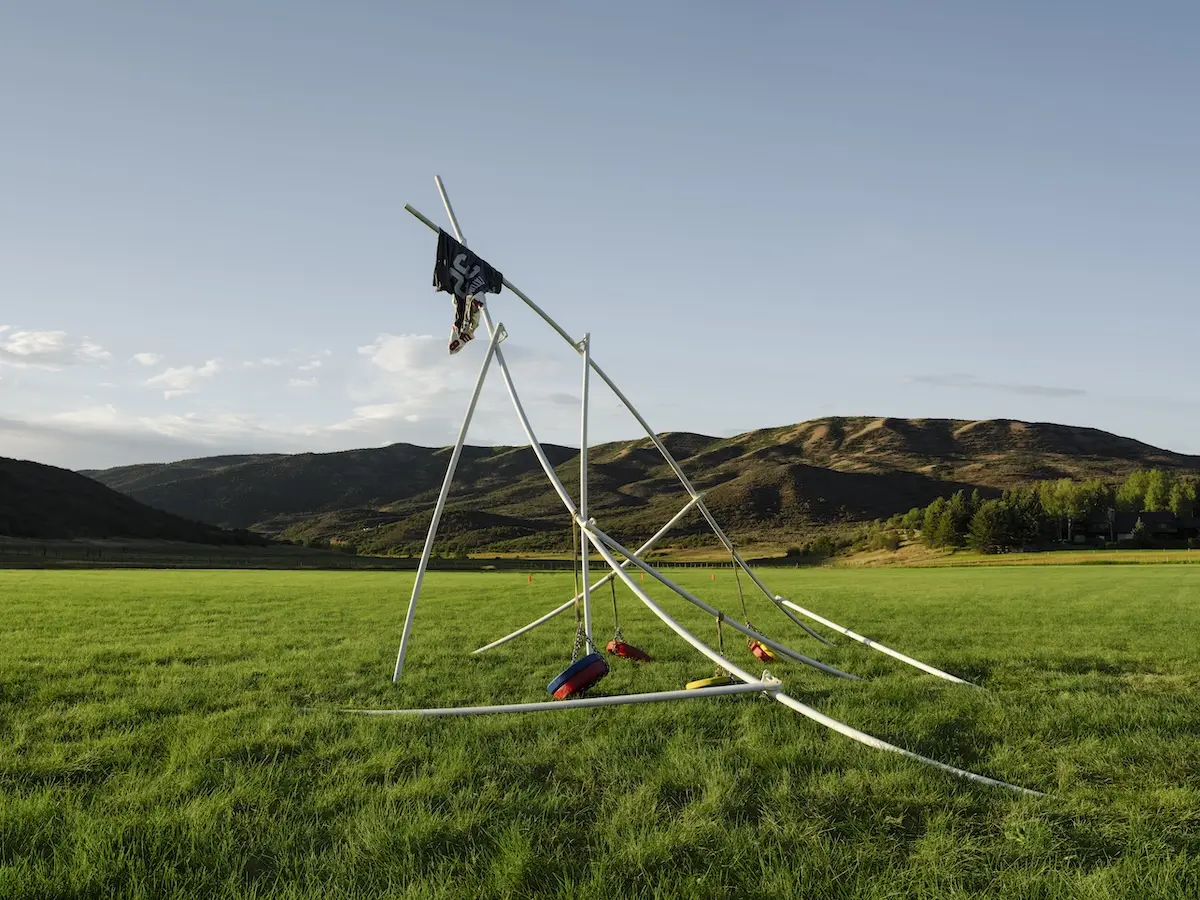
Transitioning from the ephemeral performance to permanent sculpture, Barney debuted ZONE DEFENSE at the AIR festival in July. Formally anchored by a vertical standing frame that mirrors the choreography of the previous year’s live event, the sculpture replaces the original’s flexible PVC piping with rigid, illusionistic materials.
The installation is meticulously mapped onto an exact rectangular footprint of an American football field. However, rather than functioning merely as a sports memorial, the perimeter and field are intersected by orange end-zone markers. When mapped topographically, these markers trace the exact diagonal lines of the "parallax" structure drawn during the 2025 performance, scaling up the ephemeral floor drawing into a monumental landscape intervention.
Supporting Context & Metrics: Materiality, Illusion, and Western Friction
The Illusion of Weight and Modernist Echoes
At first glance, ZONE DEFENSE appears constructed from standard industrial training gear and athletic equipment. A closer inspection, however, reveals a sophisticated exercise in material transubstantiation and trompe l’œil:
The Supporting Structure: The lower vertical skeleton is fabricated not from painted plastic, but from heavy stainless steel treated with precision trompe l’œil paint.
The "Gym Weights": Resting at the base of the structure are heavy Olympic bumper plates. Complete with the illusionistic white residue of hand powder used by bodybuilders, these weights are actually crafted from solid bronze and painted in vivid primary colors—red (45 lbs), blue (35 lbs), and yellow (25 lbs). This palette simultaneously nods to the strict standards of Olympic weightlifting and the formal legacy of Modernist art, evoking what Barney describes as a "failed Calder" or a collapsed piece of Modernist sculpture.
The Draped Jerseys: Crowning the structure are two draped football jerseys cast in aluminum. Acting as a lightweight counter-balance to the bronze weights below, these metallic garments serve as a memorial to Darryl Stingley and Jack Tatum, cementing the historical weight of Secondary into the Aspen topography.
The Politics of Territory and Property in the West
Installing a work of contemporary art on open land in the American West inevitably courts friction. Barney noted a distinct shift in the demeanor of local ranchers and landowners during the installation process. While initial visits were marked by casual curiosity about the unfolding art project, the mood altered the moment survey stakes were driven into the ground to map the football field’s end zones.
Local inquiries shifted from polite interest to defensive suspicion: What are you doing? Why are you marking territory the way you would if you were building a house?
This real-world tension directly mirrors the thematic undercurrents of Redoubt and TACTICAL Parallax. The reintroduction of wolves into Idaho (the setting for Redoubt) and, more recently, into Colorado, triggers identical societal fault lines. It exposes an ongoing ideological war between ecological conservationists and livestock-raising ranchers—a perpetual debate over land use, property rights, and who holds dominion over the American wilderness.
Official Statements & Artist Insights
Reflecting on his methodology during the transit between Aspen and Snowmass, Barney emphasized his fascination with alchemical combinations—the intentional collision of unlike elements to trigger a chemical or conceptual reaction:
"I’m interested in aspects of alchemy, where you put two unlike things together and create a compound. You can create a third space somehow, and the more reactive the two elements are, the more potential there is to create a change… I tend to think about storytelling that way, and I create structures within stories that are made from combining unlike materials and elements."
Discussing the unusual integration of trompe l’œil painting into his sculptural practice—a technique largely absent from his previous material-driven works—Barney noted its alignment with his drawing practice:
"This piece is very diagrammatic. I think of it as an aerial view of what’s happening with the end-zone markers and the parallax, and how the object exists in the intersection… Knowing that the entire thing was going to be painted, it was a more practical set of choices about weight and knowing that it would be outside."
Barney also reflected on the unexpected cross-cultural dialogues sparked by placing contemporary art in rural ranching country:
"I feel a familiarity with the sensibility out here, and I’m really interested in the way the landscape pushes back onto what you’re doing. Along with that comes unexpected conversations with people who aren’t necessarily engaged with this aspect of culture, and I enjoy that."
Future Outlook
As ZONE DEFENSE: Old Snowmass Parallax concludes its summer residency on the open land of Old Snowmass—where it remains viewable to the public by request—questions naturally turn to the future life of the installation.
Unlike site-specific earthworks designed to permanently erode into the landscape, Barney’s constructed sculptures carry portability within their conceptual DNA. Looking ahead, the artist has expressed a clear desire to exhibit the work within an indoor architectural envelope:
"One thing I would say is that I’m definitely looking forward to installing it inside. I think the way it feels within the compression of architecture is really exciting. It is definitely different. What I said before about the weights being a primary part of it is even more true inside, where you can feel the point of contact between the weights and the ground, rather than here on grass. It gives the piece a sense of touch, from an absent hand."
Whether housed within the white cube of a museum or left to weather against the unforgiving backdrop of the Rocky Mountains, ZONE DEFENSE stands as a testament to Matthew Barney’s restless ability to translate athletic choreography, historical trauma, and the political geography of the American West into enduring, physical poetry.




Comments
Facebook App ID not configured. Please add it in the Customizer.