By the Literary Desk Published in coordination with archival reviews from the August 24, 2026, issue of Publishers Weekly
Executive Overview
The contemporary literary landscape is undergoing a quiet, profound structural shift. For decades, the traditional publishing establishment—governed by corporate boardrooms, risk-averse marketing models, and centralized distribution channels—acted as the primary gatekeeper for narrative fiction. Today, however, the indie publishing movement has matured into a dynamic, highly professionalized ecosystem. No longer viewed as a fallback option for rejected manuscripts, independent publishing has become a vibrant incubator for bold, idiosyncratic, and deeply personal storytelling that often defies commercial categorization.
This evolution is driven by advances in digital production, global distribution platforms, and a growing community of readers actively hunting for originality. In this feature, we turn our lens toward a carefully curated cohort of recent independent releases spanning Middle Grade, Young Adult, Fantasy, and Science Fiction. Behind each of these titles lies an extraordinary narrative of perseverance: books born from bedtime stories whispered to children, decades-old familial collaborations, profound personal grief, academic research, and deep-seated cultural reflections.
By exploring the author statements and genesis stories behind these standout works, we uncover the heartbeat of modern indie publishing—a space where risk is embraced, authenticity is non-negotiable, and the creative bond between author and reader remains unmediated and raw.
Detailed Chronology: From First Spark to Final Publication
The journey of an independent book is rarely a straight line from outline to marketplace. Without the rigid milestone schedules imposed by traditional publishing houses, indie authors often spend years—sometimes decades—shepherding a manuscript through iterations, personal trials, and world-building evolutions. Examining the timelines of these recent releases reveals the intense labor of love required to bring an independent vision to light.
The Seven-Year Odyssey of Gathering Storms
For Lucas Fischhaber, author of the Middle Grade adventure Gathering Storms, the book’s origin traces back to a single cold night in January 2018. What began as an improvised bedtime story told to his children evolved into a seven-year commitment. Recognizing the potential of the narrative, Fischhaber sat down at his computer not to write a commercial blockbuster, but simply to preserve a few fleeting ideas.
Those ideas blossomed into a sprawling world, rewritten across three major versions. Crucially, the writing process became a family affair. Fischhaber collaborated closely with his wife to refine the world-building, while his three children—who directly inspired the novel’s animal tamer, craftsman, and wilderness ranger archetypes—literally grew up alongside the story. The resulting book is a testament to art imitating life, capturing the exact cadence of childhood imagination.
A Legacy Interrupted and Renewed: The Tree of Ticket Leaves
Perhaps no timeline in this cohort is as poignant as that of The Tree of Ticket Leaves, a middle grade fantasy co-authored by Larry Good and his daughter, Meredith Good. The project’s roots stretch back decades to Nottoway County, Virginia, where Larry—now 86 years old—was born, raised, and still resides. Balancing a demanding life as an English teacher, librarian, and family man, Larry quietly chipped away at a middle grade fantasy novel.
Decades later, the project found a second wind through crisis and caretaking. Meredith found herself at home, taking care of her mother, unable to work, and desperately in need of a mental distraction. Spotting her father’s dusty manuscript, she wiped away the years and dove in. Over several months of intensive collaboration, the father-daughter duo executed a complex editorial dance—making strategic adjustments, heavy subtractions, and surprising additions—to forge the final, collaborative version of The Tree of Ticket Leaves.
Academic Thresholds and Speculative Noir: New Stanton
In the realm of speculative fiction, Maxwell Vagus’s New Stanton showcases a timeline stretching across more than a decade. The noir fantasy originally materialized during the frenzy of National Novel Writing Month (NaNoWriMo) in 2014. What emerged was a 50,000-word block of spontaneous prose, fueled by a desire to craft a small-town narrative imbued with an otherworldly, strange glow.
For years, the project sat dormant. Vagus eventually returned to the manuscript, layering in sophisticated world-building, nuanced character arcs, and complex plot elements. The multi-year incubation period culminated not just in commercial publication, but as Vagus’s Master of Fine Arts (MFA) thesis in 2025—bridging the gap between raw indie creativity and rigorous academic achievement.
Supporting Context & Metrics: Genres, Themes, and Inspirations
To truly understand the contemporary indie landscape, one must analyze the thematic currents and environmental catalysts that shape these books. Far from operating in a vacuum, these independent authors draw heavily on lived experiences, global travels, scientific inquiry, and cultural heritage.
Folklore, Childhood Summers, and Cultural Roots
Several titles in this wave lean heavily into cultural memory and folklore. In Into the Kryvolis Forest, author L. Kharkiv utilizes verse and illustration to transport readers into a high-stakes journey through Ukrainian folklore. The book’s premise—two children, Bronas and Solomiya, fleeing monsters and racing a 13-day countdown before the forest turns them into beasts—is rooted deeply in Kharkiv’s own biography. Spending childhood summers with grandparents in a tiny Ukrainian village imbued the author with a lasting sense of wonder, directly channeling the magic of those woods and grandmotherly storytelling into the page.
Similarly, Jasmine Kah Yan Loo’s Reigning Fire tackles complex identity politics through an ancient Chinese-inspired fantasy lens. As a neurodivergent author of Chinese heritage, Loo deliberately chose to frame neurodivergence without modern diagnostic terminology. Through the metaphor of "Emberkin," the protagonist Xun experiences profound differences in a world with rigid unspoken rules. The book uses fantasy to explore historical erasure, trauma, and identity, proving that speculative fiction is uniquely suited to illuminate real-world neurodivergent experiences.
Expanding the scope of cross-cultural storytelling, Peter Man’s Unconquered follows Victoria, a Chinese Canadian girl adopted from infancy in small-town Ontario, as she embarks on a geographic and spiritual odyssey to China. Discovering that her lineage traces back to a Shang dynasty warrior mother and a Qin dynasty nomadic chief, Victoria must shoulder the fate of humanity. Man draws directly from his identity as a Chinese Canadian author, grounding grand fantasy tropes in real people, historical realities, and personal heritage.
Grief, Science, and Philosophical Inquiry
Science fiction and speculative fantasy within the indie community frequently serve as vehicles for processing profound emotional trauma and existential philosophy.
Giancarlo Roversi’s dystopian trilogy opener, Pulstar I: The Swan Barely Remembers, was born directly out of personal tragedy. In 2014, Roversi’s life shattered when his wife passed away. Seeking an intellectual and emotional framework to understand life, death, and humanity’s place in the cosmos, he began writing the Pulstar series—even composing a custom soundtrack for each volume. The books function not merely as entertainment, but as an urgent philosophical warning about the extreme fragility of societal balance.
In a similar vein, Charles Frederick Streckfus approaches existential themes through the lens of professional medical experience. As a cancer researcher deeply familiar with patient struggles at life-and-death crossroads, Streckfus penned The Voyager. The novel follows an astronaut who dies in space, only to be resurrected by alien inhabitants who find his vessel drifting in orbit. Streckfus uses this high-concept premise to explore a profoundly human psychological question: How does an individual cope with a new lease on life while carrying the psychological weight of their prior existence?
Official Statements: In the Authors’ Own Words
The direct voice of the creator is the cornerstone of the independent publishing community. Below, we curate the unedited reflections of these authors as they describe the intimate inspirations, creative frictions, and emotional breakthroughs behind their works.
Lucas Fischhaber (Gathering Storms): "I never expected a bedtime story to become more than seven years of my life. One cold night in January 2018, after telling my children one of our improvised adventures, I sat down at the computer intending to preserve a few ideas. Since then, I have rewritten the novel through three major versions, spent countless hours building its world and writing with my wife, and watched the three children—who inspired its animal tamer, craftsman, and wilderness ranger—grow alongside the story."
L. Kharkiv (Into the Kryvolis Forest): "Into the Kryvolis Forest is an illustrated middle grade novel in verse set in the world of Ukrainian folklore. After their home is invaded by monsters, Bronas and Solomiya must cross the treacherous woods to a magical village. They have 13 days to get to safety, before the Kryvolis Forest claims them and turns them into one of its beasts. I spent all of my childhood summers with my grandparents in a tiny Ukrainian village. The magic I found in those woods and fields, and the stories my grandmother shared about her life, now provide endless inspiration for my work."
Meredith Good (The Tree of Ticket Leaves, co-authored with Larry Good): "My father, Larry Good, is 86 years old and was born, raised, and still resides in Nottoway County, Virginia. In between working as an English teacher and librarian, and raising a family, he began writing a middle grade fantasy novel. Fast forward several decades and I found myself sitting at home, taking care of my mother, unable to work, and in great need of distraction. So, one day I picked up my father’s book, wiped the dust off, and decided to see what I could accomplish. After a few months, with several adjustments, a lot of subtraction, and a surprising amount of addition, our collaborative version of The Tree of Ticket Leaves emerged."
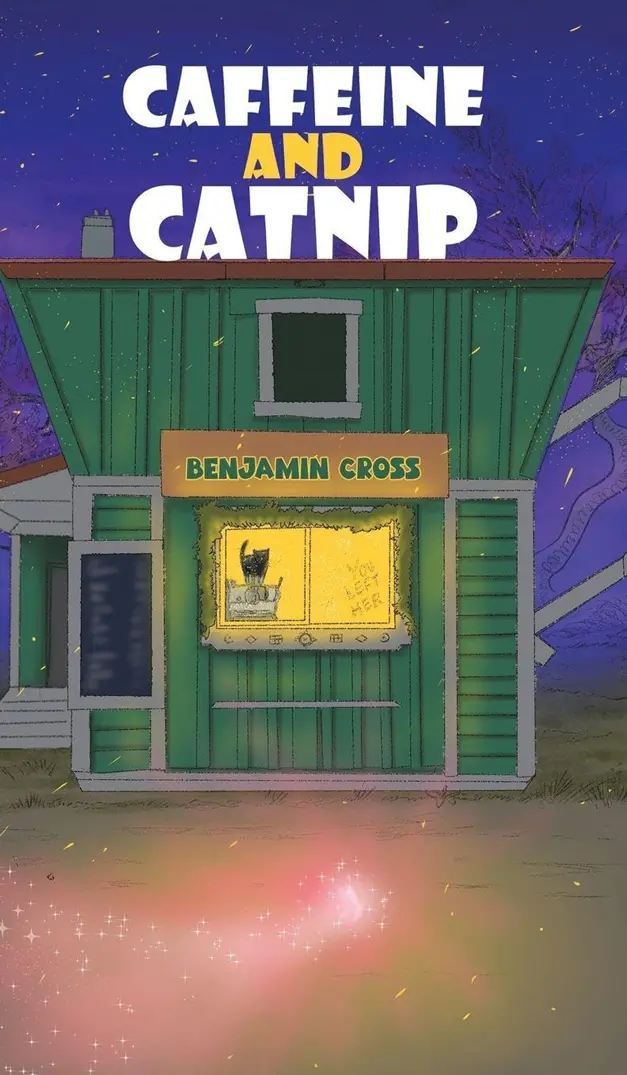
Benjamin Cross (Caffeine and Catnip): "Madison Moss thought inheriting her aunt’s cozy coffee shop would mean a quiet life in Happy Valley. Instead, she’s juggling enchanted espresso machines, a talking cat with attitude, and a winged sprite whose caffeine habit should probably be illegal. I wanted to write about inheritance, not just magic passed down, but the secrets and silences families use to protect the people they love, and what happens when those silences finally break."
Robert Walton (Chaos Gate): "I’m a great fan of Candide. I freely admit that Voltaire’s picaresque tale inspired Chaos Gate’s ever-escalating series of fantastical encounters. Unlike Candide, however, main protagonist Claire learns and grows through her experiences. Magic and monsters abound, but Claire’s path to healing gives purpose to all the action. I intended Chaos Gate to be a fantasy romp, but a romp with substance—friendship, humor, courage."
Barbara J. Moritsch (Lion Time): "Lion Time is a novel of Kenya that features telepathic communication with animals, time-travel, and a unique type of shape-shifting. This is my second book in the series Oracle of the Wild, after Wolf Time. The two books share the main protagonist, Sage McAllister. The idea for Lion Time came during a visit to Kenya’s Maasai Mara National Reserve, when a well-loved wild lion named Scarface approached our vehicle and gave me a good long look, telling me without words that lions needed help."
Jasmine Kah Yan Loo (Reigning Fire): "As a neurodivergent author of Chinese heritage, I wanted to write an ancient Chinese-inspired fantasy in which neurodivergence exists without modern diagnostic language: Xun simply experiences herself as fundamentally different in a world whose unspoken rules seem to come naturally to everyone else. Fantasy offered a way to depict that experience through the metaphor of Emberkin, while exploring identity, trauma, historical erasure, and the dangerous comfort of believing what we have always been told."
Maxwell Vagus (New Stanton): "New Stanton is a speculative noir fantasy told through the eyes of Mister Harold Dean, a shady alcoholic, who wakes up in a town that doesn’t exist, and his only means of escape is his missing 1964 Chevy Malibu. The origins of New Stanton are many and varied. It first came together as a NaNoWriMo project in 2014… After many years, I returned to the project, adding to it, layering in new ideas, characters, and plot elements, and finally completing it as my MFA thesis in 2025."
C.J. Ilex (Model 36): "I started Model 36 about six years ago, watching a science program about planck length, the smallest possible distance in the universe. Nothing can be smaller; two things can’t be closer together than that. It struck me that this sounded like a constraint you’d build into a simulation. The idea of twin sister characters, with one disappearing, came quickly after that. Then it took years before I knuckled down and got disciplined."
Giancarlo Roversi (Pulstar I: The Swan Barely Remembers): "In 2014, my life shattered when my wife passed away. So I wrote for her a dystopian science fiction trilogy called Pulstar, trying to understand life, death, and our place in the cosmos. I also composed a soundtrack for each book… The balance of society is so fragile that a single thing can shatter it. So Pulstar is also a reflection, a warning of what could happen if we don’t change and evolve."
Charles Frederick Streckfus (The Voyager): "The story is about an astronaut that dies in his spaceship, and in his death throes, he slumps forward and activates the vessel’s engine… The inhabitants, finding him deceased, resurrect him. I am a cancer researcher and I’m very knowledgeable about patient struggles with life-and-death situations. Consequently, I wanted to create a story of how an individual would cope with a new ‘lease on life’ while retaining the memories of his prior existence."
Peter Man (Unconquered): "As a Chinese Canadian author, I try to share my stories based on real people, actual places, and personal experiences. Unconquered is about a Chinese Canadian girl from a small town in southern Ontario… Victoria further learns that she is the only person who can stop humanity’s inexorable descent into darkness."
Future Outlook: The Maturation of Independent Literature
As we look toward the horizon of the publishing industry, the trajectory of independent releases outlined here points to an undeniable conclusion: indie publishing has become an indispensable pillar of literary innovation.
Where corporate publishing houses are frequently bound by market trends, homogenized formulas, and demographic risk analyses, independent authors operate with absolute creative sovereignty. They are free to explore planck lengths and quantum simulations (Model 36), blend cozy coffee-shop settings with snarky talking cats and high-stakes family secrets (Caffeine and Catnip), or channel the direct gaze of a wild African lion into an ecological epic (Lion Time).
The market response indicates that readers are hungry for this unvarnished authenticity. The success stories highlighted in this survey—ranging from multi-generational family collaborations in Virginia to academic theses born from NaNoWriMo drafts—demonstrate that quality, emotional resonance, and narrative ambition are no longer the exclusive domain of traditional New York publishing houses.
As digital tools continue to democratize production and global distribution networks expand, the indie space will undoubtedly remain the most exciting frontier in modern letters. For readers willing to look beyond the bestseller lists curated by corporate giants, the independent renaissance offers a treasure trove of bold, fearless, and deeply human stories waiting to be discovered.








Comments
Facebook App ID not configured. Please add it in the Customizer.