
Executive Overview
As the United States stumbles into its semiquincentennial—the 250th anniversary of the signing ofතික the Declaration of Independence—the cultural and political landscape bears little resemblance to the bombastic, ubiquitous pageantry that marked the 1976 Bicentennial. Back then, America was emerging from the crucible of the Vietnam War and the constitutional trauma of Watergate, desperate to stitch its fraying national identity back together through traveling history trains, localized community festivals, and an onslaught of patriotic merchandise. Today’s milestone, by contrast, is defined not by mass-marketed reconciliation, but by a brittle, aggressive ethno-nationalism.
This investigative essay explores the stark cultural chasm between these two historic anniversaries through the enduring, prophetic lenses of two giants of Black American critique: comedian Richard Pryor and poet-musician Gil Scott-Heron. Their masterworks from 1976—Pryor’s Grammy-winning comedy album Bicentennial Nigger and Scott-Heron’s spoken-word masterwork Bicentennial Blues—dismantled the hollow promises of American freedom with surgical precision.
Examining current spectacles, such as the White House-backed "UFC Freedom 250" martial arts gala on the executive lawn, this piece contrasts the forced corporate cheerleading of the modern American political elite with the profound, melancholy exhaustion of a nation that has traded its ideals for a pay-per-view broadcast of performative dominance. Ultimately, the 250th anniversary arrives not as a joyous national birthday, but as a cultural wake—a somber recognition that the myth of a unified American experiment has finally collapsed under the weight of its own unfulfilled promises.
Read Also
Detailed Chronology: From the Spirit of ’76 to the Semiquincentennial Void
To understand the profound emptiness of today’s 250th-anniversary celebrations, one must first trace the historical apparatus that manufactured the 1976 Bicentennial. The machinery of that earlier anniversary was decades in the making, designed to instill ideological coherence at a moment of profound civil unrest.
The Evolution of the American Freedom Train
The template for national ideological re-engineering was forged in the postwar paranoia of the late 1940s. In 1946, William Coblenz, a Justice Department public information officer, wandered past an exhibition of Nazi war documents at the National Archives. Struck by the potential of historical artifacts to combat "subversion," Coblenz conceptualized a traveling exhibition that would pit American founding documents against totalitarian records.
While the original concept shifted, the resulting 1947–1949 "Freedom Train" became a monumental success. A locomotive painted in bold red, white, and blue, featuring a golden eagle and three-foot-high gold lettering, traversed the nation carrying 133 foundational American artifacts, including the Mayflower Compact, the Bill of Rights, and the Gettysburg Address. Roughly 50 million Americans—one-third of the nation’s population at the time—viewed the train, signing "Freedom Pledges" and purchasing commemorative merchandise. The explicit objective, as articulated by exhibition president Thomas D’Arcy Brophy, was simple: "to sell America to Americans."
The Bicentennial Machinery of 1976
By the time the actual Bicentennial rolled around in 1976, this apparatus had expanded into a totalizing cultural saturation. Ten years earlier, President Lyndon B. Johnson had authorized the American Revolution Bicentennial Commission "to recall to the nation and to the world the ‘majestic significance of the Revolution.’"
Despite the era being torn apart by the assassinations of Martin Luther King Jr. and Robert F. Kennedy, the Kent State shootings, urban riots, feminist and LGBT activism, and the unfolding Watergate scandal, the state manufactured unity on an industrial scale. The American Revolution Bicentennial Administration designated 12,000 local "bicentennial communities."
- The American Freedom Train (1975–1976): A revived version of the 1940s train crossed 138 cities, carrying George Washington’s personal copy of the Constitution, a lunar rover, Hank Aaron’s baseball bat, Martin Luther King Jr.’s pulpit, and a double-sized replica of the Liberty Bell.
- Cultural and Athletic Integration: The NBA, MLB, and NHL hosted all-star games in Philadelphia; the NCAA held its Final Four there. Television specials hosted by Walter Cronkite, Bob Hope, and Ed McMahon beamed patriotism into every living room, while Schoolhouse Rock! introduced generations to "I’m Just a Bill."
Yet, as scholars and artists observed at the time, this national birthday party was built over deep, unhealed fractures. The Freedom Train was parked in Lowell, Massachusetts, on April 30, 1975, just as Saigon fell and the Vietnam War ended in ignominious defeat.
The Semiquincentennial Disconnect
Fast-forward fifty years to the semiquincentennial. The massive, grassroots-and-media blitz of the 1970s has been replaced by a disjointed, highly partisan, and aggressively commercialized corporate rollout.
Instead of an official congressional initiative like America 250—which had planned inclusive nationwide events like "America’s Block Party" featuring artists such as Mary J. Blige and Chaka Khan—the current political regime bypassed traditional structures. It established "Freedom 250," a public-private initiative operating directly out of the White House. This competing effort has yielded meager cultural fruit: a "Great American State Fair" that struggled to book headliners, eventually landing on acts like Vanilla Ice after numerous cancellations.
The grand historical train has failed to materialize due to a lack of corporate sponsors; the celebratory merchandise on retail shelves—such as Walmart paper plates bearing the peculiar, obituary-like inscription "America 1776–2026"—feels less like a party and more like an accidental tombstone.
Supporting Context & Metrics: The Anatomy of Cultural Disillusionment
To grasp the quantitative and qualitative shift in American public life between 1976 and 2026, one must evaluate the structural changes in media, political rhetoric, and public trust.
| Metric / Dimension | The 1976 Bicentennial | The 2026 Semiquincentennial |
|---|---|---|
| Primary Organizing Body | American Revolution Bicentennial Admin. (Congressional) | "Freedom 250" (White House-backed private-public initiative) |
| National Narrative Strategy | Inclusive, top-down myth-making ("Sell America to Americans") | Exclusive, partisan validation of demographic dominance |
| Cultural Reach | Ubiquitous across television, sports, schools, and railways | Fragmented, niche-marketed, and commercially anemic |
| Key Public Spectacle | The American Freedom Train (visited by millions) | UFC Freedom 250 (martial arts gala on the White House lawn) |
| Prominent Artistic Responses | Richard Pryor (Bicentennial Nigger), Gil Scott-Heron (Bicentennial Blues) | Exhausted irony, digital fragmentation, public apathy |
The Economy of Spectacle
In 1976, the ruling class still felt compelled to maintain the facade of a shared national narrative—a grand, pluralistic tent that incorporated diverse ethnic heritages, even if superficially. The Smithsonian’s Festival of American Folklife showcased folk songs and dances from myriad ethnic backgrounds, attempting to fold the marginalized into the master narrative.
By contrast, the 2026 celebration has abandoned the pretense of inclusivity. The premier marquee event of the semiquincentennial was not a historical retrospective or a symphony of unity, but UFC Freedom 250—an Ultimate Fighting Championship bout held directly on the White House lawn on June 14.
This spectacle encapsulated the modern American ethos: hyper-masculine, protein-maxzed, overtly transactional, and proudly exclusionary. Sponsored by Monster Energy and Crypto.com, the event featured military members meeting strict physical fitness standards watching fighters pummel one another, punctuated by political commentary from the announcers and fighters alike. The cultural signal was unmistakable: America belongs to a specific subset of "Manly White Americans Who Love Kickin’ Ass," while everyone else is merely tolerated or openly disparaged.
Official Statements & Critical Perspectives
The dissonance between official state rhetoric and the lived reality of marginalized Americans has long been the subject of profound artistic critique. In 1976, two towering figures of Black intellectual and artistic life used their respective mediums to expose the moral bankruptcy of the nation’s birthday celebrations.
Richard Pryor and the "Uncle Tom" Archetype
On his 1976 Grammy-winning comedy album Bicentennial Nigger, Richard Pryor deployed a brilliant, underappreciated vocal caricature: the "Uncle Tom" voice.
Pryor understood that effective satire did not require mimicking whiteness, but rather performing a subservient, overly grateful Blackness that sought validation from white oppressors. On the album’s title track, Pryor conjured the image of a 200-year-old Black man in blackface, standing before the nation:
"I’m just so thrilled to be here over here in America. I’m so glad y’all took me out of Dahomey. I used to could live to be a hundred and fifty. Now I die of high blood pressure by the time I’m 52."
Pryor’s routine laid bare the absurdity of demanding that Black Americans celebrate a nation built on their enslavement and ongoing subjugation. The genius of the album’s cover art—designed with a cadre of animated Richard Pryors (police officers, soldiers, pimps, slaves) chained together by an Uncle Sam figure—reminded listeners that regardless of their class or respectability, they remained "nigger subjects of the American project."
Gil Scott-Heron and the "B-U-Y Centennial"
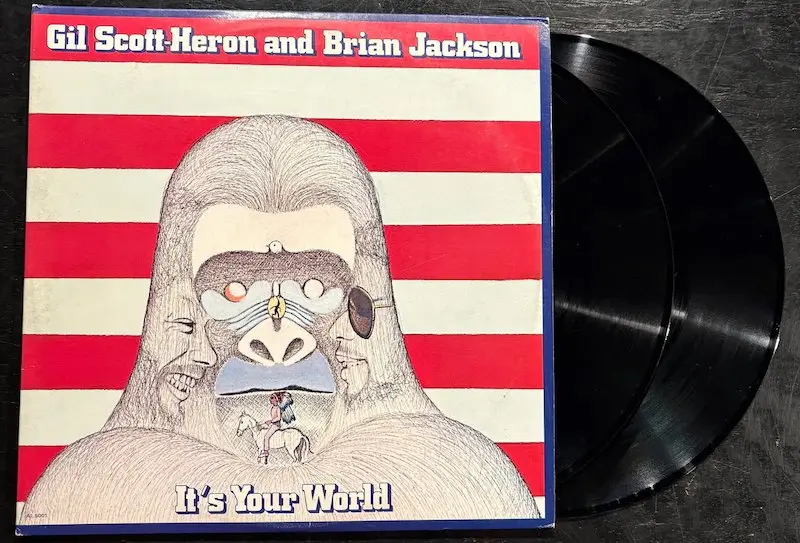
Simultaneously, poet and musician Gil Scott-Heron dismantled the commercialization of the anniversary on his 1976 album It’s Your World with the track Bicentennial Blues.
As Scott-Heron observed, the profound political ideals of the Declaration of Independence had been reduced to a crass consumerist trap:
"The year the symbol transformed into the B-U-Y centennial / Buy a car / Buy a flag / Buy a map / Until the public en masse has been bludgeoned into bicentennial submission."
In his address that same year, President Gerald Ford insisted that the Declaration of Independence was "the Polaris of our political order—the fixed star of freedom… impervious to change because it states moral truths that are eternal." Yet Ford was forced to concede that this truth was not universally accepted in 1976.
Scott-Heron met this official optimism with unflinching realism, noting that while the American blues had grown fully mature—tracing a line from Plymouth Rock to Watergate—the country’s moral and political maturity had stagnated.
Future Outlook: Navigating the Blues Years Ahead
As the semiquincentennial celebrations wind down without the fanfare, infrastructure, or emotional resonance of their 1976 predecessor, the psychological landscape of the nation is clear.
The modern political establishment no longer feels the need to persuade the public of the moral goodness of the American experiment. Having abandoned the project of collective myth-making in favor of raw, transactional power and cultural tribalism, today’s leaders preside over a nation that experiences every major civic milestone as a "blues year."
From economic precarity and geopolitical tragedy to the systematic rollback of civil rights, the contemporary American mood is defined by exhaustion rather than outrage. The public has been primed for systemic absurdity for decades, leaving little appetite for state-mandated pageantry that fails to reflect reality.
Yet, as Pryor and Scott-Heron demonstrated half a century ago, art and critical memory remain the ultimate antidotes to state propaganda. Remembering hurts, but it is also the only mechanism through which citizens can retain their souls. As the 250th anniversary fades into the background noise of history, the challenge for cultural critics, artists, and citizens alike is to refuse the hollow spectacle of the "B-U-Y centennial" and instead confront the unvarnished truth of the American experiment—demanding a reckoning with the past so that a more equitable future might finally be built.





Comments
Facebook App ID not configured. Please add it in the Customizer.