One hundred and eight years after the brutal execution of Czar Nicholas II and his family in the basement of the Ipatyev House in Yekaterinburg, the private lives of the Romanovs continue to command global fascination. While history books have long cataloged the grand-scale collapse of the Russian Empire, the geopolitical fractures of World War I, and the ascent of the Bolshevik regime, a vast, deeply personal archive tells a different story.
Thousands of surviving private photographs—many captured by the imperial children themselves using box-shaped Kodak Brownie cameras—offer an unprecedented, fly-on-the-wall perspective of an absolute monarchy hurtling toward self-destruction. Far from the icy, austere portraits commissioned for public distribution, these spontaneous snapshots, hand-colorized albums, and experimental early "selfies" humanize a dynasty that fiercely guarded its domestic sanctuary.
Yet, this stark contrast between the domestic joy captured on film and the bloody reality of their demise underscores the tragedy of the Romanovs. As historian Helen Rappaport notes, the enduring power of these images lies in their haunting contradiction: they preserve the lighthearted youth of four grand duchesses and a fragile, beloved heir whose lives were systematically cut short by a revolution born of centuries of unaddressed systemic inequality.
Detailed Chronology: From Absolute Autocracy to the House of Special Purpose
1894–1904: Ascendancy, Unpreparedness, and the Illusion of Stability
When 26-year-old Nicholas II ascended the Russian throne following the death of his father, Alexander III, he inherited an empire spanning one-sixth of the globe. Unprepared and deeply reluctant, Nicholas privately confessed to a cousin, "I am not prepared to be a czar. I never wanted to become one. I know nothing of the business of ruling."
He married Alix of Hesse—who took the name Alexandra Fyodorovna—a favorite granddaughter of Britain’s Queen Victoria. The couple faced immense public pressure to produce a male heir. Between 1895 and 1901, Alexandra gave birth to four daughters: Olga, Tatiana, Maria, and Anastasia. The repeated failure to produce a tsarevich drew open disappointment from the Russian court and public. Finally, in 1904, the long-awaited heir, Alexei, was born, setting off a chain reaction that would ultimately destabilize the dynasty.
1905–1914: The Domestic Cocoon and the Hemophilia Crisis
The birth of Alexei proved to be a double-edged sword. The young heir suffered from severe hemophilia, an incurable genetic mutation passed down through Queen Victoria’s bloodline. Terrified for her son’s life, Alexandra enforced a tight protective cocoon around the family, retreating from public view to the Alexander Palace in Tsarskoye Selo.
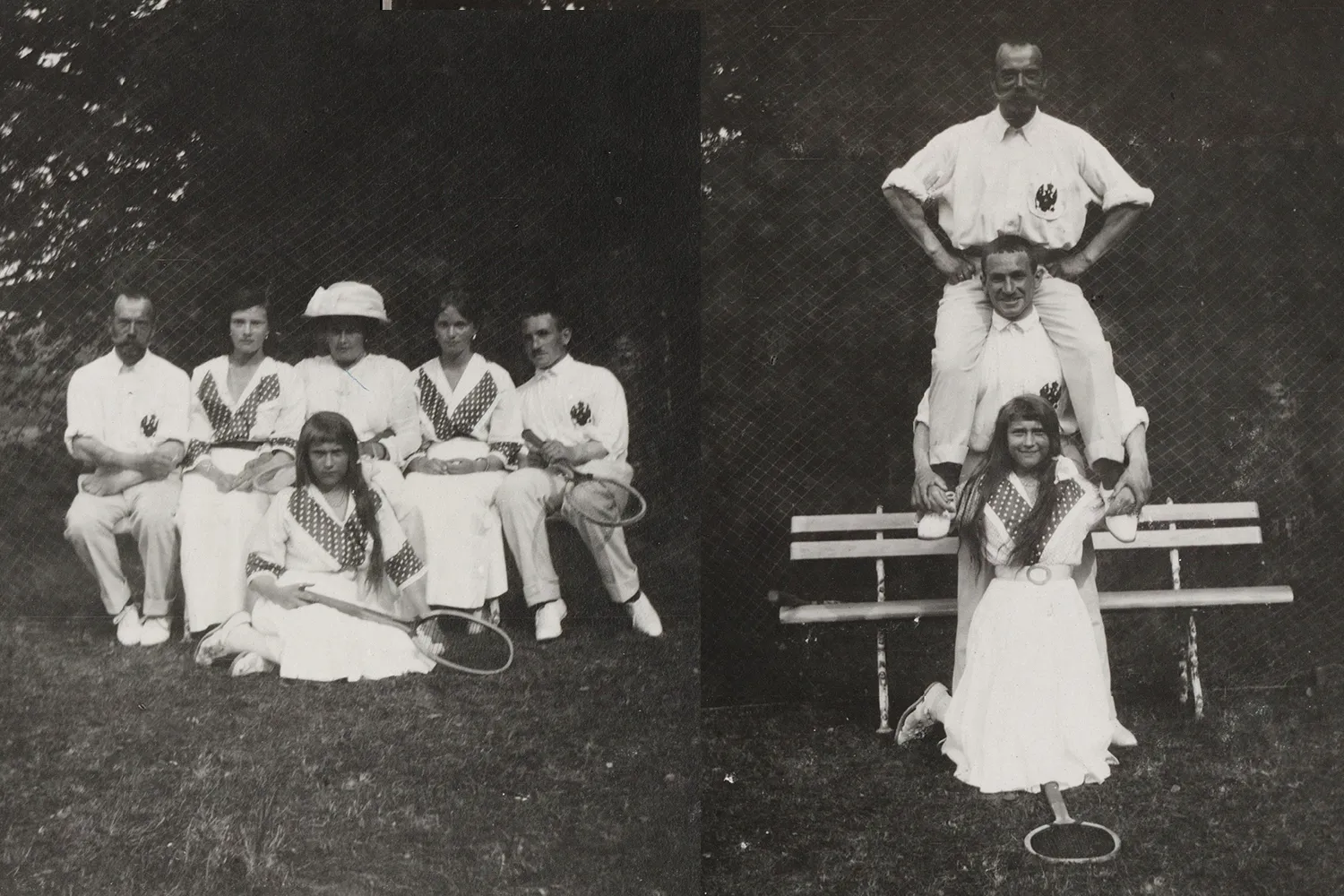
This insularity fueled public resentment. While the populace starved and revolutionary fervor mounted, the Romanov children embraced photography. Armed with Kodak Brownies, Olga, Tatiana, Maria, Anastasia, and Alexei documented their private world: boating on Finnish fjords, playing tennis, riding bicycles, and pasting images into elaborate, hand-crafted family albums.
1914–1917: World War I and the March Toward Revolution
The outbreak of World War I catalyzed the empire’s collapse. Nicholas assumed direct command of the Russian Army at the front lines in Belarus, leaving domestic affairs in the hands of Alexandra and the controversial Siberian faith healer Grigori Rasputin, who had won the Empress’s absolute trust by easing Alexei’s bleeding episodes.
Wartime casualties, food shortages, and rampant rumors regarding Alexandra and Rasputin eroded what little faith the public had left in the monarchy. Desperate elites assassinated Rasputin in December 1916, but it was too late. In February 1917, mass strikes and military mutinies culminated in the February Revolution. Pressured from all sides, Nicholas abdicated the throne on behalf of both himself and his sickly son, ending 300 years of Romanov rule.
1917–1918: Captivity, Exile, and the Bloody Night in Yekaterinburg
Initially placed under house arrest at Tsarskoye Selo—where the children contracted measles and shaved their heads in solidarity—the family was later relocated by the provisional government to Tobolsk, Siberia. Following the October Revolution, Vladimir Lenin’s Bolsheviks transferred the imperial family to the Ipatyev House in Yekaterinburg.
On the night of July 16–17, 1918, exactly 108 years ago, an execution squad of eleven men descended upon the basement of the House of Special Purpose. Nicholas and Alexandra were killed instantly, but the execution of the children descended into a horrific, prolonged ordeal. Because the grand duchesses wore jewel-studded corsets sewn with family diamonds, initial bullets bounced off their torsos. The executioners resorted to bayonets and close-range gunshots, taking 20 minutes to complete the massacre. Anastasia reportedly woke up and screamed before being silenced by a final pistol shot.
Supporting Context & Metrics
The survival of the Romanov family photo albums is nothing short of miraculous. Smuggled out of revolutionary Russia by Anna Vyrubova, a close confidant of the Empress, these primary sources provide quantitative and qualitative insights into the daily life of the imperial household:
The Scope of the Archive: Yale University’s Beinecke Rare Book & Manuscript Library houses six primary Romanov family photo albums containing thousands of individual, silver-gelatin snapshots.
The Scale of the Empire: In 1914, Nicholas II ruled over an empire encompassing approximately 22.4 million square kilometers—roughly one-sixth of the Earth’s landmass—with a population exceeding 160 million subjects.
The Cost of Autocracy: Historians estimate that Russia suffered over 3.3 million military casualties (dead and missing) during World War I prior to the 1917 revolution, a staggering loss that directly catalyzed the uprisings.
The Execution Metrics: The assassination involving 11 executioners and 11 victims (the family of seven plus four loyal attendants) turned into a 20-minute chaotic ordeal due to the protective diamond-lined garments worn by the grand duchesses.
Official Statements and Expert Perspectives
Historians and curators who have dedicated their lives to studying the Romanov archive emphasize the profound psychological disconnect between the imperial family’s private self-image and their public perception.
"What amazed me was how alike those albums were to any other family albums we have," noted Natalia Sidlina, curator of a major London exhibition on the last tsar, speaking to The Guardian. "The Romanovs looked just like any middle-class family."
This stark normalization sharply contrasts with the cold autocracy perceived by ordinary Russians. Biographer Helen Rappaport highlights the chilling nature of the family’s photographic record in her interviews with Smithsonian magazine:
"There’s something so very haunting about seeing those four lovely girls whose lives were cut short and that handsome and engaging little boy… The tragedy of their murder, the brutality of it, goes back to the photographs."
Rappaport also reflects on the prophetic nature of the family’s 1917 captivity photos, where the children posed with shaved heads following bouts of measles:
"Empress Alexandra apparently disapproved of the photoshoot, finding it terribly upsetting. She said they looked like prisoners going to their execution, which is horribly prophetic."
Future Outlook: Preservation, Digital Archives, and Historical Legacy
As the centennials of the Russian Revolution and the Romanov executions pass into history, academic and digital institutions face the ongoing challenge of preserving this fragile visual record. Modern digitization initiatives—led by institutions like Yale’s Beinecke Library, the Library of Congress, and international digital repositories—ensure that these intimate photographs remain accessible to researchers, historians, and the public without risking physical degradation.
Moving forward, the historical consensus on Nicholas II remains largely fixed: a well-intentioned family man catastrophically ill-suited to navigate the violent modernization of the 20th century. Yet, the enduring fascination with the Romanovs has evolved past mere royal nostalgia.
By analyzing the thousands of surviving snapshots taken by Anastasia, Olga, Tatiana, Maria, and Alexei, modern scholarship continues to deconstruct the myth of the unapproachable tyrant. The private photo albums serve as an eternal reminder of the human cost of political absolutism—capturing a tight-knit, joyful family blissfully unaware that the children capturing these self-portraits would soon become the focal point of one of history’s most harrowing tragedies.

/https://tf-cmsv2-smithsonianmag-media.s3.amazonaws.com/filer_public/8d/ad/8dad55dd-6089-4211-a179-dc51f45ad2b5/anastasia-tennis.png)
/https://tf-cmsv2-smithsonianmag-media.s3.amazonaws.com/accounts/headshot/meilan_headshot2.png)
:focal(750x500:751x501)/https://tf-cmsv2-smithsonianmag-media.s3.amazonaws.com/filer_public/8d/ad/8dad55dd-6089-4211-a179-dc51f45ad2b5/anastasia-tennis.png)
/https://tf-cmsv2-smithsonianmag-media.s3.amazonaws.com/filer_public/7f/d1/7fd1ff35-08f9-4b88-a2a5-8093673a2cdf/anastasia_nikolaevna_of_russia_fooling_around_original.jpg)
/https://tf-cmsv2-smithsonianmag-media.s3.amazonaws.com/filer_public/23/18/23186e2a-54a3-495b-a7f5-2aa50bdb453c/inside_anastasia_smoking.jpg)
/https://tf-cmsv2-smithsonianmag-media.s3.amazonaws.com/filer_public/30/bf/30bf0f74-b6f2-4950-839e-c4ba627ad751/romanov_cycling_on_bikes_5_of_10.jpg)
/https://tf-cmsv2-smithsonianmag-media.s3.amazonaws.com/filer_public/80/10/8010618b-b792-4a82-accc-a18190e7632b/anastasia_nikolaevna_romanova_in_a_selfie_1915.png)
/https://tf-cmsv2-smithsonianmag-media.s3.amazonaws.com/filer_public/91/8d/918daa7d-bb79-4982-8eae-1a2f78580529/mirror-selfie.png)
/https://tf-cmsv2-smithsonianmag-media.s3.amazonaws.com/filer_public/07/dc/07dcdb3f-e14f-406f-bd57-6a9ffee17e1c/3840px-family_nicholas_ii_of_russia_ca_1914.jpg)
/https://tf-cmsv2-smithsonianmag-media.s3.amazonaws.com/filer_public/35/0c/350c569a-b87e-4b0e-8f74-cdf74eabac7d/royal_family_group.jpg)
/https://tf-cmsv2-smithsonianmag-media.s3.amazonaws.com/filer_public/bb/c5/bbc55b38-df69-4bb9-af94-2e148612ebab/screenshot_2026-07-15_at_123625pm.png)
/https://tf-cmsv2-smithsonianmag-media.s3.amazonaws.com/filer_public/e9/8c/e98c51fb-f4e3-428d-9519-15783945c5a1/nicholas_ii_and_alexei_in_reval_1908.jpg)
/https://tf-cmsv2-smithsonianmag-media.s3.amazonaws.com/filer_public/f5/64/f564102b-b1d9-4459-866a-b190d4101739/empress_alexandra_fyodorovna_of_russia_and_her_children.jpg)
/https://tf-cmsv2-smithsonianmag-media.s3.amazonaws.com/filer_public/21/aa/21aae4ab-fe2a-4c73-a227-df826e8af206/olgatatianamariaanastasia1916.jpg)
/https://tf-cmsv2-smithsonianmag-media.s3.amazonaws.com/filer_public/7c/f0/7cf0dee6-b8eb-4a92-9dd0-76634fe1fdfb/olgabeachreading.jpg)
/https://tf-cmsv2-smithsonianmag-media.s3.amazonaws.com/filer_public/86/2d/862d7775-4ec5-459c-86b3-5929cb8b48d0/tatianaalexandra.jpg)
/https://tf-cmsv2-smithsonianmag-media.s3.amazonaws.com/filer_public/56/7a/567a553a-3708-4793-867c-5c2cbaf64c0e/maria_nikolaevna_aboard_the_imperial_yacht_polar_star.jpg)
/https://tf-cmsv2-smithsonianmag-media.s3.amazonaws.com/filer_public/9b/79/9b795fe5-de6a-4f55-a583-b51045cd32eb/mariaanastasiamugging.jpg)
/https://tf-cmsv2-smithsonianmag-media.s3.amazonaws.com/filer_public/bb/38/bb387afe-ee95-4efe-acb8-2602345b1dc5/anastasia_romanova_-_gym_at_the_alexander_palace_1913.jpg)
/https://tf-cmsv2-smithsonianmag-media.s3.amazonaws.com/filer_public/98/24/98240e07-a031-4e26-9098-d558295d68ed/screenshot_2026-07-15_at_123910pm.png)




Comments
Facebook App ID not configured. Please add it in the Customizer.