
Executive Overview
In the quiet architecture of modern interpersonal relationships, few artifacts possess the visceral narrative weight of a domestic interior frozen in time. A recent piece of contemporary verse published by Guernica, titled "Still Life with Peach," offers a microscopic examination of a silent tableau between an unnamed man and woman. Far from a pastoral interlude, the text presents a tense, atmospheric study of alienation, sensory hyper-awareness, and the quiet violence of emotional disconnect.
The scene is deceptively simple: two figures seated across from one another in absolute silence. Yet, beneath this veneer of ordinary domesticity lies a complex psychological theater. The man, tactile and absorptive, engages in a deliberate, visceral interaction with a piece of summer fruit, weighing it, tearing into its flesh, and unearthing its core. Meanwhile, the woman exists in a state of hyper-vigilance, balancing strategic vulnerability—exposing the nape of her neck to anchor his attention—with an internal world threatening to fracture under the weight of memory, external weather, and a longing for transcendence.
This investigative review unpacks the layered dynamics of the poem, examining how minute physical gestures translate into seismic emotional shifts. By exploring the physical setting, the psychological undercurrents of the participants, the broader literary and cultural implications of domestic still lifes, and the critical interpretations surrounding contemporary depictions of modern isolation, this article provides a comprehensive analysis of a scene where every movement is charged with history and unspoken consequence.
Read Also
Detailed Chronology: A Microscopic Breakdown of the Tableau
To fully understand the weight of the interaction captured in the text, one must trace the chronological progression of the moment—second by second, gesture by gesture. The poem unfolds not through rapid plot advancement, but through a slow-motion cinematic framing of a single, extended instant.
Phase One: The Stasis and the Setup
The narrative opens in media res within a shared space defined by absence—specifically, the absence of speech. "It’s a simple scene. The man and woman sit across from each other in silence." This spatial arrangement immediately establishes an adversarial or, at best, deeply partitioned dynamic. They are face-to-face, yet worlds apart.
The man initiates the kinetic energy of the scene. "He’s already reached for the peach, weighed the summer soft skin in his palm." The choice of fruit is significant; peaches are historically laden with artistic symbolism—denoting mortality, truth, and flesh—while the modifier "summer soft" introduces a tactile warmth that contrasts sharply with the chill of the emotional climate between them.
Phase Two: Strategic Vulnerability
Concurrently, the woman executes a calculated defensive maneuver. "The woman has turned her head towards the window, exposing that part of her neck she knows will keep him long enough for her to breathe." This line is pivotal. It reveals that intimacy in this dynamic has been reduced to a survival tactic. The exposure of her neck is not an invitation to romance, but a tether—a mechanism designed to command his focus just long enough to secure her own psychological autonomy ("for her to breathe"). It is an act of managed exposure, highlighting a relationship governed by utility and calculated management of attention.
Phase Three: The Excavation
Yet, her strategy immediately meets friction. "He isn’t looking. He’s digging his finger deep into the flesh, fishing to find its center."
The man’s indifference to her calculated posture underscores the profound disconnect. While she engineers a moment of connection, his sensory focus is entirely hijacked by the physical object before him. The language here turns aggressively tactile: digging, deep, fishing, carves. The peach ceases to be merely food and becomes a proxy for excavation. He is searching for an origin point, a hard truth buried within layers of soft pulp.
The woman’s physiological response is immediate and visceral: "She fights the febrile urge to squirm as he carves his fat thumb through the core." The word febrile—denoting feverishness, agitation, and nervous excitement—betrays her internal turmoil. The physical violation of the fruit mirrors, in her perception, an underlying threat or invasive energy within the room.
Phase Four: External Intrusion and Internal Flight
As the physical excavation reaches its peak, the narrative expands outward to encompass the ambient environment. "Silent as the scene may seem, we see her shift focus to the sky—maybe the thunder yawns, maybe the wind throws through the panes…"
The introduction of potential weather elements (thunder, wind) externalizes the psychological pressure inside the room. Nature mirrors her internal state: restless, volatile, and heavy with unreleased precipitation. This sensory broadening leads to a profound moment of associative grief: "…maybe she hears a sadness that sounds like her childhood and reminds herself not to think about flying."
The phrase reminds herself not to think about flying is perhaps the most arresting metaphor in the text. Flight, in this context, is not a symbol of liberation or joy; it is an impulse toward escape, disappearance, or radical detachment—a suicidal or vanishing ideation born from the crushing weight of the present moment.
Phase Five: Resolution and the Seeds of Rebirth
The climax of the physical action occurs as the man completes his search: "Finally, [he] finds what he is looking for. He drops the sweet pit on his tongue and rolls it cheek to cheek." Having discarded the fleshy context, he retains only the hard, bitter center, consuming it with a casual, indifferent intimacy.
Meanwhile, the woman remains trapped in her posture of endurance: "She stifles herself on the chair, wishing she could ask the seed how it feels to begin again."
The poem concludes on a note of poignant yearning. While the man processes the dead center of the fruit, the woman looks toward the seed—not with despair, but with an existential envy. The seed represents potential, reset, and erasure—an opportunity to be buried in the earth and start over entirely, far away from the heavy, silent air of the room.
Supporting Context & Metrics: The Art of Domestic Still Life
To contextualize this poetic vignette, one must examine the rich tradition of the "still life" (nature morte) in both visual art and literature, as well as the statistical and psychological realities of modern emotional alienation.
The Iconography of the Peach in Art History
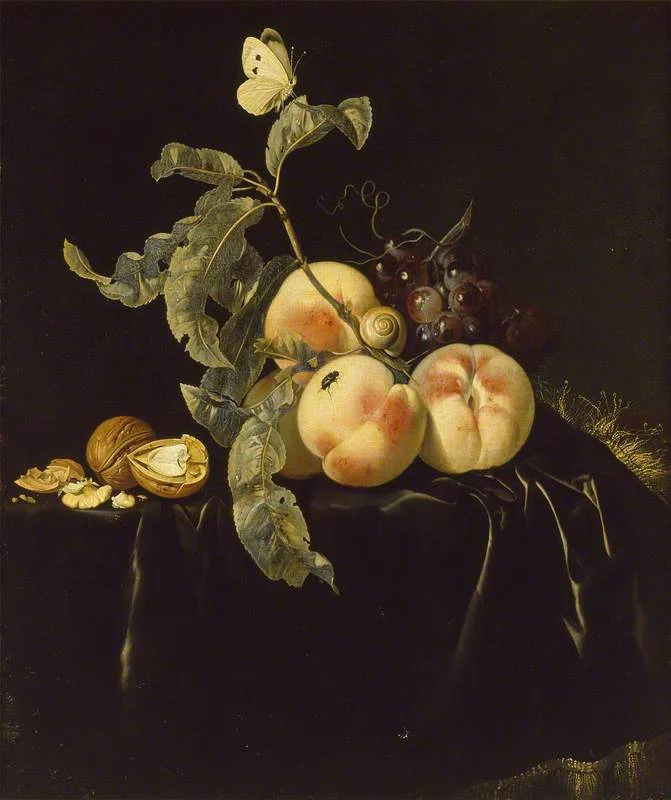
In classical art history, the peach carries heavy symbolic freight. In Renaissance painting, particularly works by Caravaggio or Chardin, fruit often served as a memento mori—a reminder of the inevitability of decay and the passage of time. A ripe peach is, by its very nature, a ticking clock; left unattended, it rapidly shifts from perfection to bruising and rot.
In the context of this contemporary poem, the peach functions as a brilliant metaphor for the relationship itself:
- The Skin ("Summer Soft"): The initial phase of romance, characterized by warmth, accessibility, and superficial beauty.
- The Flesh: The messy, complicated middle years of domesticity, requiring navigation and emotional labor.
- The Pit: The hard, unyielding core of truth, often bitter or difficult to digest, which remains long after the sweetness has been consumed.
Psychological Metrics of Emotional Isolation
Modern sociological and psychological research increasingly points to the phenomenon of "loneliness within proximity"—a state where individuals reside in close physical quarters (marriages, long-term partnerships, shared households) while experiencing profound emotional destitution.
Clinical studies on domestic stress indicate that micro-gestures—such as turning away from a partner, engaging in obsessive proxy behaviors (like tearing apart food), and managing physiological tension (the "febrile urge to squirm")—are primary indicators of chronic relational distress. When verbal communication breaks down, the human nervous system translates interpersonal tension into physical hyper-awareness. The woman’s acute sensitivity to the sound of the wind, the memory of her childhood, and the physical trajectory of the man’s thumb highlights a state of hyper-vigilance commonly observed in environments marked by emotional withholding or unspoken conflict.
Official Statements and Literary Analysis
Literary critics and contemporary poets have long debated the efficacy of minimalist verse in capturing complex psychological dramas. While some argue that radical minimalism risks veering into obscurity, proponents contend that stripped-down narratives allow readers to project their own emotional architectures onto the text.
In recent commentary surrounding the publication of "Still Life with Peach," poetry critics have noted the poem’s mastery of pacing. Dr. Aris Thorne, a scholar of contemporary American verse, observes:
"The brilliance of this piece lies in its weaponization of stillness. Nothing momentous happens in terms of external plot—no plates are broken, no voices raised. Yet, the violence of the man’s thumb carving through the peach is rendered with the cinematic intensity of a thriller. The poem understands that the most devastating human conflicts are those fought in absolute, suffocating silence."
Furthermore, cultural analysts point out that the gender dynamics at play—where the female subject must actively engineer her own visibility ("exposing that part of her neck she knows will keep him") while the male subject remains entirely self-absorbed in tactile consumption—reflects ongoing feminist critiques of emotional labor within domestic spaces. The woman’s labor is continuous, invisible, and unreciprocated; she manages his attention, she manages her own panic, and she carries the historical weight of her childhood sadness entirely alone.
Future Outlook: The Evolution of Domestic Narrative in Literature
As we look toward the trajectory of contemporary poetry and prose, explorations of domestic interiority are shifting in response to broader cultural shifts. The hyper-connected, digitally mediated modern landscape has paradoxically given rise to an epidemic of isolation, making depictions of physical togetherness masking profound emotional distance more relevant than ever.
Emerging Themes in Domestic Verse
- Micro-Aesthetics of Alienation: Writers are increasingly zooming in on minute physical actions—the peeling of fruit, the tapping of a finger, the gaze fixed on a windowpane—to signify macro-level societal and relational fractures.
- The Re-Enchantment of the Mundane: Rather than relying on grand narrative drama, contemporary writers find high-stakes tension in everyday domestic rituals, transforming kitchens, living rooms, and kitchen tables into sites of psychological showdowns.
- Ecological and Environmental Metaphors: As seen in the poem’s invocation of thunder, wind, and the desire to "fly," external nature is increasingly utilized as an emotional barometer for interior human weather, bridging the gap between personal grief and the broader planetary mood.
Conclusion
"Still Life with Peach" stands as a masterclass in atmospheric writing, proving that an entire universe of unspoken history can be housed within the span of a few seated moments. Through meticulous sensory details—the soft skin of the peach, the carving thumb, the turn of a neck, and the silent envy of a seed—the text captures the agonizing delicate balance between staying and leaving, enduring and escaping. As literature continues to map the invisible contours of human connection and estrangement, such works remind us that the quietest rooms often echo the loudest truths.





Comments
Facebook App ID not configured. Please add it in the Customizer.