
Executive Overview
A decade after crucial cartographic evidence exposed the systemic fracturing of the West Bank, the geopolitical landscape of the Middle East has undergone a radical transformation. What was once analyzed by American diplomats as a troubling trend line has hardened into an entrenched, permanent reality. Ten years ago, Frank Lowenstein—then serving as the United States special envoy for Israeli-Palestinian negotiations—presented President Barack Obama with a series of detailed maps depicting Israeli Jewish settlements across the occupied West Bank. The maps demonstrated that what had long been framed as a manageably incremental issue had reached a critical tipping point: the relentless expansion of settlement infrastructure was actively severing the territorial contiguity required for a viable, independent Palestinian state.
The core dilemma identified in those presidential briefings remains the central crisis of the region today. Because Jewish and Palestinian populations reside in roughly equal numbers across Israel and the territories occupied since the 1967 Six-Day War, the physical preemption of a Palestinian state imperils Israel’s long-term claim to be both a Jewish and democratic nation. By executing a gradual, de-facto annexation of the West Bank, settlement construction forces an impossible strategic compromise: either Israel must govern a disenfranchised, non-Jewish majority population devoid of full civil rights, or it must relinquish its distinct identity as a Jewish state. From the strategic vantage point of Washington and international security analysts, both outcomes severely undermine the broader stability of the Middle East.
Today, Lowenstein—now a policy fellow at the liberal Zionist advocacy group J Street—continues to update those cartographic models. His findings indicate that the diplomatic warnings issued during the Obama administration have been entirely eclipsed by events on the ground. The rapid, uninhibited expansion of officially authorized settlements and informal settler "outposts" has rendered early diplomatic frameworks largely obsolete, replacing the debate over two-state feasibility with the grim management of an established one-state reality.
Read Also
Detailed Chronology
+-----------------------------------------------------------------------------------+
| CHRONOLOGY OF WEST BANK SETTLEMENT EXPANSION & DIPLOMATIC MILESTONES             |
+-----------------------------------------------------------------------------------+
| 2016           | Envoy Frank Lowenstein presents West Bank maps to President Obama |
|                | U.S. abstains on UN Security Council settlement resolution       |
|                | Secretary John Kerry delivers warning on "one-state reality"      |
+-----------------------------------------------------------------------------------+
| 2017-2022      | Steady growth of settlement infrastructure and outpost network   |
+-----------------------------------------------------------------------------------+
| Early 2023     | Prime Minister Benjamin Netanyahu's coalition takes office       |
|                | Unprecedented surge in settlement approvals and outpost updates  |
+-----------------------------------------------------------------------------------+
| Oct 7, 2023    | Hamas attacks Israel; military actions destroy vast areas of Gaza|
|                | West Bank settler violence and land seizures surge significantly |
+-----------------------------------------------------------------------------------+
| 2023-2026      | Over 5,300 documented settler attacks in West Bank               |
|                | 104 new settlements approved; 58,000+ housing units authorized    |
+-----------------------------------------------------------------------------------+
| Mid-2026       | Israeli government issues tender for 1,200 housing units in key   |
| (Recent)       | West Bank corridor; international coalition issues rebuke         |
+-----------------------------------------------------------------------------------+
The 2016 Diplomatic Pivot
The trajectory of modern West Bank diplomacy shifted sharply in the final weeks of the Obama presidency. Upon reviewing Lowenstein’s cartographic analysis, President Obama made the controversial decision to depart from standard diplomatic protocol by withholding the United States’ veto power at the United Nations Security Council. This allowance permitted the passage of a UN resolution explicitly condemning Israeli settlements as violations of international law.
On December 28, 2016, Secretary of State John Kerry formalized the administration’s stance in a historic address, cautioning that unchecked settlement construction was "increasingly cementing an irreversible one-state reality." Kerry delivered an existential challenge to international observers, asking:
"Is ours the generation that gives up on the dream of a Jewish democratic state of Israel living in peace and security with its neighbors? Because that is really what is at stake."
The Modern Escalation (2023–Present)
Rather than arresting the pace of expansion, the subsequent decade saw an unprecedented acceleration. The political conditions governing the West Bank shifted dramatically with the ascension of Prime Minister Benjamin Netanyahu’s government in early 2023, supported by ultra-nationalist coalition partners committed to deepening Israeli control over the occupied territories.
Recently, in a move widely viewed by analysts as an effort to shore up political backing ahead of upcoming domestic elections, Netanyahu’s administration issued a tender offer for the construction of 1,200 new settler housing units. Strategically positioned, this project is explicitly designed to slice through the remaining Palestinian-administered sectors of the West Bank, cutting off regional connectivity and effectively preventing the formation of a cohesive municipal center for Palestinians.
Supporting Context & Metrics
The quantitative transformation of the West Bank over the last decade illustrates the shift from isolated land claims to full-scale infrastructure integration. More than 500,000 Jewish settlers now reside alongside more than three million Palestinians in the West Bank—a territory designated for a Palestinian state since the 1947 UN Partition Plan that recommended the creation of Israel.
Comparative Growth Metrics
To understand the speed of recent developments, a direct comparison between executive administrations reveals a deliberate change in policy priority regarding West Bank land use:
- Settlement Approvals: During the eight years of the Obama administration, the Israeli government officially approved a total of three new settlements in the West Bank. Since early 2023, under the current Israeli governing coalition, the government has approved 104 new settlements.
- Housing Permits: Since 2023, Israeli authorities have authorized the construction of more than 58,000 housing units within West Bank settlements.
- Total Outpost Footprint: The combined number of authorized settlements and unauthorized (or retroactively legalized) outposts has more than doubled, expanding from roughly 300 locations to approximately 640 sites.
SETTLEMENT APPROVALS: A TALE OF TWO ERAS

Obama Administration (8 Years):
[3] New Settlements Approved

Netanyahu Coalition (Since 2023):
[#################################################################################] 104 New Settlements
Rising Violence and Population Displacement
The physical expansion of settlement infrastructure has been mirrored by a dramatic surge in violence against Palestinian residents, frequently occurring with the passive allowance or active protection of Israeli security forces.
+-----------------------------------------------------------------------------------+
| WEST BANK SETTLER INCIDENTS & DISPLACEMENT DATA                                    |
+-----------------------------------------------------------------------------------+
| Metric                                   | 2016 Baseline     | Post-2023 Era      |
+------------------------------------------+-------------------+--------------------+
| Documented Settler Violence Incidents    | 107 per year      | 5,300+ total       |
| Daily Attack Rate                        | ~0.3 per day      | >4.0 per day       |
| Recent Attack Rate (First 7 Mos. 2026)   | --                | >6.0 per day       |
| Palestinians Killed by Settlers/Forces   | --                | >1,100 killed      |
| Displaced Palestinian Communities        | Minimal           | 117 communities    |
| Total Uprooted Individuals               | Negligible        | >5,900 people      |
+-----------------------------------------------------------------------------------+
In 2016, the United Nations recorded 107 incidents of settler attacks resulting in property damage or casualties. Since 2023, UN monitors have documented over 5,300 attacks—averaging more than four incidents daily. In the first seven months of 2026 alone, the rate grew to over six attacks per day (1,380 recorded incidents), resulting in 76 Palestinian deaths. Overall, direct aggression by settlers or accompanying military operations has claimed the lives of over 1,100 Palestinians in the West Bank since 2023.
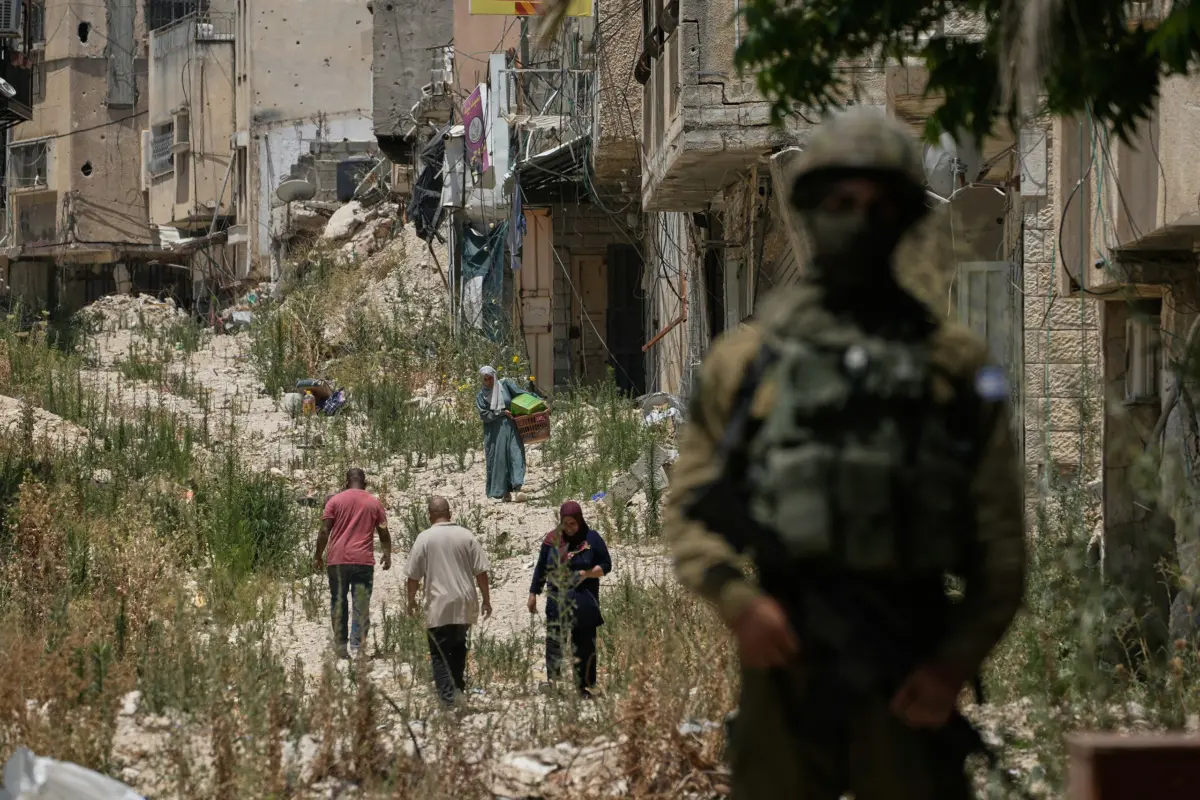
This campaign of pressure, intimidation, and structural demolition has led to significant physical displacement. According to UN tracking, demolitions and violent harassment have forced the full or partial abandonment of 117 Palestinian communities, uprooting more than 5,900 residents from their ancestral lands.
The Broader Regional Footprint: Gaza
The structural realignment of the West Bank is inextricably linked to developments in Gaza following the Hamas attack on October 7, 2023. Over the course of subsequent military operations, Israeli forces took control of more than 65 percent of Gaza’s land area, while heavy bombardment damaged or destroyed upwards of 90 percent of the residential housing stock.
As a result, almost the entirety of Gaza’s two million inhabitants have been forced into makeshift tent encampments situated within the remaining 35 percent of the territory. The broader humanitarian toll of the offensive in Gaza has seen Palestinian casualties top 70,000 killed, further destabilizing the geopolitical architecture of the region.
Official Statements
The latest tender offer for 1,200 West Bank housing units triggered immediate responses across the diplomatic spectrum:
International Coalition
A joint coalition comprising the European Union and more than twenty sovereign governments—including the United Kingdom, France, and Germany—issued an immediate directive demanding that Israel withdraw the tender. The diplomatic bloc stated:
"We urge the government of Israel to immediately retract the tender offer. This construction directly undermines the prospect of a viable two-state solution by driving an irreversible wedge through the West Bank and severing Palestinian continuity."
United States Stance
While the United States notably declined to join the international statement, Washington expressed its own opposition to the move. A representative for the Trump administration reaffirmed its policy stance against formal West Bank annexation, declaring:
"The position of the administration remains firm: a stable, secure West Bank is essential to keeping Israel secure, and actions that disrupt that stability do not serve long-term regional peace."
Analytical Assessment
Reflecting on the evolution of these diplomatic maneuvers, Frank Lowenstein noted that official political language has failed to keep pace with structural reality:
"Where such assaults or evictions once occurred sporadically, it is now going haywire every single day. The evolving maps have effectively drained the traditional political vocabulary of its meaning. Discussions that treated the two-state model as an achievable policy goal ignore the physical infrastructure currently occupying the land."
Future Outlook
The reality documented by cartographers and international monitors points toward a fundamental redesign of the region’s political framework. The rapid expansion of physical settlements, industrial infrastructure, bypass roads, and security outposts has created a single, highly fragmented geographic domain governed by asymmetric legal frameworks.
THE EVOLVING WEST BANK REALITY
=============================================================================
HISTORICAL PARADIGM                    EMERGING REALITY
-------------------                    ----------------
• Negotiated Two-State Solution        • Irreversible One-State Infrastructure
• Sporadic Outpost Growth              • Systematic Government-Funded Expansion
• Isolated Diplomatic Friction         • Deepening Legal & Civil Asymmetry
• Temporary Military Occupation        • Permanent Structural Control
=============================================================================
As the traditional political vocabulary surrounding the conflict erodes, international actors face an uncomfortable diplomatic shift. The former consensus model—premised on a two-state solution negotiated through mutual territorial concessions—is increasingly viewed by policy experts as incompatible with the physical reality built over the past decade.
Moving forward, foreign policy institutions will be forced to navigate the realities of a permanent one-state framework. Without a drastic reversal of current land-use policies, settlement expansion will continue to lock in structural inequalities. Consequently, global actors may soon be forced to shift their diplomatic emphasis away from managing a theoretical transition to two separate states, focusing instead on addressing the immediate legal, human rights, and regional security consequences of an entrenched single state.





Comments
Facebook App ID not configured. Please add it in the Customizer.