
The 2026 FIFA World Cup—co-hosted across the vast geopolitical landscapes of North America (CANMEXUS)—has transcended the traditional boundaries of an athletic exhibition to become an unprecedented sociological study in communication, bureaucratization, and linguistic hegemony. Beyond the pitch, where a newly expanded 48-team tournament has altered the tactical geography of the sport, FIFA has implemented radical regulatory innovations. Most notably, the introduction of stadium-wide amplified referee audio for video-assisted reviews (VAR) and an uncompromising ban on mouth concealment during "confrontational situations" have elevated speech clarity to an iron edict.
This deep dive examines how these regulatory shifts intersect with an underlying tension: the totalizing, corporate dominance of English as the sport’s lingua franca versus the irrepressible, multi-accented Babel of the global diaspora. From Salvadoran referee Iván Barton’s operatic red-card announcements to the tactical linguistic compartmentalization deployed by national team managers, the 2026 tournament proves that while football is ostensibly played with the feet, its administrative and cultural framework is an arena of high-stakes semiotics.
Detailed Chronology: The Evolution of a Polyglot Crisis
The Opening Salvo: New Rules and Bureaucratic Theater
As the Greatest Show on Earth kicked off in North America, FIFA’s regulatory adjustments immediately altered the theatrical rhythm of matches. The integration of on-field microphones designed to broadcast VAR verdicts transformed referees from silent arbiters into theatrical narrators. Concurrently, the strict prohibition against covering one’s mouth with a hand during heated exchanges—enacted primarily to root out racism and obscured verbal abuse—set the stage for high-profile administrative clashes.
The Group Stage Incident: Paraguay vs. Türkiye in Santa Clara
The new rules faced their most dramatic trial during the group-stage fixture between Paraguay and Türkiye in Santa Clara, California. Mid-match, video assistants stationed in a centralized control room in Dallas flagged Paraguayan forward Miguel Almirón for a potential mouth-concealment infraction.
Referee Iván Barton—a commanding, hyper-methodical official whose demeanor evokes a minor general from a Gabriel García Márquez novel—paused the match. Striding to the sideline monitor, Barton reviewed the footage, returned to the pitch, and reached into his back pocket. Delivering his verdict through the stadium’s powerful sound system, Barton transformed a bureaucratic infraction into a cinematic summary execution:
"Number ten, Paraguay—cover his mouth! The decision is rrrrred card!"
The broadcasted decree reverberated across the stadium, establishing a new reality for players, pundits, and administrators alike: any motion to speak must be fully exposed to the panopticon of modern broadcasting.
Tactical Experiments and Linguistic Blocs
The unintended consequences of these linguistic and behavioral mandates quickly manifested on the pitch. During the Round of 16, as Paraguay sought to rattle a formidable French squad, French star Kylian Mbappé was captured on un-obscured audio offering a crisp, multilingual appraisal to defender Júnior Alonso: "la concha de tu madre."
Meanwhile, national team managers wrestled with the communicative realities of modern diasporic squads. Iraq, returning to their first World Cup since 1986 with a roster comprising native Arabic, Kurdish, and Assyrian speakers alongside European-born expatriates, attempted an extraordinary tactical experiment. Australian manager Graham Arnold organized his starting formations into linguistic blocs, placing English-speaking players predominantly on the left side of the pitch and Arabic speakers on the right. Though the experiment ultimately failed to secure a group-stage advancement—resulting in three losses and twelve goals conceded—it highlighted the profound challenges of managing linguistic heteroglossia in elite athletic environments.
Supporting Context & Metrics: The Monolingual Hegemony vs. The Global Diaspora
The 2026 World Cup operates within a fascinating paradox: while individual squads represent the chaotic, beautiful cross-currents of global migration, the administrative apparatus of the tournament remains fiercely monolingual.
The Tyranny of English
Despite FIFA recognizing four official languages and the host nations possessing three state languages, English functions as the undisputed corporate and bureaucratic lingua franca of the tournament.
- Stadium Renaming: Even culturally sacred venues must bow to this linguistic standardization. In Mexico City, the legendary Estadio Azteca was officially re-branded as "Mexico City Stadium" for the tournament’s duration, accompanied by austere, English-language sideline placards marking the halfway line.
- Administrative Outreach: The global nature of recruitment often relies on this linguistic homogenization. Cape Verde defender Roberto "Pico" Lopes—born and raised in Ireland—initially ignored an outreach message sent via LinkedIn by the Cape Verdean football association because it was drafted in Portuguese. It was only when the federation followed up in English that Lopes engaged, highlighting the modern reality that even international football recruitment is mediated by Anglophone corporate platforms.
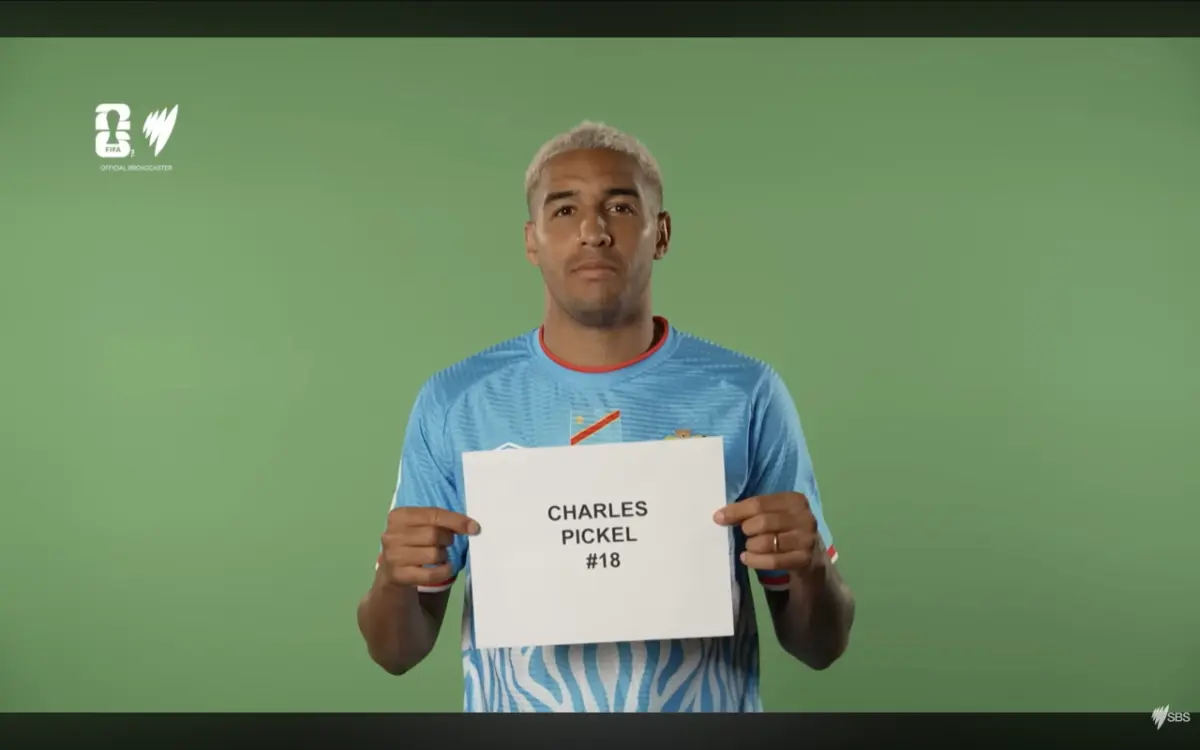
- The "Americanization" of Names: Prior to the tournament, FIFA produced phonetic pronunciation guides for commentators struggling with the 1,248 participating players. Several players utilized these modules to playfully "Americanize" their names, offering a surreal glimpse into an alternate reality where elite European-trained stars like Marcus Thuram, Rayan Cherki, and Charles Pickel hailed from generic American suburbs rather than Turin, Lyon, and Solothurn.
Pronunciation and the Play-by-Play Babel
For American television broadcasters—a mix of former players, weary British analysts, and analytical statisticians—enunciating foreign names became an exercise in linguistic gymnastics.
Nowhere was this more apparent than in the treatment of Portuguese names. While traditional English commentary has long flattened Portuguese phonetics into a quasi-Spanish register (transforming "José" into "Ho-zay"), the 2026 tournament witnessed a radical split. Some announcers embraced the full Iberian palato-alveolar fricative, dramatically calling out plays from Portugal’s Nuno Mendes as "Noon Mensshhhhhh bursting upfield." Others continued to stumble over the dueling Araújos of Portugal and Uruguay, demonstrating the persistent friction between localized pronunciation and mass-media standardization.
Official Statements and Institutional Perspectives
FIFA officials have vigorously defended the regulatory updates, emphasizing that transparency and inclusivity are paramount in an era of heightened global scrutiny.
"The introduction of on-field audio transparency and the elimination of obscured communication are non-negotiable steps toward ensuring a fair, accountable, and progressive game," noted a senior tournament administrator following the group stages. "Football is a global language, but on the field of play, integrity requires absolute visibility—both visual and auditory."
Conversely, cultural critics and linguistic sociologists argue that the imposition of strict Anglophone operational standards risks homogenizing the vibrant, localized character of international competition. As noted by analysts observing the tournament’s broader cultural footprint, the relentless push toward bureaucratic clarity often steamrolls the poetic ambiguities that make regional playing styles—from juego de posición to Gegenpressing—so compelling.
The tension between linguistic expression and athletic efficiency is further exemplified by the contrasting public personas of the sport’s greatest icons:
- Harry Kane: England’s prolific captain embodies the ultimate linguistic minimalism off the pitch. Exhibiting total verbal economy, his standard post-match refrain—mumbled into the turf while noting he is "absholutely buzhing"—suggests that his entire personality and expressive capacity have been channeled exclusively into striking a football.
- Michael Olise: Representing France with a brilliant, deadpan reticence, Olise treats media inquiries with dry amusement. Asked by a French journalist to describe his flaws prior to the tournament, Olise simply replied: "Normale. Je suis une personne normale."
- Lionel Messi: Leading Argentina on adopted home soil after three seasons with Inter Miami, Messi has firmly refused to engage in public English-language interviews. Despite this "Anglophone mutism," his commercial footprint remains staggering; Messi appears in roughly one-quarter of all World Cup-themed advertisements on US television, proving that athletic transcendence easily bypasses the need for corporate linguistic assimilation.
Future Outlook: The Unconquerable Babel of Football
As the 2026 FIFA World Cup heads toward its climactic rounds, the legacy of its regulatory and linguistic experiments will reverberate for years to come. The expansion to 48 teams has successfully navigated the logistical hurdles of the expanded tournament structure, proving that Romance languages like French (seizièmes de finale) and Spanish (dieciseisavos de final) can adapt to bureaucratic expansion just as fluidly as English.
Yet, the tournament has fundamentally altered how we think about the relationship between speech, transparency, and sport. The era of the covered mouth on the pitch has officially closed, replaced by a regime of total accountability where every muttered insult or tactical instruction risks amplification across global airwaves.
Ultimately, English may reign supreme in the boardroom, the broadcast booth, and the corporate sponsorship deck, but it remains permanently haunted by the glorious cacophony of the global game. As players from dozens of linguistic backgrounds clash across North America, the sport continues to prove that beneath the veneer of administrative uniformity lies an irrepressible human expression—one that defies total linguistic control, echoing out into the stadiums with every roar, every whistle, and every unforgettable cry of celebration.



Comments
Facebook App ID not configured. Please add it in the Customizer.