
In an era defined by a relentless digital preoccupation with the immediate—an attention economy that tether itself exclusively to the present—modern Western societies risk losing the long-term historical perspective necessary for survival. While traditional civilizations revered the elderly and studied history to glean wisdom from past human experience, contemporary America worships youth and novelty. This cultural amnesia leaves the nation dangerously ill-equipped to confront its most pressing geopolitical and domestic challenges, chief among them the preservation of social cohesion amid large-scale, cross-continental migration.
As the demographic and cultural landscape shifts under the weight of mass migration, particularly from the Islamic world, Western nations face profound systemic stress. Islam is a comprehensive framework governing both civic and spiritual life; as its adherents attain critical mass in Western host countries, it inevitably emerges as a rival to the Judeo-Christian bedrock of Western civilization. Observers across the political spectrum note that such foundational social and cultural alterations are inherently disruptive, polarizing, and potentially volatile. Yet, rather than yielding to enervating despair or fatalistic declinism, policymakers and legal scholars can look to "applied history"—the systematic mining of past institutional successes and failures—to engineer pragmatic solutions.
This analysis examines the viability of adapting constitutional and legal frameworks from unique pluralistic models, such as Malaysia’s 1957 Merdeka Constitution, to protect Western civilization’s Judeo-Christian heritage without resorting to unconstitutional authoritarianism. By distinguishing between private religious devotion and assertive public proselytization, Western democracies can safeguard civic stability, preserve social order, and proactively manage the profound challenges of modern mass migration.
Read Also
Detailed Chronology: The Evolution of Religious Pluralism and Immigration Law
To understand how modern Western states arrived at their current vulnerability, one must examine the historical trajectory of immigration law, religious freedom, and statecraft from the founding era to the modern geopolitical landscape.
- 1790 (The Naturalization Act): Following the ratification of the U.S. Constitution, the nascent American republic passed its first naturalization statute, restricting citizenship to "free white persons" of good character. This established a foundational precedent that American immigration has never operated as an entirely open-door, unrestricted enterprise.
- 19th Century (The Rise of Nativism): As Catholic immigration surged—particularly from Ireland and Germany—intense cultural friction erupted. This culminated in the formation of the "Know-Nothing" or American Party, a political movement dedicated to curbing the perceived institutional influence of the Catholic Church within American civic life.
- 1957 (The Merdeka Constitution of Malaysia): Following the end of British colonial oversight and the turbulent years of the Malayan Emergency, the Federation of Malaya drafted its historic independence constitution. Engineered through British diplomatic statesmanship and indigenous consensus, the document declared Islam the official religion of the federation while preserving secular state administration and protecting the religious practices of Chinese and Indian minorities "in peace and harmony."
- 1948–1960 (The Malayan Emergency): British forces under General Sir Gerald Templer successfully countered a violent communist insurgency (the Malayan National Liberation Army) by pioneering counter-insurgency doctrines centered on "winning hearts and minds," laying the groundwork for a stable, market-driven, Sunni-majority democracy upon exit.
- 2015–Present (The European Migration Crisis): Mass migration waves from Syria, North Africa, and the Middle East fundamentally alter the demographic fabric of Western and Northern Europe. Subsequent years witness rising social fractures, religiously inspired terrorism, and localized failures of municipal policing—most notably exemplified by the grooming gang scandals in British industrial towns such as Rotherham and Manchester.
- 2022 (The Election of Anwar Ibrahim): The political victory of Anwar Ibrahim in Malaysia underscores the resilience of the country’s pluralistic democratic framework, demonstrating that counterbalancing political forces can successfully moderate religious extremism within an officially Islamic state framework.
Supporting Context & Metrics: Demographic Shifts and Institutional Strains
The friction between traditional Western jurisprudence and assertive missionary religions is not merely theoretical; it is grounded in tangible demographic realities and documented institutional strains.
The Demographic Realities of Modern Migration
According to sociological research and demographic polling, the share of the population identifying with traditional Western Christianity has steadily declined across the United States and Europe over the past three decades. Concurrently, Islamic populations within Western nations have expanded rapidly through higher birth rates and sustained net migration.
- Religious Composition: Approximately 60% to 65% of the American population continues to self-identify as Christian, mirroring the roughly 65% Muslim majority baseline in Malaysia.
- Geographic Concentration: Unlike broad national assimilation patterns of previous centuries, contemporary migration frequently results in distinct municipal enclaves. Cities such as Hamtramck and Dearborn in Michigan, Paterson in New Jersey, and segments of Minneapolis, Minnesota, have witnessed the public introduction of community-wide Islamic practices, including the electronically amplified call to prayer (adhan) broadcast over public loudspeakers.
Comparative Public Order Challenges
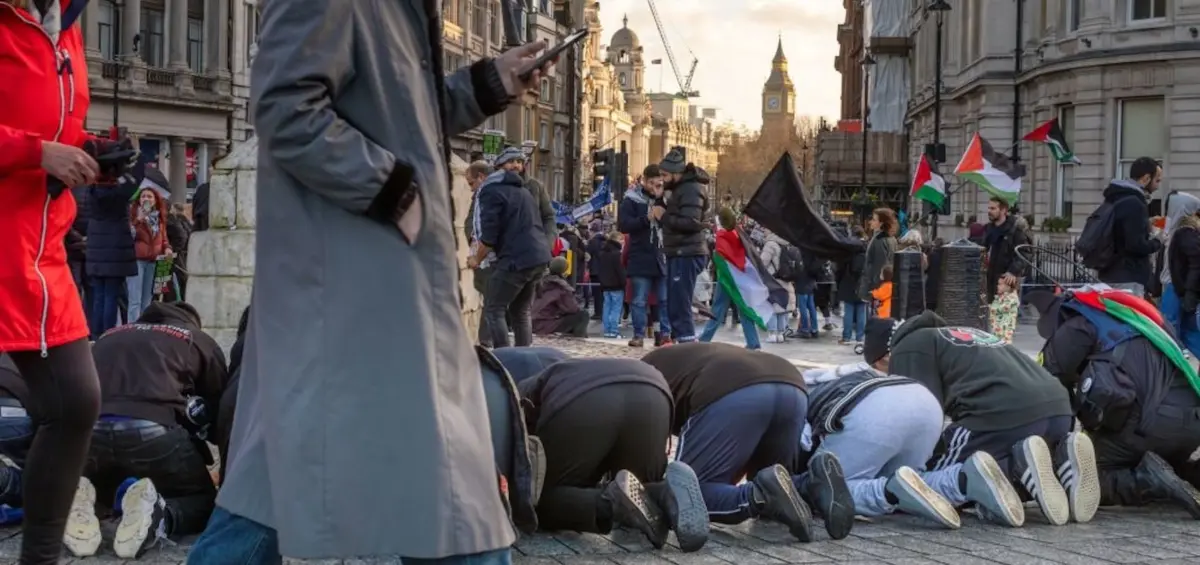
The divergence in how Western nations manage public space versus how stable hybrid models operate highlights a growing vulnerability in Euro-American jurisprudence. In major European urban centers—such as London, where mass Friday prayers (Jumu’ah) routinely occupy spaces like Trafalgar Square—local authorities and law enforcement have frequently exhibited hesitation in maintaining rigorous public order. This hesitation is largely driven by institutional anxiety over being labeled "Islamophobic," a dynamic that critics argue compromises the equal enforcement of civil law and fosters a pervasive fear of confronting criminal behavior within insular communities.
Official Statements & Intellectual Perspectives
The debate over how Western democracies should respond to the public encroachment of non-Western religious legal systems divides contemporary political theorists, legal scholars, and constitutional analysts.
The Classical-Liberal and Progressive Consensus
Mainstream progressive commentators and classical-liberal analysts argue that the foundational tenets of Western democracy—specifically the First Amendment in the United States—forbid any form of governmental preference for a majority religion. Proponents of this view maintain that the universalist principles of human equality enshrined in the Declaration of Independence mandate an open, non-discriminatory approach to immigration and civil rights.
"The great egalitarian principles of our Founding forbid us from discriminating among the millions of people around world who would like to enter our country… whatever the religions and cultural practices of their home countries," note progressive legal advocates who view unrestricted migration as a moral imperative of the American social contract.
The Postliberal and Historical Realist Perspective
Conversely, institutional historians and postliberal critics argue that a society cannot survive by severing ties with its civilizational bedrock. They contend that the state possesses a legitimate "police power" to preserve public morals, social cohesion, and the foundational cultural identity of the nation.
"History counsels against enervating despair," writes historian James Hankins. "It stands as a witness that there are other exits from the impasses of today… The form of government the Founders created… was the result of sifting and adapting different elements of the Western republican tradition."
In assessing potential models for balancing religious majority rights with minority protections, analysts point to the Malaysian constitutional framework as a pragmatic blueprint. Under this model, the state protects its foundational Islamic identity by restricting public proselytizing and public ceremonial displays by non-Muslims, while simultaneously guaranteeing full civil equality, economic participation, and judicial protection under secular civil law for minorities.
Future Outlook: Navigating the Intersection of Faith and Law
As Western nations look toward the coming decades, the imperative to reconcile mass migration with domestic stability will define the survival of the republic. Failing to address the structural strains of unassimilated, politically ambitious religious movements risks replicating the severe social polarization currently visible across Continental Europe and the United Kingdom.
To avert this trajectory without violating foundational constitutional liberties, legal scholars and policymakers must begin laying the intellectual and legislative groundwork for reform:
- Refining Legal Categories: Future jurisprudence may need to formally distinguish between the free exercise of private religious conscience—an inviolable right protected under the First Amendment—and the public exercise of aggressive, electronically amplified missionary movements that seek to contest the public square and establish parallel legal norms.
- Municipal and State-Level Regulations: Following the precedents set by democratic nations such as Denmark and Greece, state legislatures can utilize traditional police powers to enact stricter municipal permitting laws regarding the placement of large-scale religious structures in city centers and restrict electronically amplified public broadcasts of religious calls to prayer.
- Strategic Immigration Curation: Policymakers must summon the moral and political courage to implement rational, security-conscious immigration screenings that account for cultural compatibility and the preservation of Western civic norms, while maintaining humanitarian exceptions for persecuted religious minorities globally.
Through a sober application of historical precedent and courageous institutional stewardship, Western democracies can successfully navigate the pressures of the modern era, ensuring that the Judeo-Christian foundation of their civilization remains secure for generations to come.



Comments
Facebook App ID not configured. Please add it in the Customizer.