
Executive Overview
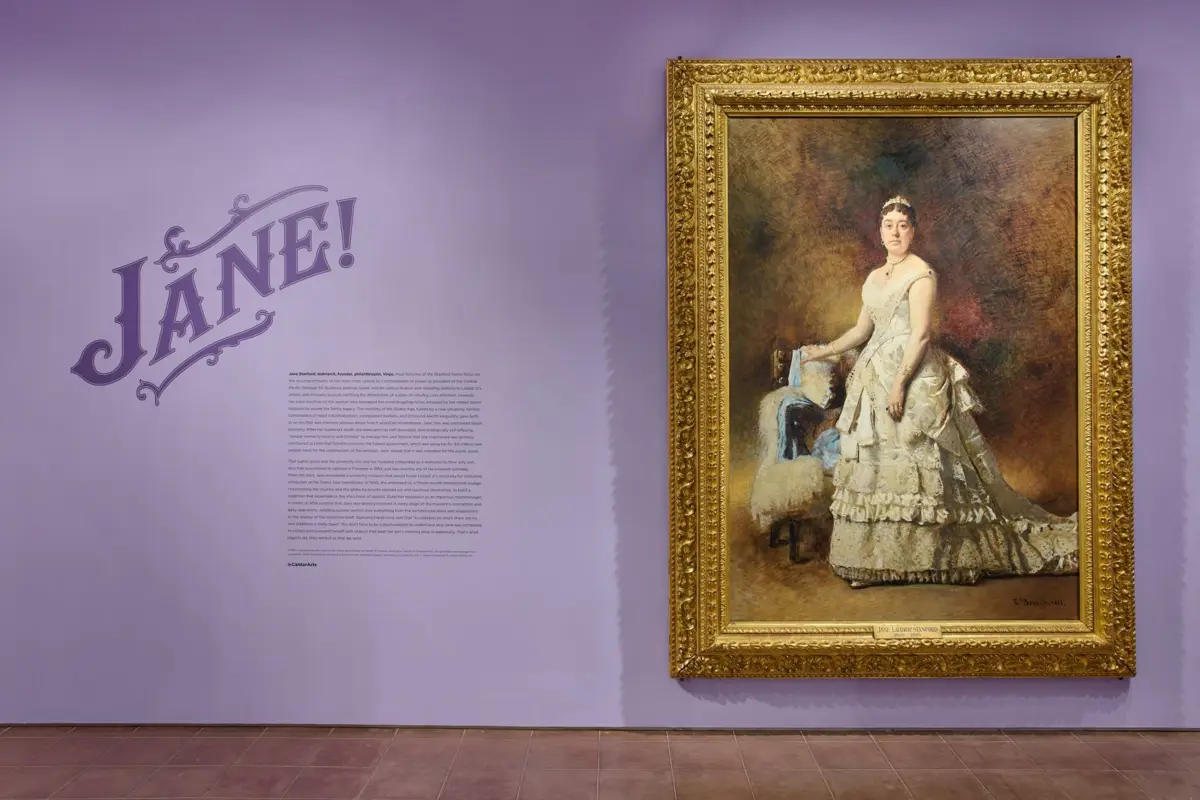
Long before Silicon Valley emerged as a global epicenter of technological disruption and venture capital, its ideological foundation was forged in profound personal tragedy. Jane Stanford—the visionary matriarch and co-founder of Leland Stanford Junior University—has historically been cast as a secondary figure to her husband, the railroad magnate and statesman Leland Stanford. However, a landmark exhibition currently on view at the university’s Cantor Arts Center challenges this historical oversight. Titled "Jane!" and running through May 18, 2028, the showcase offers an unprecedented, deeply intimate look at a woman whose life was defined by sweeping philanthropic ambition, global exploration, profound grief, and a violent, unsolved end.
Curated by Patrick R. Crowley and supported by institutional scholarship, "Jane!" brings to light artifacts that have never before been publicly displayed. These range from high-art portraits and eccentric family keepsakes—such as ceramics depicting her son’s final breakfast—to haunting relics connected to her mysterious death by strychnine poisoning in 1905.
/https://tf-cmsv2-smithsonianmag-media.s3.amazonaws.com/filer_public/cb/f5/cbf53a8f-ab25-4f04-9809-58da970031e4/2026-07_jane_gc-4-web.jpg)
For decades, the official narrative surrounding Jane Stanford’s death was one of natural causes, a convenient fiction manufactured by university leadership to shield the nascent institution from scandal. Today, historians, university archaeologists, and museum curators are rewriting her legacy. They are presenting her not merely as a grieving mother who memorialized her child, but as a formidable, complex, and pioneering institutional leader who laid the structural and financial groundwork for one of the world’s most prestigious universities.
Read Also
Detailed Chronology
To understand the trajectory of Jane Stanford’s life is to examine a sweeping historical arc defined by sudden ascents to immense wealth, devastating personal losses, and relentless institutional building.
/https://tf-cmsv2-smithsonianmag-media.s3.amazonaws.com/accounts/headshot/IMG_7600-edit-v2.png)
- 1828: Jane Lathrop is born into a large, prominent family in Albany, New York, where she develops the foundational values of duty, family responsibility, and social standing.
- 1850: Jane marries Leland Stanford, an ambitious attorney who would soon seek his fortune out west during the transformative era of American westward expansion.
- May 10, 1869: Leland Stanford—then serving as the president of the Central Pacific Railroad—drives the ceremonial gold spike at Promontory Summit, Utah, completing the nation’s first transcontinental railroad and cementing a colossal industrial fortune.
- 1884: While touring Europe, the Stanfords experience an unmitigated catastrophe. Their only child, 15-year-old Leland Stanford Jr., contracts typhoid fever in Athens, Greece, and dies. The loss shatters the family, redirecting their immense capital toward a philanthropic mission that would reshape higher education.
- 1893: Leland Stanford passes away, leaving Jane as the sole surviving family steward of the fledgling university. Against the prevailing norms of the late 19th century, which routinely barred women from wielding executive power in higher education, Jane assumes direct administrative control, steering the university through delicate financial and legal hurdles.
- 1894: The Leland Stanford Junior Museum (now the Cantor Arts Center) opens its doors. Its architecture is deliberately modeled after the National Archaeological Museum in Athens to honor Leland Jr.’s youthful fascination with classical antiquities.
- January 14, 1905: While residing in her San Francisco mansion, Jane falls violently ill after taking a sip of mineral water. A subsequent chemical analysis reveals the water has been laced with a lethal dose of strychnine.
- February 28, 1905: Fearing for her safety, Jane flees to Hawaii en route to Japan. At the Moana Hotel in Honolulu, she consumes a bicarbonate of soda powder and dies in excruciating agony. Despite an autopsy confirming fatal strychnine poisoning, university president David Starr Jordan publicly attributes her death to heart failure.
- Early 2000s: Medical historians and scholars, including Robert W.P. Cutler and W.B. Carnochan, reopen the archival record of Jane’s death, dismantling Jordan’s century-old cover-up narrative and spotlighting her personal secretary, Bertha Berner, as the primary murder suspect.
- 2022: Stanford historian Richard White publishes Who Killed Jane Stanford?, offering a comprehensive investigative breakdown of the conspiracy, institutional cover-ups, and the conflicting press narratives surrounding the murder.
- July 2026 – May 2028: The Cantor Arts Center launches "Jane!", a multi-year exhibition bringing rare archival objects, personal heirlooms, and forensic clues out of university archives and into the public eye.
Supporting Context & Metrics
The narrative of Jane Stanford cannot be extracted from the socioeconomic landscape of late 19th-century America. The Gilded Age was an epoch defined by rapid industrialization, the accumulation of staggering corporate fortunes, and entrenched patriarchal power structures.
The Gilded Age Wealth Engine
Leland Stanford’s role in the Central Pacific Railroad placed him at the nexus of national commerce, politics, and real estate development. The fortune that built Stanford University was derived directly from the labor of thousands of workers—notably Chinese immigrants who laid the treacherous tracks of the transcontinental railway. When Leland Jr. died, the family’s net worth was estimated in the tens of millions of dollars (equivalent to billions in contemporary terms).
:focal(1500x1000:1501x1001)/https://tf-cmsv2-smithsonianmag-media.s3.amazonaws.com/filer_public/cb/f5/cbf53a8f-ab25-4f04-9809-58da970031e4/2026-07_jane_gc-4-web.jpg)
Rather than passing this dynastic wealth down through generations or squandering it on high society, Jane and Leland made the radical decision to dedicate their entire estate to public education. As Isabelle Rogers, assistant registrar at the Cantor Arts Center, notes: "They didn’t have a child anymore, and so she thought that all of California could be her children."
The Spiritualist Movement and Coping with Grief
The sudden loss of Leland Jr. in 1884 fractured Jane’s psychological baseline. In an era before modern grief counseling or psychiatry, she turned to Spiritualism—a popular religious movement promising tangible communication between the living and the departed. Spiritualism allowed Jane to maintain an ongoing, active relationship with her deceased son and husband, guiding her administrative decisions for the university through what she believed were supernatural consultations. This mystical worldview informed her eccentricities and set her apart from the buttoned-down, pragmatic industrialists of her husband’s circle.
/https://tf-cmsv2-smithsonianmag-media.s3.amazonaws.com/filer_public/04/9d/049d1eb9-1c67-4577-a6ff-562c1f7bc7e4/mosaic.png)
The Forensic Reality of the Murder
The mystery of Jane’s death rests on hard scientific and archival metrics:
- The Poison: Strychnine is a powerful, highly toxic alkaloid traditionally utilized as a pesticide to eradicate rodents. It causes violent muscle spasms and asphyxiation, matching the exact physical symptoms Jane experienced in both San Francisco and Honolulu.
- The Suspect Pool: Investigations centered primarily on two individuals: David Starr Jordan, the university president who actively suppressed the coroner’s findings to prevent institutional disgrace, and Bertha Berner, Jane’s personal secretary, who possessed unsupervised access to Jane’s living quarters, possessions, and financial assets.
Official Statements & Curator Insights
The intellectual weight of the "Jane!" exhibition rests on the meticulous work of Stanford’s curatorial and heritage teams, who have spent years unearthing forgotten items from campus vaults.
/https://tf-cmsv2-smithsonianmag-media.s3.amazonaws.com/filer_public/c5/92/c5920bad-a7a1-405a-998e-8eb181e8a40b/jls14897_cdp-pub_angel.jpg)
Exhibition curator Patrick R. Crowley emphasizes the surprising dichotomy of Jane’s character, noting in a statement that she was "so formidable, peculiar and unexpectedly human." Crowley points out that while high-art items populate the exhibition, visitors will also encounter eccentricities that reveal the raw, unvarnished texture of the Stanford family household. Among these are a painting documenting Jane’s legendary jewel collection, plaster death masks, and ceramic sculptures by artist David Gilhooly recreating Leland Jr.’s final meal of bacon, eggs, and toast.
Laura Jones, director of Stanford’s heritage services and the official university archaeologist, underscores Jane’s under-recognized agency as an executive and builder:
/https://tf-cmsv2-smithsonianmag-media.s3.amazonaws.com/filer_public/91/19/911943c8-65db-4727-8472-c9a7c4d406a0/jls18217_cdp-pub_portrait.jpg)
"She started out with very little wealth, and they developed massive wealth and power and influence. And she learned about that alongside him… She was prepared as a widow to take on that role of making the decisions about the university’s future."
Jones rejects the notion that the university was solely Leland’s intellectual property. She frames Jane as the archetype of the modern Silicon Valley founder:
/https://tf-cmsv2-smithsonianmag-media.s3.amazonaws.com/filer_public/37/65/3765fd26-99f1-41ce-adf4-f98e9202dd97/leland.jpg)
"She’s huge as a philanthropist, and she doesn’t really get recognized for that. People talk all the time now at Stanford about ‘founders.’ All our students want to found something or build something. And she really is our prototype."
Future Outlook
The opening of "Jane!" at the Cantor Arts Center marks a watershed moment in how academic institutions process, curate, and display their foundational histories. For over a century, university lore favored a sanitized, paternalistic origin story that lionized Leland Stanford while relegating Jane to the sidelines as a tragic, grieving widow.
/https://tf-cmsv2-smithsonianmag-media.s3.amazonaws.com/filer_public/41/6e/416e4309-595b-4fe7-9232-bd9aa2cbb6ba/199153_gilhooly_breakfast-2.jpg)
By dedicating a multi-year exhibition to her complex personality, her passion for global art collecting, her spiritualism, and the unresolved criminal conspiracy behind her assassination, Stanford University is actively correcting its institutional memory.
As scholars continue to analyze archival documents, and as the public interacts with newly exhibited artifacts through May 2028, Jane Stanford’s legacy is undergoing a permanent transformation. No longer obscured by the shadow of her husband or the sanitized myths of early university presidents, she is finally stepping into the light as the true, formidable architect of one of the world’s premier educational institutions—a visionary leader whose life and death remain as fascinating as the university she left behind.



Comments
Facebook App ID not configured. Please add it in the Customizer.