In 2022, an anonymous cardboard box was dropped off at a United Service Organizations (USO) office in New York. Inside lay more than 300 handwritten artifacts: a remarkably preserved, decades-old archive of wartime correspondence. The letters spanned the globe—from England and France to Belgium, Germany, and North Africa—chronicling the thoughts, anxieties, and enduring devotion of a young American soldier known to his wife as "Speedy."
For years, the origins of the collection remained a blank slate. Neither the donor nor the post-war fate of the couple was known. The trove eventually traveled to the USO’s headquarters in Virginia, sparking an multi-year investigative effort by historians, archivists, journalists, and amateur genealogists.
Through a blend of digital sleuthing, media campaigns, and public outreach, researchers finally cracked the case, tracking down living relatives who could breathe life into the black-and-white photographs and ink-stained pages. The discovery offers an intimate, everyday perspective on the monumental sweep of World War II, shedding light on the psychological tolls of prolonged separation, military bureaucracy, and the fragile threads that kept families connected across oceans of uncertainty.
Detailed Chronology: From the Bronx to the Front Lines
The story of Louis "Speedy" Weber and his wife, Frances, began long before the world was consumed by global conflict. In 1940, the young couple lived near each other in New York City, children of immigrant parents who populated the bustling neighborhoods of the Bronx. They married in 1941, just as the looming shadow of global war began to reshape American life.
The Early Days of Separation (1942)
Following the attack on Pearl Harbor, America’s entry into World War II upended millions of lives. In the spring of 1942, 23-year-old Louis Weber enlisted in the United States Army. Thrust into a jarring new reality, he learned how to endure the grueling monotony and physical rigors of military training—waking up in the pitch-dark morning hours, working kitchen duty until sunset, and sporting the mandatory 1.5-inch military haircut.
To cope with the sudden rupture from his newlywed life, Speedy threw himself into his duties, realizing that staying busy was his best defense against crippling homesickness. On June 17, 1942, he wrote to Frances:
"I don’t feel as blue as I did yesterday. They don’t give me a minute to think about anything but Army life, and in a way that’s the best thing for me, because if I stopped to think about home I’d go nuts."
Crossing the Atlantic and Witnessing History (1944)
As the war escalated, Speedy shipped out to the European theater, joining the immense logistical machine preparing for the liberation of Europe. Like hundreds of thousands of other GIs, he relied on writing as his primary emotional lifeline. He penned roughly 100 letters a year—averaging one every three or four days—sending them back home under datelines bearing evocative, intentionally vague headings like "somewhere in England," "somewhere in France," and "somewhere in Luxembourg."
By June 1944, Speedy found himself crossing the English Channel in the wake of the D-Day landings. He viewed the historic invasion with a mixture of awe and youthful bravado. On June 14, 1944, he captured the sheer scale of the operation for Frances:
"When I was on my way across the channel, I felt just as safe as if I were in your arms, because as far as the eye could see, there was nothing but ships of every description. When I looked up into the sky, I had a hard time seeing the sun because of the planes we had up there. It was a sight I’ll never forget."
Yet, alongside the grand historical moments came the tedious frustrations and absurdities of military life. In early 1945, Speedy penned a letter explaining that he had been demoted from private first class to private. Writing with characteristic wit, he noted that while a reason had been given, he and his peers considered it entirely flimsy—though he reassured Frances that she need not worry about him dropping any lower, "because there is no smaller grade than private."
Post-War Normalization and Decades of Silence
When the guns finally fell silent, Speedy returned home to New York. He and Frances built a stable, quiet life together. Speedy worked as a truck driver, while Frances managed a career at the U.S. Post Office. Though they never had children, they spent decades side by side, eventually retiring to Florida. Speedy passed away at age 78, and Frances followed at 87; they rest side by side in a Jewish cemetery.
For decades, their wartime correspondence remained a private family echo—until a mysterious anonymous drop-off at a New York USO office in 2022 thrust Speedy Weber back into the public eye.
Supporting Context & Metrics: The Lifeline of Wartime Mail
The preservation of Speedy’s letters offers a rare window into the communication systems that sustained Allied morale during World War II. According to Lynn Heidelbaugh, a curator at the Smithsonian’s National Postal Museum, mail was the absolute primary channel of communication for those on the front lines.
The U.S. government recognized early on that keeping service members in touch with their loved ones was vital to operational success. Authorities actively encouraged military personnel to write home, frequently providing free stationery and waiving postal fees. Statistics from a 1944 military survey underscore the sheer volume of this correspondence: service members sent letters, postcards, and single-page V-Mail—a microfilmed mail system designed to save cargo space—at an average rate of six times per week.
Despite these staggering numbers, the survival rate of such massive collections is remarkably low. Heidelbaugh notes that letters sent from service members to the home front were far more likely to survive because families safely stored them in boxes, attics, and closets. Conversely, letters sent to soldiers on the move were frequently lost, destroyed, or discarded as units constantly shifted positions across active war zones.
Speedy’s letters stand out not only for their volume—over 300 individual pieces preserved in a single box—but also for their literary quality. Archivist Michael Case of the USO describes Speedy’s writing style as "everyday elegant." Though he likely never advanced past high school, Speedy possessed an innate theatricality and emotional intelligence. He peppered his letters with imaginative affectionate nicknames for Frances, ranging from the traditional ("Dearest," "Darling") to the whimsical ("Legs," "Knucklehead," "Shape," and famously, "Meatball").
Official Statements and the Breakthrough Investigation
For years, the identity of the donor who dropped the cardboard box at the USO remained an impenetrable mystery. The USO’s initial partnership with the Washington Post in 2024 uncovered census records establishing Speedy and Frances’s pre-war roots in New York, but failed to locate living descendants.
Determined to unlock the family history, the USO ramped up its public outreach efforts. In May 2026, the organization digitized a curated selection of the letters, timing the release with media coverage of WWII dramas such as Focus Features’ Pressure. To generate public interest, the USO enlisted actor Andrew Scott—star of Pressure—to read excerpts of Speedy’s gripping, bleak dispatches written immediately after D-Day.
Jennifer Passey, vice president of communications at the USO, voiced the organization’s mission to the press:
"We’re putting the letters back out there as people are talking about this movie. We would love for anyone who may know more about Speedy or his wife, Frances, to reach out to us."
The turning point finally arrived through crowdsourced determination. Matthew Brown, an amateur genealogist in California, spent hours cross-referencing records on Ancestry.com until he uncovered a potential living relative: Arthur Serota. Brown forwarded the lead to Washington Post journalist Joe Heim, who successfully tracked Serota down in Los Angeles.
Though Serota, then 84, had no prior knowledge of the newly discovered letter archive, he held vivid childhood memories of his favorite uncle. Born in 1942—the exact year Speedy shipped out—Serota recalled Speedy’s eventual homecoming as one of the defining, joyous memories of his early youth.
"He was generous and just had this natural warmth that emanated from him," Serota shared with reporters.
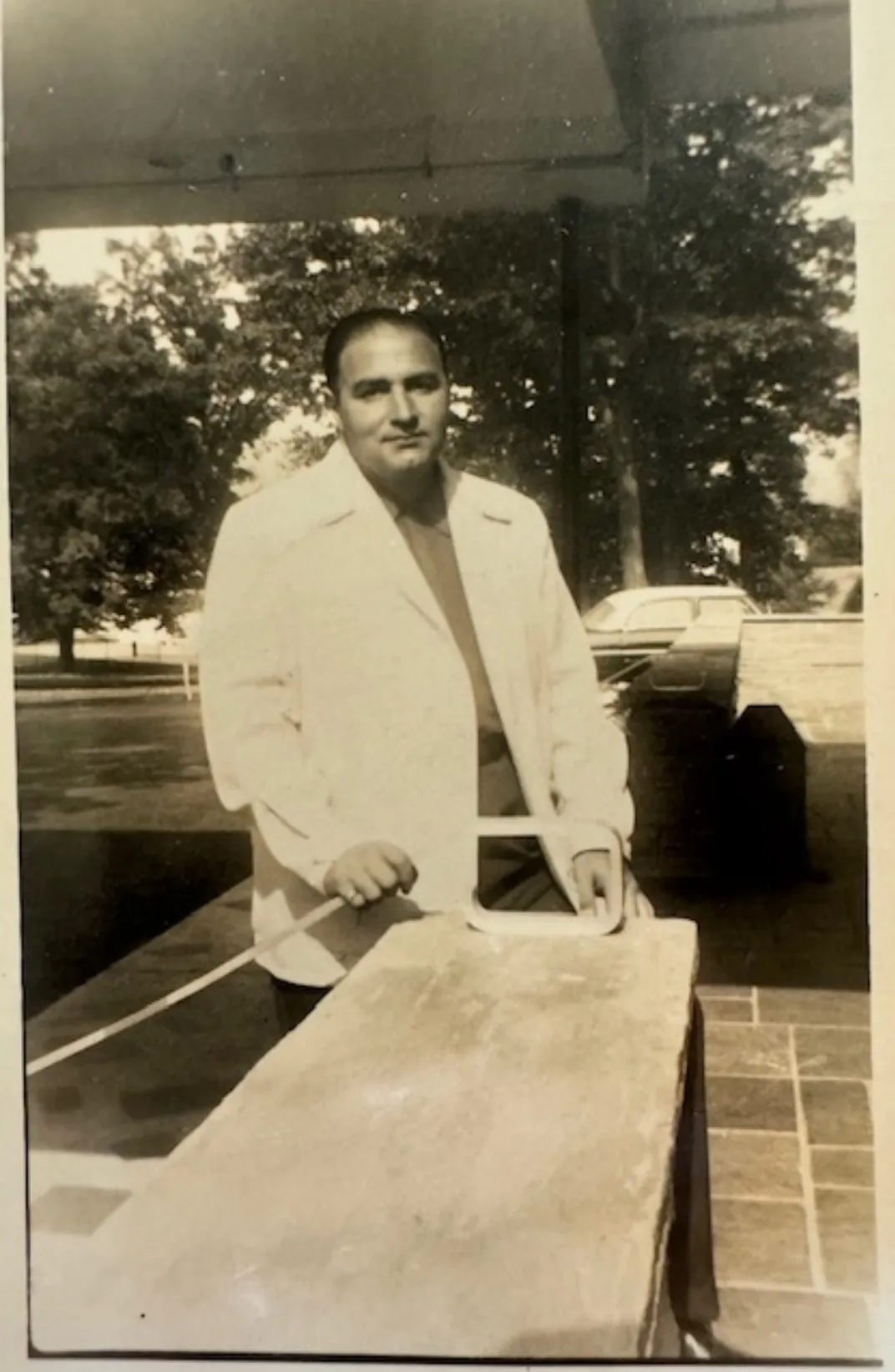
Serota subsequently connected researchers with another relative, niece Karen Weber Figilis, who contributed crucial physical pieces to the puzzle: two precious black-and-white photographs showing Speedy and Frances in a group setting, and Speedy posing independently in a white jacket. For archivist Michael Case, putting a face to the name transformed an abstract historical project into a deeply personal victory.
Future Outlook and Ongoing Mysteries
While the discovery of Matthew Brown, Arthur Serota, and Karen Weber Figilis has illuminated major chapters of Speedy and Frances’s post-war life, significant gaps in the archive remain.
The Donor’s Identity: The primary enigma persists—who exactly dropped the box of 300 letters at the New York USO office in 2022? Archivists theorize that an individual may have stumbled upon the cache while clearing out an estate or cleaning an attic, noticing the USO letterhead and instinctively returning the items to the organization.
Frances’s Perspective: The collection is heavily skewed toward Speedy’s voice. Despite evidence indicating that Frances wrote regularly, only two of her letters survive within the box. Historians note that this imbalance is typical of wartime correspondence, as soldiers on the move rarely had the luxury of archiving incoming mail. Furthermore, archival examination hints that Frances left several of her husband’s letters unopened—an intriguing psychological detail that may never be fully explained.
Public Accessibility: The USO continues to integrate Speedy Weber’s letters into educational exhibits and digital archives. By transforming a private family heirloom into a public historical resource, the organization ensures that contemporary audiences can grapple with the human cost of global conflict.
Ultimately, the Weber archive transcends dry military history. It stands as a timeless testament to the resilience of ordinary people caught in extraordinary circumstances. As Michael Case observes, Speedy Weber was no general or political figure, but rather an everyday citizen who happened to have a front-row seat to history—and who used his pen to keep love alive across a fractured world.

/https://tf-cmsv2-smithsonianmag-media.s3.amazonaws.com/filer_public/fe/a4/fea4733a-0d55-495d-8871-35601a376f66/gettyimages-2186736524.jpg)
/https://tf-cmsv2-smithsonianmag-media.s3.amazonaws.com/accounts/headshot/Ellen_Wexler.png)
:focal(1500x1000:1501x1001)/https://tf-cmsv2-smithsonianmag-media.s3.amazonaws.com/filer_public/fe/a4/fea4733a-0d55-495d-8871-35601a376f66/gettyimages-2186736524.jpg)
/https://tf-cmsv2-smithsonianmag-media.s3.amazonaws.com/filer_public/94/0d/940dfb2b-7f54-4ad0-8162-d1b5b15d54bc/gettyimages-2186736369.jpg)
/https://tf-cmsv2-smithsonianmag-media.s3.amazonaws.com/filer_public/cc/06/cc0606eb-e5e8-41a8-842c-d31e30c1c266/gettyimages-2287835789.jpg)
/https://tf-cmsv2-smithsonianmag-media.s3.amazonaws.com/filer_public/95/2a/952a9cc4-a2ba-4d8c-ae2e-c7c7a0e4a418/louis_speey_weber_20260608_104427_gmail.jpg)

Comments
Facebook App ID not configured. Please add it in the Customizer.