
Executive Overview
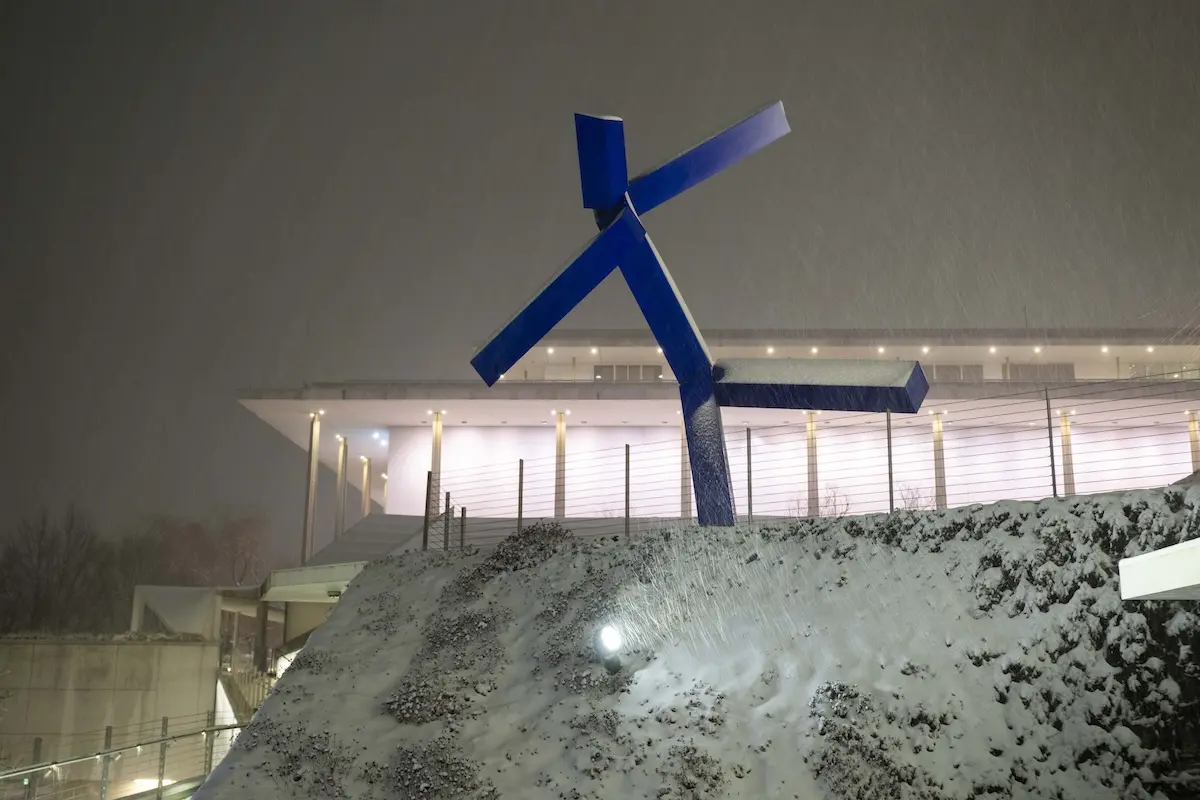
The dismantling of Joel Shapiro’s monumental 2019 sculpture Blue from the grounds of the John F. Kennedy Center for the Performing Arts in Washington, D.C., marks a dramatic escalation in the ongoing ideological and political tug-of-war surrounding one of the nation’s premier cultural institutions. Standing at an imposing 24 feet, the minimalist metal sculpture—which features abstracted human forms captured in a dynamic, suspended state of kinetic energy—was carefully disassembled, its cobalt-hued limbs pulled apart in a sequence of events first reported by the New York Times.
The removal of the artwork coincides directly with renewed efforts by the Trump administration to exert direct administrative and symbolic control over the Kennedy Center. While the institution’s leadership has remained tight-lipped, offering no formal explanation to press inquiries regarding the sudden de-installation, the cultural and political communities have been quick to draw a line between the physical alteration of the campus grounds and the broader authoritarian push to reshape the venue’s identity.
This controversy is not occurring in a vacuum. It represents the latest chapter in a protracted battle over the legacy, governance, and physical presentation of the Kennedy Center. From past legal skirmishes over executive attempts to force the inclusion of Donald Trump’s name on the building’s neoclassical facade to behind-the-scenes board maneuvers, the fate of the center has increasingly become a proxy war for broader American cultural politics.
Read Also
As civic groups, artists, and preservationists sound the alarm over what they perceive as the erosion of artistic independence, the de-installation of Blue has transformed from a logistical museum operations issue into a flashpoint for free expression. This in-depth report examines the chronology of the removal, the artistic significance of Shapiro’s masterwork, the political friction surrounding the Kennedy Center’s administration, and the broader implications for public art in the nation’s capital.
Detailed Chronology of the De-Installation and Political Upheaval
To understand the weight of the current crisis at the Kennedy Center, it is necessary to examine the timeline of events that brought Blue to the campus, its subsequent dismantling, and the parallel administrative maneuvers undertaken by the executive branch.
2019: The Birth of the REACH and the Arrival of Blue
The story of Blue is inextricably linked to the grand expansion of the Kennedy Center known as the REACH (an acronym standing for Renew, Experience, Activate, Create, and Honor). Opened to the public in September 2019, this $250 million, pavilion-style indoor-outdoor expansion was designed by Steven Holl Architects to integrate the performing arts center more fluidly with the banks of the Potomac River.
As part of the vision for the REACH, curators sought out monumental public art that could engage passersby, soften the brutalist architecture of the original Edward Durell Stone building, and inject a sense of kinetic vitality into the public grounds. Joel Shapiro, a titan of American Minimalism, was commissioned to create a site-specific installation. The resulting sculpture, Blue, rose 24 feet into the air, its jagged, linear geometry offering a striking dialogue with neighboring monumental works by artists such as Deborah Butterfield and Roy Lichtenstein, as well as a prominent statue of President John F. Kennedy.
The Late-Career Triumph of Joel Shapiro
The installation of Blue coincided with a fertile period of retrospective appreciation for Shapiro, who passed away last year. Known internationally for redefining the parameters of sculpture through his use of simple wooden or metal elements to evoke human anatomy and psychological states, Shapiro crafted works that balanced structural austerity with deep emotional resonance.
In a profile published by Art in America around the time of the artist’s death, critic Max Norman encapsulated Shapiro’s genius, writing that the figures appear “gracefully frozen in a gravitational in-between that tickles your brain and tightens your stomach.” Speaking of Blue itself, Shapiro noted during its installation:
"It’s about action and risk and performance and energy. It’s a celebration of possibility."
September 2026: The Sudden Dismantling
Without advance public notice, maintenance and rigging crews arrived at the REACH to dismantle the towering structure. As documented by the New York Times, the process involved systematically unbolting and pulling apart the sculpture’s dynamic limbs.
When pressed by journalists for an official rationale, representatives for the Kennedy Center declined to provide an explanation. The suddenness of the move—undertaken without consultation with the arts community or, notably, a transparent public review process—immediately triggered speculation that the de-installation was politically motivated rather than driven by standard conservation or structural maintenance needs.
The Administrative Takeover and Facade Battles
The physical dismantling of Blue occurred against a backdrop of aggressive administrative restructuring. The Trump administration has increasingly sought to consolidate control over the Kennedy Center’s board, operational policies, and branding.
This campaign is a continuation of previous friction. During earlier phases of political maneuvering, attempts were made to legally mandate the inclusion of Donald Trump’s name on the prominent exterior facade of the building. Although a federal judge ultimately blocked the administration from using executive authority to force the architectural renaming, the underlying desire to bend the institution to the executive’s will has never truly abated. Observers note that while the battle over the signage was fought largely in the headlines and courtrooms, the removal of Blue signals a tactical shift: a move from fighting over the literal nameplate to reshaping the physical curation of the campus grounds.
Supporting Context & Metrics: The Architecture of Public Art at Risk
To fully appreciate the gravity of losing a work like Blue, one must examine the unique role that public art plays within federal cultural institutions in Washington, D.C., and the specific metrics governing the Kennedy Center’s expansion and artistic footprint.
The Cultural Footprint of the REACH
- Total Investment: The REACH expansion cost approximately $250 million, funded largely through private donations and designed specifically to democratize access to the arts.
- Scale of Blue: Rising to a towering 24 feet, the sculpture was engineered to anchor the outdoor landscape, visible from multiple vantage points along the Potomac waterfront and the campus walkways.
- Curatorial Context: Blue stood alongside blue-chip contemporaries, including major installations by Pop Art pioneer Roy Lichtenstein and equestrian sculptor Deborah Butterfield, making the REACH one of the most significant open-air contemporary sculpture gardens in the Mid-Atlantic region.
The Governance Structure of the Kennedy Center
Unlike municipal museums or private galleries, the Kennedy Center occupies a unique hybrid status. Established as a living presidential memorial by an act of Congress in 1958 (initially as the National Cultural Center, before being renamed in honor of JFK following his assassination), the institution is simultaneously:
- A bureau of the Smithsonian Institution for maintenance purposes, yet independently operated through a self-perpetuating board of trustees.
- A recipient of federal appropriations for building upkeep and operations.
- Subject to direct political appointments via presidential board nominations, creating a perennial tension between partisan influence and artistic autonomy.
When an administration seeks to exert control over the Kennedy Center, it typically targets this board structure and administrative leadership. The physical removal of a cherished contemporary artwork serves as a visceral, highly visible manifestation of institutional capture, signaling to the arts community that existing curatorial protections are vulnerable to political whims.
Official Statements and Institutional Reactions
The opaque nature of the de-installation has drawn fierce rebukes from family members, arts advocates, and civil society groups, contrasting sharply with the silence from the Kennedy Center’s current executive leadership.
The Artist’s Family Speaks Out
Ivy Shapiro, the daughter of the late artist, voiced profound dismay over the destruction of her father’s vision. In a statement to the New York Times, she emphasized how deeply personal and professionally significant the commission was for her father:
"My father would have been alarmed by the removal. In Joel’s mind, it was one of his greatest site-specific commissions, which celebrated joy, freedom, and creativity."
The family’s distress highlights a critical ethical issue in museum and institutional management: the moral rights of artists—and by extension, their estates—regarding site-specific commissions. When an artwork is conceived and fabricated explicitly for a specific architectural and spatial environment, tearing it down without consulting the artist’s legacy holders is viewed by many in the fine art community as an act of cultural vandalism.
Grassroots Activism and the Arts Community
The broader cultural sector has not remained silent. Advocacy organizations dedicated to protecting federal cultural assets have mobilized quickly to condemn the action.
Hands Off the Arts, a prominent coalition of artists, curators, and activists formed to monitor and resist political interference in Washington’s cultural institutions, released a searing statement linking the removal of Blue to the ongoing battle over the building’s identity:
"First they came for the facade, now they come for the grounds."
The group argues that the removal is part of a systematic campaign to purge the campus of artworks and programming that do not align with a specific nationalist, partisan aesthetic. By targeting an abstract minimalist work celebrating "action, risk, and possibility," the administration is seen as seeking to replace challenging, thought-provoking contemporary art with sanitized, politically compliant imagery.
Future Outlook: What the Removal of Blue Means for American Culture
As the disassembled parts of Joel Shapiro’s Blue sit in storage—their ultimate destination and future status shrouded in bureaucratic secrecy—the incident serves as a chilling bellwether for the future of public art and cultural institutions in the United States.
The Threat to Artistic Independence
The politicization of the Kennedy Center threatens to establish a dangerous precedent. If executive administrations can bypass curatorial boards and professional museum standards to remove artworks they find aesthetically unpalatable or ideologically misaligned, public art across all federal spaces becomes inherently unstable. Museums, monuments, and performance halls risk becoming weather vanes for whichever political party holds the White House, stripping them of their historic role as independent sanctuaries for free thought and creative expression.
Legal and Ethical Questions Ahead
Legal scholars and arts advocates are currently examining whether the removal violates any provisions of the Visual Artists Rights Act (VARA) or the specific terms of the original commission agreements between Shapiro and the Kennedy Center. While site-specific works present complex legal challenges regarding de-installation and relocation, the complete lack of transparency from the institution’s leadership opens the door to potential litigation from the Shapiro estate.
Conclusion: A Test for Civil Society
The dismantling of Blue is far more than the removal of a 24-foot metal sculpture; it is a test of the resilience of America’s cultural infrastructure. As the administrative struggle for the soul of the Kennedy Center continues behind closed doors, the public loss of this monumental celebration of joy and freedom stands as a stark reminder of how fragile artistic liberty can be when subjected to the levers of political power. Whether the arts community, legal advocates, and civil society can successfully push back against this encroachment will determine whether the nation’s premier cultural center remains a beacon of creative possibility or becomes another casualty of partisan politics.


Comments
Facebook App ID not configured. Please add it in the Customizer.