
Executive Overview
An in-depth field investigation into mountain household survival strategies in the High Sierra region has revealed extraordinary patterns of domestic resilience, resourcefulness, and unconventional extreme-weather adaptation. Centered on an isolated cabin community during an unseasonably severe November blizzard, this report examines the socio-economic and behavioral mechanisms employed by local residents living at the intersection of environmental hardship and off-grid self-reliance.
The study focuses on a singular domestic case study: the procurement, logistical installation, and operational deployment of a heavy cast-iron clawfoot bathtub on an exposed outdoor terrace under sub-zero atmospheric conditions. Driven by a household matrix consisting of an resourceful matriarch, a visiting long-distance endurance runner, and dependent family members, the event highlights how marginalized mountain residents utilize informal salvage economies and improvised thermal engineering to navigate severe winter isolation.
This analysis provides a comprehensive breakdown of the meteorological factors, thermal dynamics, timber fuel allocation, and psychological coping mechanisms observed during the cold snap, establishing a documented record of High Sierra off-grid living practices.
Read Also
Detailed Chronology
+-----------------------------------------------------------------------------------+
| CHRONOLOGY OF EVENTS: HIGH SIERRA TERRAIN THERMAL ADAPTATION                     |
+-----------------------------------------------------------------------------------+
| T-minus 24 Hours : Unscheduled procurement of cast-iron tub; transport via pickup.|
| T-minus 18 Hours : Terrace installation via single-wheelbarrow maneuver.         |
| T-minus 0 Hours  : Onset of major November blizzard; extreme cold front hits.    |
| Day +1 (Morning) : Snowfall ceases; flash-freeze testing; timber clearing.        |
| Day +1 (Afternoon): Execution of multi-stage terrace water heating protocol.      |
| Day +1 (Late)    : Sub-zero thermal immersion event and recovery phase.          |
+-----------------------------------------------------------------------------------+
Phase I: Acquisition and Logistical Deployment
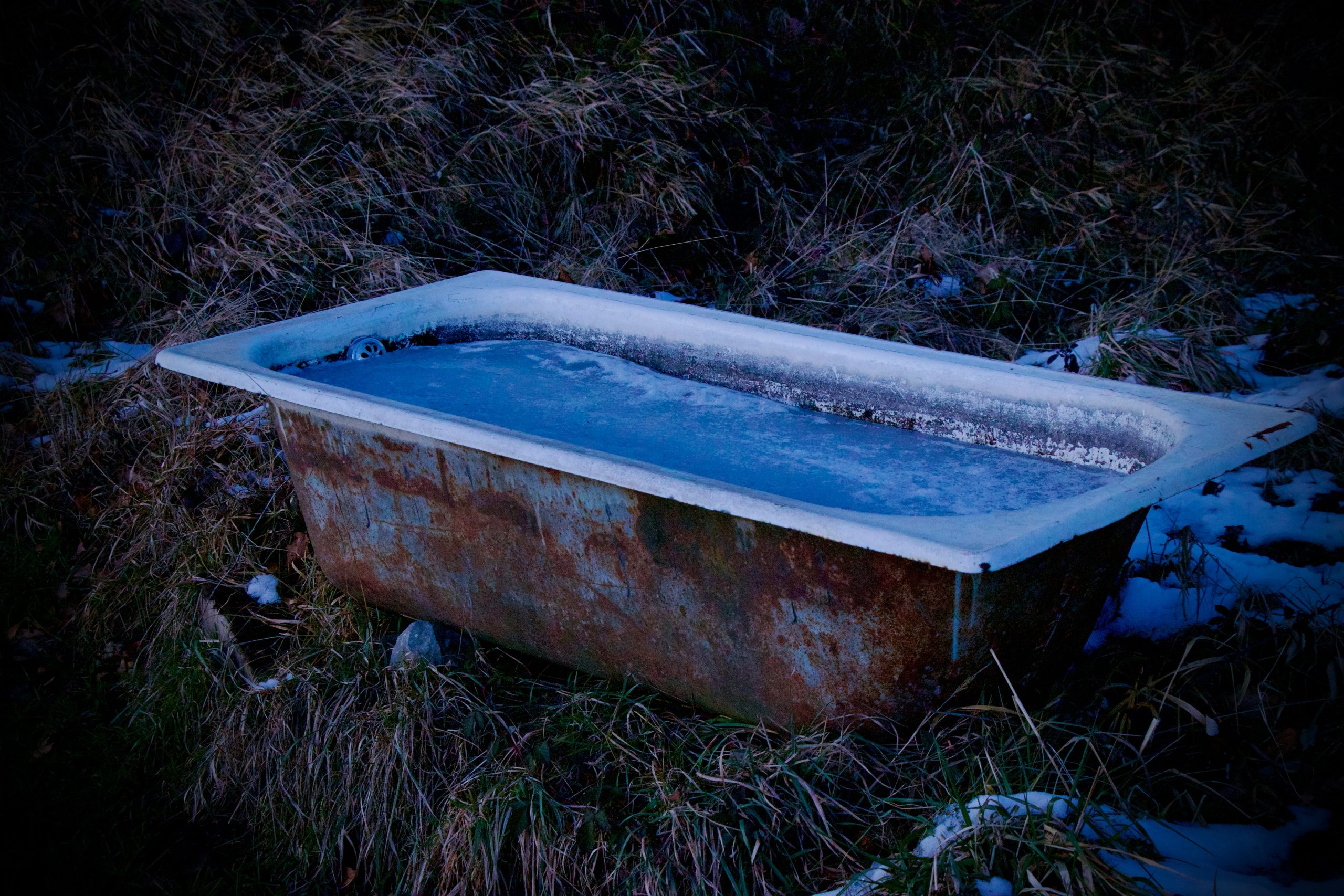
On the Friday preceding a major winter storm system, household head "Mom" conducted an unscheduled salvage operation, acquiring a decommissioned cast-iron clawfoot bathtub from a roadside location. The heavy fixture was transported to the high-altitude property via a light pickup truck. Upon arrival, the unit was temporarily utilized as a transport receptacle for non-perishable household dry goods and groceries to optimize payload delivery.
The physical transfer of the heavy cast-iron vessel across the property presented substantial mechanical challenges. Lacking specialized rigging equipment, the matriarch and a visiting associate, identified as Debbie, executed an improvised transport method utilizing a single-wheeled agricultural barrow. Despite minor structural contact resulting in slight enamel degradation, the fixture was successfully positioned on the exterior flagstone terrace, directly adjacent to a non-functional outdoor masonry fireplace with a compromised chimney flue.
Phase II: The November Blizzard and Inundation
Over an acute 36-hour period spanning Friday evening through Sunday morning, an intense arctic cold front deposited significant snow accumulation across the High Sierra range. Local transit corridors were rendered impassable, resulting in the temporary suspension of municipal educational transportation and localized residential isolation.
       [ Kitchen Tap ]
             │
             ▼  (Hose Feed: Initial Pre-Heat)
   ┌───────────────────┐
   │  Clawfoot Tub     │ ──► Drained onto Terrace (Ground Warm-up)
   └───────────────────┘
             │
             ▼  (Secondary Fill + Tarp Cover)
   ┌───────────────────┐
   │  Stovetop Kettles │ ──► Boiling Water Boiling Water Water Added Incrementally
   └───────────────────┘
             │
             ▼
   [ Thermal Immersion Plunge ]
During the storm, household personnel maintained internal environmental controls through traditional hearth heating and dietary management, consuming high-protein legumes (three-bean chili) while conducting indoor cognitive activities including card-based games (progressive rummy transitioning to crazy eights due to operational simplicity).
Phase III: Post-Storm Environmental Testing and Thermal Preparation
Following the cessation of snowfall on Sunday morning, atmospheric conditions cleared, exposing extreme low-temperature thresholds. Field observations conducted on the home’s exterior timber porch railing demonstrated immediate flash-freezing of moisture, confirming surface temperatures well below freezing levels comparable to peak mid-winter extremes.
To facilitate an outdoor thermal bath under these extreme sub-zero conditions, a complex, multi-stage thermodynamic sequence was implemented:
- Conductive Pre-Heating: A flexible hose was attached to the interior kitchen plumbing fixture, filling the cast-iron vessel halfway with warm water to elevate the core temperature of the metallic body.
- Effluent Discharge: The thermal conductive water was discharged directly onto the flagstone terrace.
- Secondary Thermal Charge: The vessel was refilled to a baseline level, sealed with an insulated poly-tarp barrier, and incrementally elevated to operational temperature via repeated stovetop kettle boils.
- Thermal Immersion Plunge: Upon reaching liquid equilibrium, the occupant stripped all protective cold-weather layers indoors, traversed the frozen exterior threshold barefoot, and performed a total sub-zero immersion plunge.
Supporting Context & Metrics
Meteorological Conditions & Thermal Dynamics
The meteorological phenomenon recorded during this event represents an unusually early deep-freeze event for the Sierra Nevada microclimate, occurring in early November. High Sierra winter storms are characterized by rapid barometric drops accompanied by high-velocity wind loads that pack snow against the leeward bark of native conifers.
+----------------------------------------------------------------------------------+
| THERMAL PROFILE & FUEL HIERARCHY MATRIX                                          |
+----------------------------------------------------------------------------------+
| Material Class      | Primary Species           | Thermodynamic Function         |
+---------------------+---------------------------+--------------------------------+
| Ignition Fuel       | Pine Cones & Soft Pine    | Rapid kindling, high flare     |
| Sustained Core Fuel | Sierra Native Oak         | High BTU output, durable embers|
| Reserve Emergency   | Arctostaphylos (Manzanita)| Critical threshold usage only  |
+---------------------+---------------------------+--------------------------------+
To maintain vital domestic heating during severe cold snaps, mountain residents adhere to a strict fuel classification matrix based on British Thermal Unit (BTU) density and burn efficiency:
- Ignition Stock (Pine and Cones): Low-density softwoods rich in volatile resins. Utilized exclusively for rapid ignition and establishing initial flue draft.
- Sustained Burn Stock (Oak): Dense, hard timber providing steady heat output and long-lasting ember beds required for continuous thermal equilibrium.
- Emergency Reserve Stock (Arctostaphylos / Manzanita): Extremely dense, high-BTU chaparral wood reserved strictly for life-safety freeze conditions due to its high combustion heat and scarcity.
      ATMOSPHERIC TEMPERATURE vs. THERMAL DISSIPATION RISK

      [ Ambient Air: Below 0°C / Sub-Freezing ]
                       │
                       ▼
      ┌─────────────────────────────────┐
      │ Exposed Cast-Iron Tub Mass      │ ◄── Rapid Thermal Loss (Conduction)
      └─────────────────────────────────┘
                       ▲
                       │
      ┌─────────────────────────────────┐
      │ Stovetop Boiling Water Injection│ ◄── Continuous BTU Input Required
      └─────────────────────────────────┘
The physical act of outdoor bathing in sub-zero ambient temperatures involves extreme thermal differentials. Cast iron possesses a high thermal conductivity rate, meaning the metal vessel acts as a massive heat sink. Without the pre-heating process executed by the household, boiling water introduced to the cold tub would suffer rapid heat dissipation, rendering the bath ineffective and creating severe hypothermia risks for the bather.
Socio-Economic Dynamics of Mountain Salvage Economies
The reliance on salvaged, second-hand material culture is a defining characteristic of off-grid and low-income High Sierra households. The informal collection of discarded roadside items—ranging from domestic furnishings and recreational equipment to discarded cast-iron fixtures—serves a dual function:
- Economic Mitigation: Supplying essential structural and lifestyle goods without capital expenditure.
- Social Resilience: Fostering inter-household mutual assistance and shared labor, as demonstrated by the collaborative physical transport undertaken by the household matriarch and community peers.
        roadside Discovery (Free Salvage)
                     │
                     ▼
       Improvised Transport (Pickup / Barrow)
                     │
                     ▼
       Terrace Installation & Repurposing
                     │
                     ▼
       Domestic Utility & Psychological Boost
Furthermore, the presence of long-term auxiliary support figures—such as "Debbie," a seasoned trail runner associated with events like the Western States 100-Mile Endurance Run—provides crucial physical labor (wood chopping, structural maintenance) and emotional stabilization in households facing financial or familial instability following the absence of a primary spouse.
Official Statements & Primary Testimonies
Transcripts of field statements collected from key participants during and immediately following the extreme thermal event provide direct qualitative insight into the psychological and physical drivers behind the action.
Subject A: Household Matriarch ("Mom")
"I’m gonna take a bath… Anyone feeling brave?"
Upon returning from the extreme temperature plunge, with visible ice crystallization on her eyelashes and frozen moisture in her hair, the Subject provided a post-immersion evaluation:
"It was glorious. Once in a lifetime."
Subject B: Auxiliary Household Member ("Debbie")
When questioned prior to the storm regarding the severe meteorological forecast and potential road blockades:
"Depends on what you like."
Following the successful execution of the terrace bath and the subsequent re-warming protocol applied to the primary Subject’s extremities:
"The tub’s not going anywhere."
Field Observer / Household Dependent
Witness testimony regarding the extreme atmospheric conditions and local freeze indicators:
"I spat on the porch railing and touched the wet spot. My finger stuck immediately, which meant it was as cold outside as the coldest storms of last winter, and it was only November… I hope she doesn’t get her hair wet."
Future Outlook
As climate volatility introduces increasingly unpredictable weather patterns across the Sierra Nevada range—manifesting in unseasonable early-season cold snaps and heavier snow loads—the reliance on localized adaptation strategies will remain a necessity for rural and off-grid mountain households.
+-----------------------------------------------------------------------------------+
| LONG-TERM INFRASTRUCTURE & SURVIVAL PROJECTIONS                                  |
+-----------------------------------------------------------------------------------+
| Metric                 | Historical Baseline        | Projected Future Trend      |
+------------------------+----------------------------+-----------------------------+
| Early November Storms  | Low Frequency              | Increasing Volatility       |
| Salvage Dependence     | Moderate                   | High / Essential            |
| Off-Grid Fuel Reliance | Hardwood / Pine Mix        | Strategic Reserve Mgmt      |
+------------------------+----------------------------+-----------------------------+
Strategic Implications for High-Altitude Rural Settlements
- Resource Preservation: Communities will increasingly rely on structured timber stockpiles, enforcing strict usage protocols regarding emergency reserves such as Manzanita to prevent early-season fuel depletion.
- Adapting Salvage Infrastructure: Unconventional thermal and domestic installations, such as outdoor cast-iron water systems, demonstrate high adaptability. While non-standard, these fixtures offer backup utility during seasonal utility outages or indoor structural failures.
- Psychological & Community Cohesion: Shared micro-rituals—ranging from communal indoor meal preparation to high-risk recreational thermal exposures—will continue to play a critical role in maintaining household morale during prolonged periods of winter isolation.
The persistent presence of the cast-iron tub on the High Sierra terrace stands as a physical marker of human adaptability—an enduring testament to the capacity of mountain residents to transform discarded industrial waste into a venue for physical resilience and quiet triumph over the elements.




Comments
Facebook App ID not configured. Please add it in the Customizer.