
Executive Overview
In an era saturated with hyper-fixated, literalist categorization, art and literature often find themselves drafted into the service of utility, easily digestible narratives, and moral signposts. Yet, a counter-current persists across cultural history—one that seeks to shatter the boundaries of dualistic thinking. From the foundational awakening of Huineng, the sixth patriarch of Zen Buddhism, to the modern poetic mechanics of Chase Twichell and the cinematic geometry of Michelangelo Antonioni, certain works of art function not as windows to look through, but as glass to be broken.
This article examines the philosophical intersection of nonduality (Advaita) and creative expression. By analyzing historical legend, poetry, and mid-century European cinema, we explore how artistic masterworks intentionally disrupt our conditioned, linear realities. Rather than offering comfort, closure, or tidy resolutions, these mediums employ "Negative Capability"—the embrace of uncertainty—to awaken the human mind to an indivisible, timeless field of perception. Through a synthesis of literary critique, philosophical inquiry, and cinematic analysis, we trace how stepping out of the conceptual cave allows both creators and audiences to encounter reality directly.
Detailed Chronology: From the Marketplaces of Lingnan to the Silver Screen
To understand the architecture of nondualistic art, one must trace its historical and conceptual lineage, observing how traditions of radical unknowing have evolved from ancient ascetic practices to contemporary artistic manifestos.
Read Also
1. The Awakening of Huineng (c. 638–713 CE)
The foundational mythos of Zen’s nondualistic tradition finds its cinematic prototype in the life of Huineng, the sixth patriarch of Chan (Zen) Buddhism. As a young man in the cold spring of Lingnan, Huineng was dispatched to the local market by his widowed mother to trade gathered firewood for sustenance. Amid the din of merchants and travelers, a cadre of itinerant monks from northern China gathered to debate.
At the center of the circle, a monk proclaimed the famous lines of the Diamond Sutra:
All conditioned phenomena!
Are like a dream! An illusion! A bubble! A shadow!
Like dew or a flash of lightning! Thus we shall perceive them!
For Huineng, hearing these words triggered an existential rupture. The boundary between his physical body—his hemp robe, his sandals—and the surrounding earth, wood, and atmosphere dissolved. This sudden shock propelled him on a month-long pilgrimage to the East Mountain Monastery, where his radical egalitarian insight eventually upended traditional monastic hierarchies. Set to work hulling rice with a foot-treadle pestle, Huineng tied a heavy river stone to his waist to compensate for his emaciated frame, turning the mechanical act of physical labor into an ongoing, embodied meditation.
[ Lingnan Marketplace ] ---> ( Hears Diamond Sutra ) ---> [ Dissolution of Ego ]
                                                                 |
[ Rice Shed & Stone Weight ] <--- ( Pilgrimage North ) <---------+
2. The Romantic Embrace of Uncertainty (1817)
Centuries later, Western literature independently converged upon a similar psychological stance. In a letter to his brothers, poet John Keats articulated the concept of Negative Capability. Keats praised individuals who were "capable of being in uncertainties, mysteries, doubts, without any irritable reaching after fact and reason." This formulation served as an ideological bridge, suggesting that intellectual mastery and literal categorization are defense mechanisms against the vast, untamable complexity of the universe.
3. The Cinematic Rupture of L’avventura (1960)
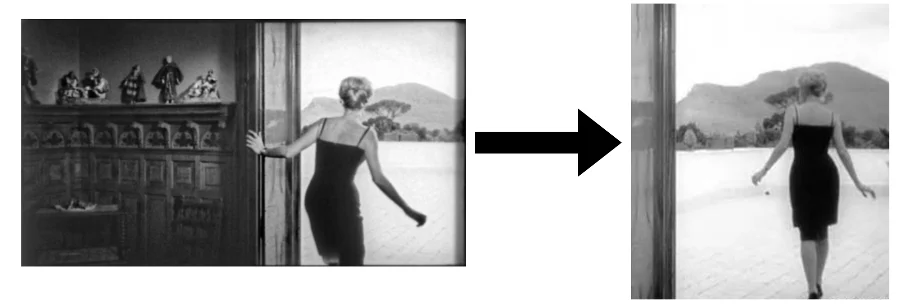
The mid-twentieth century witnessed a radical translation of these principles into the medium of film. Michelangelo Antonioni’s masterwork L’avventura systematically dismantled the traditional narrative tethers—plot, linear dialogue, and psychological exposition—that audience members relied upon to navigate a film.
Following the mysterious disappearance of a young woman named Anna on a desolate Mediterranean island, her lover Sandro and her friend Claudia embark on a search that gradually morphs into an ill-fated romance. Antonioni utilized spatial framing—repeatedly having characters cross through archways, doors, and thresholds—to induce a cinematic equivalent of the psychological "doorway effect," wherein memory and identity scatter upon passing from one space to the next. The film rejects dualistic moralizing; it refuses to clarify whether Sandro and Claudia’s emotional amnesia stems from modern ennui or deep-seated moral decay, leaving audiences suspended in an inescapable aesthetic mystery.
Supporting Context & Metrics: Defining Nonduality in Art
To fully appreciate the mechanics of nondualistic art, one must examine the fundamental friction between human language—which is inherently dualistic—and the unlanguageable spaces art attempts to map.
The Paradox of Language and the Nondual Lens
Language operates by division: subject and object, past and present, self and other. Sanskrit philosophy defines Advaita ("not two") as a state that cannot be defined by what it is, but only by what it is not. It is impersonal, timeless, and indivisible.
Poet and translator Jane Hirshfield notes:
"Non-duality is not the negation of multiplicity in favour of some idea of the absolute; it is also not the nihilism so many Westerners think Buddhism to be."
When poetry or film attempts to convey this state, standard literal comprehension fails. Literary works become less like transparent windows and more like constructed traps designed to stall the linear intellect.
Consider Giuseppe Ungaretti’s micro-poem "Mattina":
M’illumino d’immenso
(I illuminate myself with immensity)
Here, the poem bypasses the traditional framing of a narrator anchored in time and space, recasting the "self" as an unbounded, limitless field of immediate experience.
Metrics of Reception: Reader and Spectator Discomfort
Cultural reception studies regarding avant-garde poetry and slow-cinema indicate a consistent psychological response among uninitiated audiences:
| Medium | Primary Artistic Device | Audience Reaction | Underlying Philosophical Intent |
|---|---|---|---|
| Zen Koans (e.g., Joshu’s "Mu!") | Logical contradiction / non-answer | Intellectual frustration / cognitive stall | Subversion of dualistic reasoning |
| Lyric Poetry (e.g., Chase Twichell) | Interruption of literal imagery | Disorientation / perceived obscurity | Exposing language as a fabricated construct |
| Slow Cinema (e.g., Antonioni) | Protracted static shots / ellipsis | Boredom or profound immersion | Rejection of tidy narrative closure |
As poet Chase Twichell observes of poetry’s uncompromising nature:
"Poetry’s not window cleaning. / It breaks the glass."
Official Statements & Critical Perspectives
Prominent figures across literary, philosophical, and cinematic disciplines have frequently addressed the necessity of breaking away from literalism in favor of transcendent, nondualistic expression.
-
On the Imparatibility of Art:
Chase Twichell emphasizes the direct, non-analytical transmission inherent in both Zen and verse:"Zen is said to be a ‘mind-to-mind transmission.’ The best poems are exactly that: they leap from one mind to another without stopping to explain exactly how they did it. Poetry cannot be paraphrased because it can’t be apprehended by a purely literal mind."
-
On the Rejection of Exposition:
When contemporary critics pressured Michelangelo Antonioni to provide clear narrative resolutions and moral frameworks following the ambiguous, haunting conclusion of L’avventura—where Sandro weeps on a Sicilian bench while Claudia looks out toward the smoking peak of Mount Etna—the director’s response was legendary in its brevity. Echoing the famous Zen koan, Antonioni effectively replied:Mu!
Future Outlook: The Relevance of Nondualism in the Digital Age
As contemporary culture accelerates toward hyper-quantification, algorithmic categorization, and instant information retrieval, the human mind is increasingly trapped within a digital cave of shadows, mistaking data points for reality. The lessons of Huineng, Keats, Twichell, and Antonioni remain more vital than ever.
The future of artistic expression relies heavily on its capacity to resist the flattening effects of technological literalism. By cultivating spaces for "Negative Capability"—embracing doubt, ambiguity, and the collapse of the false self—future creators will continue to forge works that function as modern koans.
Ultimately, art that refuses to explain itself invites us to step out of the intellectual structures we cling to for safety. Whether through the flash of lightning in a foundational Buddhist text, the chilling descent of frost on a New England pine, or the silent, ash-strewn vistas of Sicilian piazzas, the nondualistic tradition reminds us that true perception begins precisely where language ends.


Comments
Facebook App ID not configured. Please add it in the Customizer.