
Executive Overview
On August 23, 1944, a catastrophic aviation accident unfolded in the quiet English village of Freckleton, Lancashire. A United States Army Air Forces (USAAF) B-24H Liberator bomber, assigned the name Classy Chassis II and operating out of a nearby base, slammed directly into the Holy Trinity School during a violent, sudden midmorning thunderstorm.
The resulting explosion and subsequent inferno obliterated the school’s infants’ wing, a local café, and adjacent structures. In a matter of minutes, 61 lives were extinguished. The dead included 38 schoolchildren aged four to six, two teachers, 18 civilians and service personnel at a nearby snack bar, and the three-man American air crew. Of the 41 young children inside the infants’ classroom at the moment of impact, an astonishing 38 perished, wiping out nearly an entire generation of the village’s youngest residents.
Despite claiming the dubious distinction of being the single greatest civilian air disaster suffered by the Allied forces during World War II, the Freckleton air disaster has slipped into relative historical obscurity. Overshadowed at the time by the monumental sweep of the Allied liberation of Paris and buried beneath the broader tragedies of global conflict, the event remains largely forgotten today in both the United Kingdom and the United States.
Read Also
/https://tf-cmsv2-smithsonianmag-media.s3.amazonaws.com/filer_public/bc/67/bc67e7cd-5e2c-4ce2-89ef-dbe16c632594/freckleton-coffins.png)
This deep-dive retrospective examines the events leading up to the tragedy, the chronology of the crash, the socio-military context of "Little America" in Lancashire, the subsequent investigations, and the enduring mission of survivors to ensure the victims are never forgotten.
Detailed Chronology: August 23, 1944
A Morning of Foreboding and Routine
The day began with deceptively mild weather forecasts for late August: early sunshine and light clouds expected to give way to scattered rain showers. At the Holy Trinity School, 176 students had returned for only their second day of the new academic term.
In the infants’ wing, teacher Louisa Hulme was preparing for her impending retirement scheduled for the following week. Alongside her was Jennie Hall, a 20-year-old Freckleton native marking her very first week on the job. Meanwhile, across the village, life proceeded at its wartime cadence.
/https://tf-cmsv2-smithsonianmag-media.s3.amazonaws.com/accounts/headshot/meilan_headshot2.png)
At Base Air Depot 2 (BAD2) in neighboring Warton, First Lieutenant John Bloemendal, serving as the rotating officer of the day, was delayed in his departure for a routine test flight aboard the 25-ton B-24 Liberator Classy Chassis II. Scheduled to take off at 8:30 a.m., Bloemendal, co-pilot Jimmie Parr, and flight engineer Gordon Kinney were held up by administrative duties.
At 10:30 a.m., clearance was finally granted. A second B-24, piloted by Peter Manassero, lifted off immediately afterward on a parallel test flight.
The Gathering Storm
Within minutes of airborne operations, weather conditions degraded at an astonishing velocity. Pilot Peter Manassero later described encountering an imposing thunderhead formation. By 10:40 a.m., severe turbulence, torrential rain, and gale-force winds gusting up to 60 miles per hour swept across the Fylde coast.
:focal(750x500:751x501)/https://tf-cmsv2-smithsonianmag-media.s3.amazonaws.com/filer_public/bc/67/bc67e7cd-5e2c-4ce2-89ef-dbe16c632594/freckleton-coffins.png)
Base operations at BAD2 transmitted urgent radio orders instructing both test aircraft to abort their missions and return immediately.
As Classy Chassis II initiated its return loop, it vanished into the roiling squall line. Manassero radioed a frantic warning to Bloemendal: "We had better head north and get out of the storm." Bloemendal acknowledged the transmission, but the aircraft was already caught in the violent grip of a powerful downdraft or atmospheric shear.
Eyewitnesses on the ground reported the heavy bomber flying at an alarmingly low altitude. Whether a rogue bolt of lightning disabled the aircraft’s control surfaces or the sheer ferocity of the microburst overwhelmed the crew, the B-24 entered an irreversible, fatal downward spiral.
/https://tf-cmsv2-smithsonianmag-media.s3.amazonaws.com/filer_public/82/0e/820ee920-d5e6-4ab0-b138-14a183ca3591/fre_011566.jpg)
The Impact
At 10:47 a.m., the 25-ton bomber careened into the heart of Freckleton. Clipping a nearby building, the aircraft shed its right wing tip. Its main landing gear wheel and tail turret violently struck the Sad Sack Snack Bar—a popular local eatery frequented by British and American servicemen—while its nose turret and engines smashed straight into the Holy Trinity School.
Nearly 2,800 gallons of highly volatile aviation fuel instantly atomized and ignited, transforming the center of the village into a raging inferno.
In the infants’ wing, teachers Hulme and Hall had just instructed their pupils to rest their heads on their desks and listen to a story to calm their nerves amid the storm’s fury. The impact was instantaneous and catastrophic. Young survivors recalled classmates falling from desks as if in slow motion as the roof collapsed and blinding, acrid smoke filled the room.
/https://tf-cmsv2-smithsonianmag-media.s3.amazonaws.com/filer_public/da/ae/daae3ba5-c3a4-4c36-9186-6723e4353095/rescuers_searching_through_demolished_school_after_aberfan_disaster.jpg)
Supporting Context & Metrics: "Little America" in Lancashire
The Strategic Footprint of Base Air Depot 2
To understand why an American bomber crashed into an English classroom, one must examine the massive logistical footprint of the U.S. Eighth Air Force in the United Kingdom. Lancashire had become heavily militarized due to the presence of BAD2 at Warton, situated less than two miles from Freckleton.
BAD2 was an industrial behemoth of the European Theater, responsible for the repair, overhaul, and modification of 10,068 aircraft. In the months leading up to the disaster, more than 10,400 American service members lived and worked at the depot.
This sudden influx of foreign personnel transformed the rural landscape. Freckleton earned the colloquial moniker "Little America." Pubs buzzed with cross-cultural camaraderie, and American servicemen frequently shared scarce luxury items—such as chewing gum, chocolate, and nylon stockings—with local children.
/https://tf-cmsv2-smithsonianmag-media.s3.amazonaws.com/filer_public/1f/7b/1f7b09de-c439-4bc8-b4bc-1938bd1f3425/media-13622.jpeg)
Yet this wartime industrialization carried a heavy price. The Eighth Air Force suffered staggering attrition rates across Europe, but training accidents within the continental United States and operational mishaps on British soil claimed thousands of additional lives. Flight operations in the crowded, unpredictable skies of the British Isles frequently clashed with inexperienced pilots unfamiliar with local meteorological phenomena.
Official Statements and Investigation
Blame, Bureaucracy, and the Limits of Inquiry
In the immediate aftermath of the tragedy, the USAAF launched a formal inquiry into the crash of Classy Chassis II. The resulting investigation placed primary accountability on First Lieutenant Bloemendal, concluding that the accident "resulted from pilot’s error in the judgment of the violence of the storm."
Investigators noted that American pilots, accustomed to the predictable convective storm patterns of the southern United States, frequently underestimated the localized, highly erratic microclimates characteristic of British coastal weather.
/https://tf-cmsv2-smithsonianmag-media.s3.amazonaws.com/filer_public/08/9c/089c435b-016a-4d93-8de5-52b7d6f6ac24/media-40683.jpeg)
However, subsequent historical evaluations—such as those by military historian James R. Hedtke—suggest a more nuanced sharing of responsibility. Critics pointed out that Flight Control Operations at BAD2 held updated meteorological data regarding the storm’s velocity and track that was never successfully relayed to the aircraft in real-time. Ultimately, because the aircraft was completely pulverized and all three crew members perished, the exact mechanical or meteorological catalyst remains speculative.
Diplomatic Sensitivities
Recognizing the potential for the tragedy to strain delicate Anglo-American relations during the height of the war effort, military and civilian leaders moved swiftly to offer condolences and financial restitution.
General Carl A. Spaatz, commander of U.S. strategic air forces in Europe, dispatched formal messages expressing profound regret to the Crown’s representatives in Lancashire. Local authorities graciously accepted the gesture, prioritizing Allied solidarity.
/https://tf-cmsv2-smithsonianmag-media.s3.amazonaws.com/filer_public/9b/d1/9bd1e639-5c8f-4d45-9216-741526848edf/2jxw16g.jpg)
Notably, international news syndicates largely buried the story. On August 24, 1944, front pages across the globe were dominated by monumental geopolitical milestones: the advancing Allied liberation of Paris and the rapid collapse of the German front lines in France. Consequently, the Freckleton disaster was effectively sidelined from the global historical consciousness.
The Human Toll and Aftermath
The Burial and the T-Shaped Grave
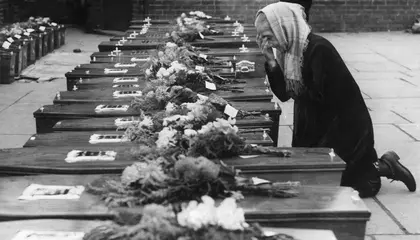
On August 26, 1944, Freckleton held a massive communal funeral. The United States military covered all associated expenses, and American servicemen volunteered to dig the massive T-shaped grave and act as pallbearers.
In a poignant arrangement, Jennie Hall and her students were laid to rest within the arms of the T-shaped plot, while Louisa Hulme and other adult villagers were interred in the vertical trunk of the formation. The three American airmen were initially buried in Cambridge before their remains were repatriated to the United States after the war’s conclusion.
/https://tf-cmsv2-smithsonianmag-media.s3.amazonaws.com/filer_public/81/41/81411415-ed29-45c8-9f7e-dccbe6b71beb/2jxw0hw.jpg)
Survivors and the Long Shadow of Trauma
Of the 41 children in the infants’ wing, only three survived: Ruby Currell, David Madden, and George Carey. All three sustained horrific burns and endured years of painful reconstructive surgeries.
The psychological scars ran even deeper. Survivors recalled the overwhelming guilt of survival, the haunting memories of classmates lost, and the eerie silence that settled over a village missing an entire generation of children.
In a surreal moment of respite amid the grief, legendary American entertainer Bing Crosby visited the surviving children in the hospital on September 1, 1944. Unable to sing inside the ward after witnessing the severity of their burn injuries, Crosby stood in the hallway and performed "White Christmas" and "Don’t Fence Me In" for the recovering youngsters.
/https://tf-cmsv2-smithsonianmag-media.s3.amazonaws.com/filer_public/16/20/1620ed79-a647-4e56-90d7-72c4fd224082/gettyimages-886731788.jpg)
Future Outlook & Legacy: Ensuring No Child Is Forgotten
In the decades following World War II, monuments were erected to honor the fallen. American airmen gifted a children’s playground to the village in August 1945, and a stone memorial was dedicated in 1947. Yet, for many years, the disaster remained a localized grief, quietly passed down through oral histories rather than national curricula.
It was not until the 21st century—catalyzed by local researcher Joyce Turner’s 2007 book and subsequent BBC documentary programming—that broader public awareness began to surface. Today, surviving witnesses like Ruby Currell, who dedicated her remaining years to advocacy, ensure that the victims’ names are spoken aloud.
As time marches forward, the Freckleton air disaster serves as a sobering reminder of the hidden domestic costs of total war. It stands as a testament to the resilience of a small English community, the deep bonds forged between wartime allies, and the enduring obligation of history to rescue forgotten tragedies from the shadows of the past.



Comments
Facebook App ID not configured. Please add it in the Customizer.