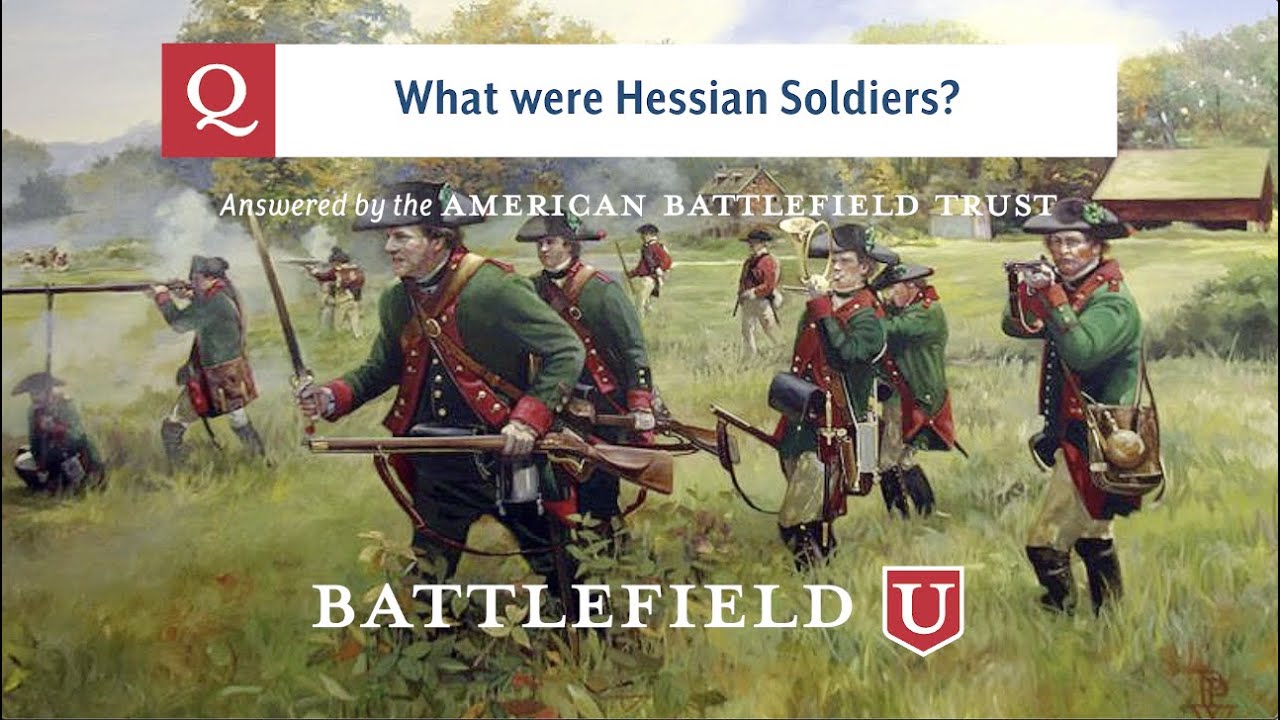
As the United States approaches its monumental 250th anniversary, historians continue to peel back layers of myth to reveal the intricate, messy realities of the American War for Independence. Among the most enduring caricatures of this foundational conflict is the figure of the "Hessian mercenary"—traditionally depicted as a heartless, bloodthirsty soldier-for-hire, easily recognized by his tall brass miter cap, who fought for the British crown purely for personal enrichment.
A Smithsonian magazine special report, drawing on recent scholarship including historian Friederike Baer’s definitive 2022 work Hessians: German Soldiers in the American Revolutionary War, completely upends this historical strawman.
When a flotilla of British vessels arrived off Staten Island on August 15, 1776, bearing more than 8,600 foreign troops, they marked the vanguard of a staggering military mobilization. Over the course of the seven-year conflict, approximately 30,000 German soldiers—representing a mosaic of German principalities, not just Hesse—would be thrust into the American theater.
Far from being free-agent mercenaries, these men were state-sanctioned auxiliaries deployed under traditional European subsidy treaties. They were drafted subjects, volunteers, and press-ganged unfortunates caught in the gears of 18th-century European geopolitics.
Their harrowing transatlantic crossing, their pivotal involvement in major engagements from Long Island to Trenton, their demonization by patriot propaganda, and their surprising post-war integration into American society paint a portrait far more nuanced than the one immortalized in revolutionary pamphlets. Ultimately, while King George III envisioned these foreign troops as the definitive hammer to crush the colonial rebellion, the human reality of the German deployment created ripples that inadvertently helped shape the cultural and demographic fabric of the nascent United States.
Detailed Chronology: From European Ports to the American Crucible
The deployment of German troops to North America was not an isolated impulse of imperial desperation, but the culmination of months of tense diplomatic maneuvering, transatlantic suffering, and rapid escalation on the battlefield.
Late 1775 – Early 1776: Diplomatic Bargaining and Recruitment
Following the outbreak of armed hostilities in Massachusetts in 1775, King George III resolved to forcefully suppress the colonial insurrection. Facing recruitment shortfalls at home, British envoys approached foreign courts, including Russia’s Catherine the Great and the Dutch Republic, seeking auxiliary manpower. Rebuffed by St. Petersburg and The Hague, Britain successfully negotiated subsidy treaties with six independent German territories within the fragmented Holy Roman Empire, most notably Hesse-Cassel and Hesse-Hanau.
Back in Germany, recruitment took various forms. While some men volunteered, many others were conscripted through local militias, and a significant number were unceremoniously pressed into service off the streets. By mid-April 1776, the first major contingent departed the port city of Bremerlehe, mustering in Portsmouth before facing a grueling, nightmarish Atlantic crossing. Conscript Johann Gottfried Seume later recorded the horrific conditions: men packed so tightly into bunks that they had to synchronize rolling over, subsisting on rotting, worm-infested bread and rancid water that "smelled like the rivers of Hades."
August to September 1776: Arrival and the New York Campaign
On August 14, 1776—just one day before the German troops disembarked on Staten Island—the Continental Congress passed a resolution offering land and the rights of citizenship to any foreign soldiers willing to desert British ranks. This initiative was quickly backed by smuggling printed appeals into the German camps.
However, upon arrival, the exhausted troops were immediately pressed into service by British commander General William Howe. On August 22, British and German forces crossed the bay to Long Island. Five days later, at the Battle of Long Island, a combined force of 20,000 British and German troops overwhelmed the Continental Army, inflicting heavy casualties and capturing over a thousand Americans.
Following Washington’s nocturnal retreat across the East River, the Anglo-German juggernaut pursued the retreating Americans through Manhattan—striking at Kip’s Bay and Harlem Heights, forcing the Continental Army through White Plains, and ultimately driving them across the Hudson River into New Jersey and Pennsylvania.
December 1776: The Turning Point at Trenton
Having seemingly pushed the rebellion to the brink of collapse, the British and German forces garrisoned the Delaware River valley. Among these outposts was Trenton, New Jersey, held by a German garrison.
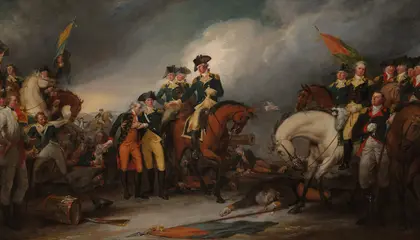
Recognizing an opportunity to shatter British complacency, General George Washington led his troops across the ice-choked Delaware River on the night of December 25, 1776. Launching a surprise dawn assault, the Continental Army overwhelmed the garrison in a fierce two-hour engagement. Close to 900 German soldiers were taken prisoner. The Battle of Trenton fundamentally altered the psychological landscape of the war, proving that the fledgling American military could decisively defeat professional European armies and sustaining the viability of the revolution through its darkest hour.
1777–1783: Protracted Conflict and Demographic Shift
Over the remaining years of the war, German auxiliary troops participated in virtually every major military campaign. Yet, as the conflict dragged on, interactions between the local civilian population and the German soldiers began to shift.
Recognizing that many Germans were reluctant participants caught in a war far from home, American attitudes evolved from hysterical dread—fueled by early rumors of cannibalism and barbarism—to a strange sort of sympathetic pragmatic acceptance. Many Americans noted that German occupiers often treated prisoners and civilians with greater leniency and civility than their British counterparts. When the war finally concluded with the Treaty of Paris in September 1783, thousands of German soldiers chose not to return to Europe, embedding themselves permanently into the North American landscape.
Supporting Context & Metrics
To fully understand the scope of the German involvement in the American Revolution, historians rely on demographic metrics and geopolitical context compiled through meticulous archival research.
Total Troop Strength: Approximately 30,000 German soldiers served under the British flag during the conflict, originating from six distinct principalities: Hesse-Cassel, Hesse-Hanau, Brunswick, Ansbach-Bayreuth, Waldeck, and Anhalt-Zerbst.
Casualties and Attrition: Out of the 30,000 deployed, military historian Edward J. Lowell estimated that roughly 17,300 survived to return to their native lands. Approximately 1,200 were killed in direct combat, while nearly 6,400 died from disease, accidents, or exposure.
Desertion and Settlement: Roughly 5,000 soldiers deserted their posts. Modern historians, including Friederike Baer, estimate that between 5,000 and 6,000 Germans permanently remained in North America after the war. Of those, an estimated 3,500 settled within the newly formed United States, while others relocated to Canada or elsewhere in the hemisphere.
The Financial Mechanism: Under the terms of the subsidy treaties, British taxpayers paid substantial sums to German princes for the deployment of their troops. This included maintenance subsidies, replacement fees for casualties, and, in some agreements, extra payments for wounded or killed soldiers—a transactional practice critics angrily labeled "blood money."
Official Statements and Contemporary Perspectives
The deployment of foreign troops ignited fierce ideological and political debates across the Atlantic world, galvanizing revolutionary sentiment and shaping foundational American legal documents.
The Colonial Outrage and the Declaration of Independence
The decision by King George III to hire foreign auxiliaries crossed a critical red line for many undecided colonists. John Jay, who initially favored reconciliation with Great Britain, pointedly captured the prevailing moral outrage in a widely circulated address, writing:
"Why are the mercenaries of Germany transported near 4,000 miles to plunder your houses, ravish your wives and daughters?"
This profound sense of betrayal was permanently etched into the founding narrative of the United States. When the Continental Congress adopted the Declaration of Independence on July 4, 1776, the deployment of German troops was highlighted as one of the chief grievances against the Crown. The document explicitly condemned the king for:
"transporting large armies of foreign mercenaries to complete the works of death, desolation and tyranny, already begun with circumstances of cruelty and perfidy scarcely paralleled in the most barbarous ages."
George Washington’s Assessment
As the war progressed and direct interactions between Americans and German prisoners accumulated, military leadership recognized a stark contrast in discipline and temperament between the British regulars and their German auxiliaries. In a February 1777 letter, General George Washington offered a measured observation regarding the captured troops:
"One thing I must remark in favor of the Hessians, and that is, that our people who have been prisoners generally agree that they received much kinder treatment from them than from the British officers and soldiers."
Future Outlook: Re-examining the Revolutionary Legacy
As the United States prepares to mark its 250th anniversary, public history initiatives and academic institutions are placing renewed emphasis on broadening the narrative of the American Revolution. The traditional, one-dimensional caricature of the "Hessian" is giving way to a more humanizing historical inquiry—one that examines transnational migration, the mechanics of 18th-century statecraft, and the personal testimonies of ordinary European conscripts swept up in an ideological storm.
Modern genealogical research suggests that millions of Americans today may trace a line of descent back to these German participants who laid down their arms, shed their miter caps, and chose to build new lives across the Atlantic. Far from acting merely as instruments of imperial subjugation, the German troops of the Revolutionary War era left behind a complex legacy—one that underscores how global conflicts have historically redrawn not only political borders, but also the very demographic and cultural fabric of American society.

/https://tf-cmsv2-smithsonianmag-media.s3.amazonaws.com/filer_public/15/6a/156a4923-bf80-47e0-8353-584546bf7130/hessians.png)
/https://tf-cmsv2-smithsonianmag-media.s3.amazonaws.com/accounts/headshot/greg2.png)
/https://tf-cmsv2-smithsonianmag-media.s3.amazonaws.com/filer_public/15/6a/156a4923-bf80-47e0-8353-584546bf7130/hessians.png)
/https://tf-cmsv2-smithsonianmag-media.s3.amazonaws.com/filer_public/0e/80/0e80db64-b989-4e83-80ed-6e306678c4d4/gettyimages-1397980674.jpg)
/https://tf-cmsv2-smithsonianmag-media.s3.amazonaws.com/filer_public/38/a7/38a79759-383b-4869-bf46-c6f855ad30df/compleat.jpg)
/https://tf-cmsv2-smithsonianmag-media.s3.amazonaws.com/filer_public/cf/14/cf14d00d-fa37-4406-8eb7-00a46f9e314d/johanngottfriedseume_frommeyersgroschenbibliothek.png)
/https://tf-cmsv2-smithsonianmag-media.s3.amazonaws.com/filer_public/34/d2/34d2d403-ec4f-4001-a857-090886ae1d34/johann_koch.png)




Comments
Facebook App ID not configured. Please add it in the Customizer.