
Executive Overview
On a humid summer morning in New York City, the offices of Ms. magazine—situated on the 17th floor of an unassuming commercial building just east of the Port Authority Bus Terminal—present a stark contrast to the cultural gravity of the publication housed within. Far from the polished, corporate marble towers typically associated with influential media institutions, the headquarters are defined by a maze of utilitarian cubicles and a modest conference room doubling as a library. Yet, it is from this unpretentious epicentre that Gloria Steinem, co-founder, contributing editor, and chief fundraiser, has helped orchestrate one of the most profound social transformations of the twentieth century.
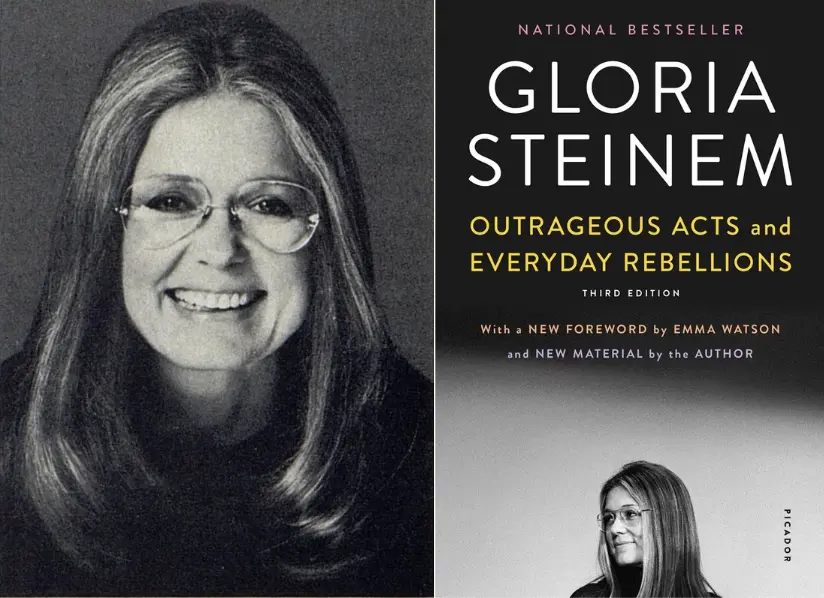
At 49 years old, Steinem remains the most recognizable face of contemporary feminism. Dressed casually in a loose calf-length skirt and a short-sleeved cotton knit sweater, she projects a rangy silhouette characterized by a slight, thoughtful stoop. Her signature aesthetic—frosted, shoulder-length blonde hair, ubiquitous oversized eyeglasses, and a remarkably open gaze—belies a disarming warmth and a self-deprecating laugh. Far from the stern, humourless caricature frequently manufactured by a sensationalist media, Steinem exhibits an approachable, resilient grace forged through decades of cultural resistance and professional reinvention.
This autumn marks a significant milestone in Steinem’s literary and public life with the release of Outrageous Acts and Everyday Rebellions (Holt, Rinehart and Winston). With an initial print run of 60,000 copies, the collection represents Steinem’s first major book project since her early-career guidebook to India in the late 1950s. Spanning over two decades of journalism, the volume brings together more than two dozen essays that both document the evolution of modern feminism and chronicle Steinem’s own biographical transformation from a compartmentalized young writer into a unified public intellectual.
Read Also
As the feminist movement confronts fresh political headwinds and structural resistance, this comprehensive retrospective offers an authoritative window into the life of a woman whose personal, political, and professional trajectories are permanently intertwined with the history of American civil rights.
Detailed Chronology: From Toledo to the Global Stage
Formative Years and the Roots of Independence
Gloria Steinem’s journey to the forefront of American intellectual life began in a working-class neighborhood of Toledo, Ohio. Born when her mother, Ruth, was 35, Steinem experienced an unorthodox upbringing shaped by her parents’ eventual divorce. Her father operated a seasonal summer resort before transitioning into an itinerant antiques dealer—a transient lifestyle that instilled in young Gloria an early familiarity with financial precarity.
"He prepared me for insecurity," Steinem reflects. "That probably did help me to become a freelance writer, because I think I inherited his feeling that as long as tomorrow was unknown, it might be great."
Her mother, who had abandoned a promising early career in journalism to support her husband’s enterprises, suffered periods of profound psychological distress during Steinem’s adolescence. In an original essay included in her new collection, "Ruth’s song," Steinem offers a deeply sympathetic and revealing portrait of a mother-daughter dynamic in which the traditional roles were frequently reversed, leaving the adolescent Gloria to care for her mother.
Seeking an escape from the limitations of her hometown, Steinem enrolled at Smith College, describing the institution as her passport to a broader world. "I loved Smith; I couldn’t understand women who were not happy there," she recalls. "They gave you three meals a day to eat, and all the books you wanted to read—what more could you want?"
Despite harbouring early ambitions of becoming a writer, Steinem initially viewed the profession as an impossibility. "I didn’t know anybody, male or female, who was making a living as a writer; I didn’t see any women out there in the world who were professional journalists." Although she majored in government and participated in creative writing courses, her academic training steered her toward the esoteric confines of mid-century literary fiction—specifically, the understated, minimalist short stories popularized by The New Yorker.
The Catalyst of India and Early Activism
Two academic mentors profoundly shaped her intellectual trajectory: a Shakespeare scholar whom Steinem likens to "Bella Abzug with an English accent," and Vera Micheles Dean, an eminent foreign policy expert. Combined with childhood exposure to theosophy through her mother and grandmother, Dean’s teachings inspired Steinem to accept a prestigious two-year post-graduation fellowship in India. Pragmatism also played a role: "I was trying not to get married. I needed a dramatic way of breaking my engagement."
Arriving in India after spending her junior year in Geneva, Steinem found an immediate sense of cultural resonance that eluded her in Europe. Beyond the practical utility of English as a shared administrative and conversational medium, she was drawn to India’s vast cultural diversity and pressing socio-political crises.
Though nominally enrolled at the University of Delhi, Steinem quickly dismissed formal coursework as "pointless," opting instead to seek out grassroots political activists. She aligned herself with the Radical Humanists, a pre-independence movement, and travelled extensively through Calcutta, Madras, and southern India during a period marked by severe caste riots. Recruited to participate in village-level peace commissions, Steinem discovered the strategic necessity of her gender: "You had to have a woman to go into the women’s quarters and invite them to come out to the meetings, or they wouldn’t come. Indian women," she laughs, "may be smarter than we are."
Adapting to local customs by wearing a sari and immersing herself in rural communities, Steinem began freelancing for Indian newspapers, penning cultural commentaries such as "Sari Psychology," alongside an official government guidebook.
Navigating the New York Media Landscape
Returning to New York in the late 1950s, Steinem faced the harsh economic realities of the freelance market, sleeping on living room floors "for an alarmingly long time" while wrestling with the stark socioeconomic contrasts of post-war America.
Her career gained traction when she joined the left-leaning National Student Association, recruiting American delegates for the 1959 World Youth Festival in Vienna. While the role provided vital professional networking opportunities, it later subjected her to intense political scrutiny, with critics from both the political right and left accusing her of covert Central Intelligence Agency ties due to the festival’s indirect governmental funding. Reflecting on the episode with characteristic candor, Steinem admits, "Yes, we knew at the time that some of the money was coming from the government. It hadn’t any strings attached, and we thought it was a great use of government money. That was very naive."
Steinem subsequently transitioned into magazine publishing as an assistant to Harvey Kurtzman, creator of Mad magazine, on a new satirical venture titled Help!. Working within a lean three-person staff, she mastered the mechanical intricacies of print production and established vital connections across the New York media ecosystem. These relationships enabled her to pitch an ambitious contraceptive roundup for an upcoming college issue of Esquire. The resulting piece launched her career as an independent journalist.
"The secret of making a living is being dependably publishable," Steinem asserts. "You don’t necessarily have to be good. On the other hand, some very good writers are so erratic, it’s hard for them to make a living. But if you’re always punctual and understandable, which I was, then you can make it work."
The Playboy Bunny Exposé and the Split Identity
In early 1963, Steinem published one of her most enduring early investigations: "I Was a Playboy Bunny," an undercover exposé for Show magazine. Rather than an explicit feminist polemic, the piece operated within the traditions of investigative journalism.
"I wasn’t a very conscious feminist. I was an emotional feminist," she explains. "I didn’t name it; I didn’t understand it; I just knew I was mad."
While the article cemented her reputation, it also pigeonholed her into a cycle of lightweight assignments focusing on celebrity profiles, fashion trends, and movie reviews. Meanwhile, the profound intellectual and political awakening she had experienced in India was relegated to the background. "It had no relation to my real, everyday life," she notes. "It was like a black hole in the sky; it just sort of dropped out. And I adapted, I survived in New York."
By the mid-1960s, however, Steinem successfully transitioned to substantive political reporting. Covering prominent political figures taught her a lesson she considers vital for any journalist: "Disrespect. That’s important. You learn they’re not as smart as you thought they were."
Supporting Context & Metrics: The Birth of Ms. Magazine
The Convergence of Journalism and Activism
The year 1968 marked a structural turning point in Steinem’s career. When editor Clay Felker launched New York magazine—an offshoot of the defunct Herald Tribune Sunday Magazine—Steinem joined as a contributing editor and political columnist. For the first time, the disparate threads of her professional life converged. Her essay "Ho Chi Minh in New York" explicitly linked her international experiences in Asia with contemporary American anti-war and civil rights politics.
In 1969, coverage of an abortion hearing catalyzed her transition into advocacy journalism. Her subsequent, exhaustively researched essay, "After Black Power, Women’s Liberation," earned her the prestigious 1970 Penney-Missouri Journalism Award. This landmark feminist essay provoked immediate backlash from male colleagues across the publishing establishment, exposing institutional resistance that ultimately propelled Steinem from passive observer to active organizer within the burgeoning women’s movement.
Launching Ms. Magazine: Data and Impact
By 1972, Steinem, alongside Jane O’Reilly and a collective of feminist writers, sought to establish a dedicated, editorially independent feminist publication. After encountering persistent institutional resistance from male-dominated financial circles, Clay Felker intervened by offering production support through New York magazine.
To introduce the publication to the public, a 30-page preview excerpt was embedded within a 200,000-copy year-end double issue of New York. In January 1972, the independent premiere issue of Ms. hit newsstands.
| Metric | Details |
|---|---|
| Initial Print Run | 300,000 copies |
| Target Shelf-Life Strategy | Dated "Spring" to extend newsstand visibility |
| Sell-Through Velocity | Completely sold out within eight (8) days |
| Page Count | Exceeded 100 pages |
| Initial Staff Commitment | Operating on a volunteer, pro-bono basis |
"We called it Spring so that it could lie there on newsstands for a long time," Steinem recalls. The precaution proved unnecessary; the entire initial print run vanished in just over a week, cementing the publication’s financial and cultural viability.
Initially viewing her tenure at Ms. as a temporary detour from her freelance routine, Steinem experienced a psychological shift during a subsequent fellowship at the Smithsonian Institution. "For the first time in my life I stopped feeling temporary," she reflects. "I had no idea what my real life was."
Official Statements and Perspectives
Reflecting on her immense public visibility, Steinem dismisses the notion that celebrity status is an unavoidable burden. While acknowledging that public life requires adaptation—"If I pull my hair back, it works wonders"—she views her recognition not as an intrusion, but as a profound privilege.
"To the extent that I am visible, it’s a kind of gift. You get people coming up and telling you the most extraordinary things. You get this incredible intimacy with strangers, because their lives have been changed by the movement in some way, and they feel they know you."
— Gloria Steinem
Differentiating her experience from that of actors or traditional celebrities, Steinem emphasizes the authenticity of the bond shared between feminist advocates and the public: "It isn’t like being well known as someone else—for an actor it must be terrible, because people think you’re the role you play, and you’re not. But for us, we’re doing what we care about, so the connection is a real connection."
When assessing institutional resistance to feminist literature and advocacy, Steinem maintains that opposition is primarily concentrated among entrenched power structures. She views the broader readership of her essays as inherently sympathetic, while recognizing that systemic transformation requires unremitting vigilance.
Future Outlook: The Ongoing Wave of Social Change
As Outrageous Acts and Everyday Rebellions prepares to enter the literary marketplace, Steinem’s gaze remains fixed on the horizon of social reform. Addressing the long-term prospects of gender equality and the potential ratification of constitutional amendments, she rejects the premise that legal protections alone can guarantee permanent security.
"Oh no. It’s a constant struggle. We still have to change the culture," Steinem warns.
Placing the contemporary women’s movement within a historical framework, Steinem notes the relative infancy of American democratic traditions: "It’s a young country, we’ve had only two waves of feminism. We spent the first 150 years trying to get a legal identity as human beings for women, instead of being chattels—literally, owned. This wave, we’re trying to get legal equality, which means reproductive freedom too. But I’m sure there will be many waves to come."
For Steinem personally, the future remains anchored in the act of writing—an activity she describes as the sole pursuit where temporal anxiety vanishes. Looking toward the years ahead from her bustling 17th-floor office, her ambitions are remarkably clear: "I would be quite happy to keep the magazine going, doing some traveling, doing my own writing—more writing, I hope."
In an era defined by rapid political shifts and cultural contestation, Gloria Steinem continues to navigate the unknown with the same resilient, inquiring spirit inherited from her father on the roads of Ohio—convinced that as long as tomorrow remains unwritten, its potential for greatness endures.




Comments
Facebook App ID not configured. Please add it in the Customizer.