
Executive Overview
In a high-stakes legal development that bridges executive overreach, executive infrastructure expansion, and foundational environmental law, the legal battle over President Donald Trump’s controversial East Wing ballroom project has reached the highest court in the United States. On Friday, Supreme Court Chief Justice John Roberts issued a temporary administrative stay halting a lower court injunction that threatened to immediately freeze construction on the massive subterranean and vertical structure.
The emergency order, executed by Chief Justice Roberts individually, ensures that round-the-clock construction on the White House grounds will continue "pending further order" from the full bench of the Supreme Court. This latest judicial maneuver represents a critical reprieve for the Trump administration, which has aggressively advanced the project despite successive legal defeats in lower courts. The D.C. Circuit Court of Appeals had previously ruled that President Trump overstepped his executive authority by initiating the construction without explicit congressional authorization.
Yet, beyond the immediate architectural controversy on Pennsylvania Avenue, legal scholars note that the ultimate resolution of this case carries profound implications for the broader American legal landscape. The plaintiffs challenging the ballroom project base their legal standing on the doctrine of "aesthetic injury"—a foundational principle that has historically enabled environmental organizations and citizens to challenge federal actions that degrade natural or historic surroundings. If the Supreme Court ultimately rules against the plaintiffs or dismantles the aesthetic injury standard to clear the way for the ballroom, the collateral damage to U.S. environmental law could be sweeping and irreversible.
Read Also
Detailed Chronology of the East Wing Ballroom Project
The genesis of the White House East Wing ballroom reflects a rapid, highly accelerated executive undertaking that caught preservationists, congressional leaders, and legal watchdogs entirely by surprise. From initial conceptualization to subterranean excavation, the timeline of the project is marked by breakneck construction speeds and escalating legal friction.
1. Inception and Rapid Mobilization
Shortly after taking office, President Trump announced plans to construct a grand ballroom on the White House estate, framing the project as a long-overdue modernization necessary for hosting international heads of state and large-scale diplomatic functions. Unlike traditional public-private federal infrastructure projects that undergo lengthy consultative phases with the National Capital Planning Commission (NCPC) and Congress, the administration moved to fast-track the initiative.
Construction crews mobilized with unprecedented velocity. According to filings submitted by the administration’s solicitor general, the project has operated under grueling schedules—running twenty hours a day, seven days a week. This relentless pace has transformed sections of the historic White House complex into an industrial-scale job site.
2. Legal Challenges and Lower Court Rulings
As heavy machinery tore into the historic grounds, preservation groups and legal advocacy organizations filed emergency lawsuits to halt the construction. The plaintiffs argued that the project violated federal preservation statutes, bypassed mandatory environmental reviews, and—most crucially—proceeded without the constitutionally required consent of Congress.
The legal resistance achieved initial success in the federal district courts, where judges scrutinized the administration’s unilateral justification of the project. Matters escalated earlier this month when the D.C. Circuit Court of Appeals delivered a decisive blow to the administration. The appellate court upheld a lower court ruling finding that President Trump had distinctly exceeded his executive authority by unilaterally pursuing the multi-million-dollar ballroom without seeking or obtaining congressional approval.
3. The National Security Argument and Escalating Rhetoric
In response to the appellate court’s ruling, the White House pivoted to an unorthodox legal and public relations defense. The administration attempted to recharacterize the architectural project under national security and military operational necessity.
In official statements and public declarations, administration defenders labeled the site a "Military Complex." Meanwhile, President Trump intensified his rhetoric against his judicial and civic critics, taking to social media to denounce the project’s opponents in stark terms, famously branding them as "TREASONISTS."
Despite these fiery defenses, the D.C. Circuit’s ruling was clear: the executive branch cannot unilaterally reshape the historic White House compound without legislative mandate. However, the appellate court and the preceding district court had temporarily paused their own injunctions to allow the administration a window to seek Supreme Court intervention. That administrative grace period was hours away from expiration on Friday when Chief Justice Roberts stepped in.
Supporting Context, Project Metrics, and Architectural Scope
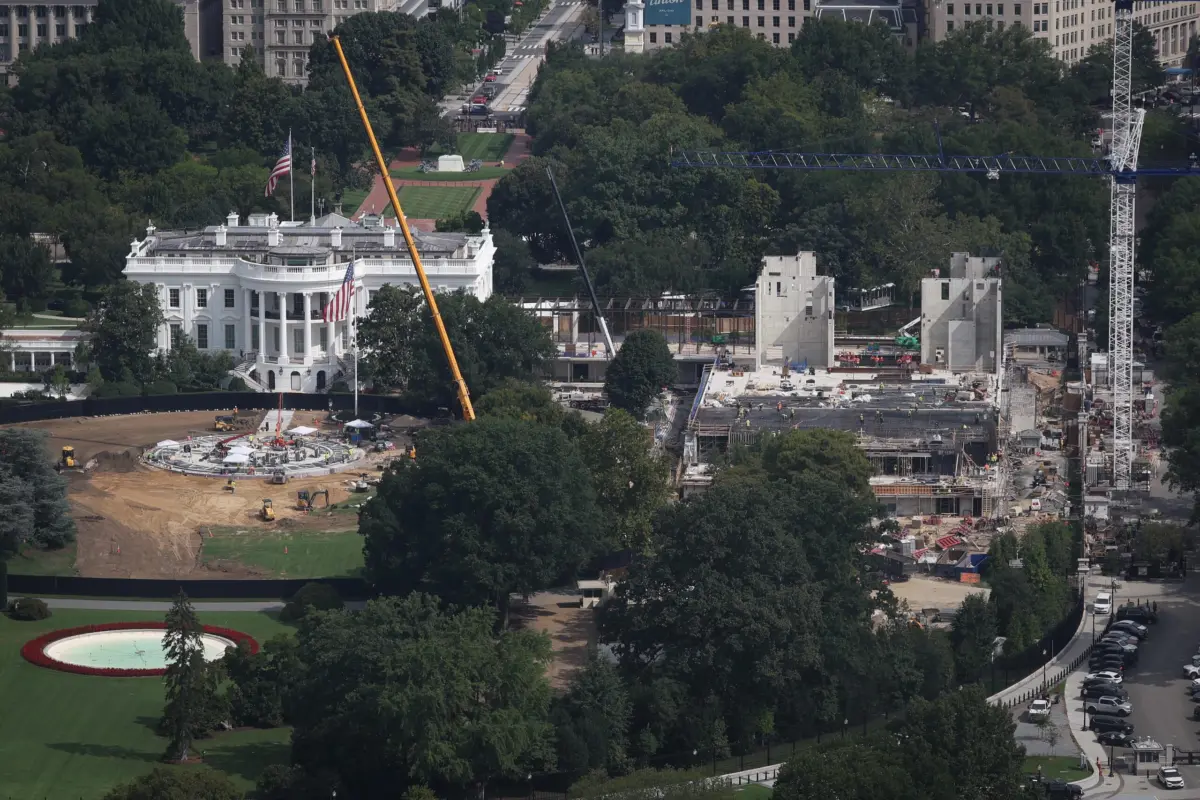
To fully grasp the magnitude of the legal conflict, one must understand the physical reality of what is currently being built beneath and beside the historic East Wing. The project is not a minor cosmetic renovation; it is a massive structural engineering feat executed within one of the most secure and historic sites in the democratic world.
Physical Dimensions and Construction Pace
Publicly available details and court disclosures outline a staggering architectural footprint:
- Completion Rate: Legal representatives for the administration confirmed that the ballroom structure was approximately 65 percent complete as of mid-August.
- Vertical and Subterranean Scale: The edifice towers roughly 70 feet above its base level while simultaneously plunging five stories below ground.
- Labor Intensity: To maintain this rapid trajectory, contractors have maintained a grueling 20-hour workday, seven days a week, pushing construction labor forces to their absolute limits to achieve fait accompli status before the judiciary can issue a permanent halt.
The Doctrine of "Aesthetic Injury" and Environmental Law
While the physical ballroom dominates media coverage, legal analysts are deeply focused on the mechanics of the lawsuit itself. The ability of the plaintiffs—chiefly preservationist and civic groups—to bring their case before a federal judge relies upon the legal doctrine of standing.
Specifically, the plaintiffs invoke "aesthetic injury," a legal concept asserting that individuals or organizations suffer a cognizable legal harm when their visual, historic, or environmental surroundings are unlawfully degraded by government action. This exact doctrine is not unique to historic preservation; it serves as the foundational bedrock for much of modern U.S. environmental law.
Under established jurisprudence, citizens and environmental groups utilize the aesthetic injury standard to challenge federal permits for industrial projects, pipelines, and public land degradation. If the Supreme Court uses the White House ballroom case to narrow, restrict, or entirely invalidate the aesthetic injury standard of standing, the ripple effects will extend far beyond Pennsylvania Avenue. A ruling against the plaintiffs on standing grounds could effectively dismantle public enforcement mechanisms across a vast array of federal environmental and land-use statutes.
Official Statements and Legal Arguments
The divergence between the executive branch’s aggressive defense and the judiciary’s insistence on separation of powers highlights a constitutional tension over executive privilege and property management within the federal government.
The Administration’s Position
The administration’s legal team, spearheaded by the solicitor general, has consistently argued that the president possesses inherent authority to alter, maintain, and improve the Executive Residence and its immediate environs. By framing the construction through the lens of national security and the operational needs of the presidency, the administration seeks to shield the project from standard legislative oversight and judicial injunctions.
In briefs submitted to the high court, administration attorneys emphasized that halting construction at this advanced stage—given that the structure is nearly two-thirds complete and deeply integrated into the subterranean infrastructure of the East Wing—would inflict irreparable financial and logistical harm on the federal government.
The Opposition’s Stance
Conversely, the plaintiffs and concurring lower court judges have underscored the fundamental constitutional principle of the separation of powers. Article I of the Constitution grants the legislative branch the power of the purse and authority over federal property and appropriations.
Legal advocacy groups maintain that allowing an administration to unilaterally construct massive permanent buildings on federal historic land without congressional appropriation or statutory authorization establishes a dangerous precedent for executive overreach. They argue that administrative speed and fait accompli tactics should not override constitutional checks and balances.
Future Outlook: What Lies Ahead at the Supreme Court
Chief Justice Roberts’s administrative stay is merely a procedural stopgap designed to freeze the legal chess board while the justices evaluate how to proceed. However, the stakes could not be higher.
- Full Court Review: The case is now positioned for the full Supreme Court to decide whether to grant certiorari (a full hearing) or to lift the stay, which would immediately allow the lower court injunction to take effect and force a halt to construction.
- Constitutional Precedent: Should the Court hear arguments, its ultimate decision will define the boundaries of executive authority regarding federal property and unilateral capital improvements to the White House complex.
- Environmental and Standing Fallout: If the Court rules against the plaintiffs by dismantling or restricting the "aesthetic injury" standard of standing, it will fundamentally alter who can sue the federal government over environmental degradation, historic preservation, and public land use for decades to come.
As Washington awaits the full Court’s formal docket decisions, the heavy machinery on the White House grounds continues its relentless churn, racing against a judicial clock that may ultimately determine the physical and constitutional shape of the executive estate.





Comments
Facebook App ID not configured. Please add it in the Customizer.