
Executive Overview
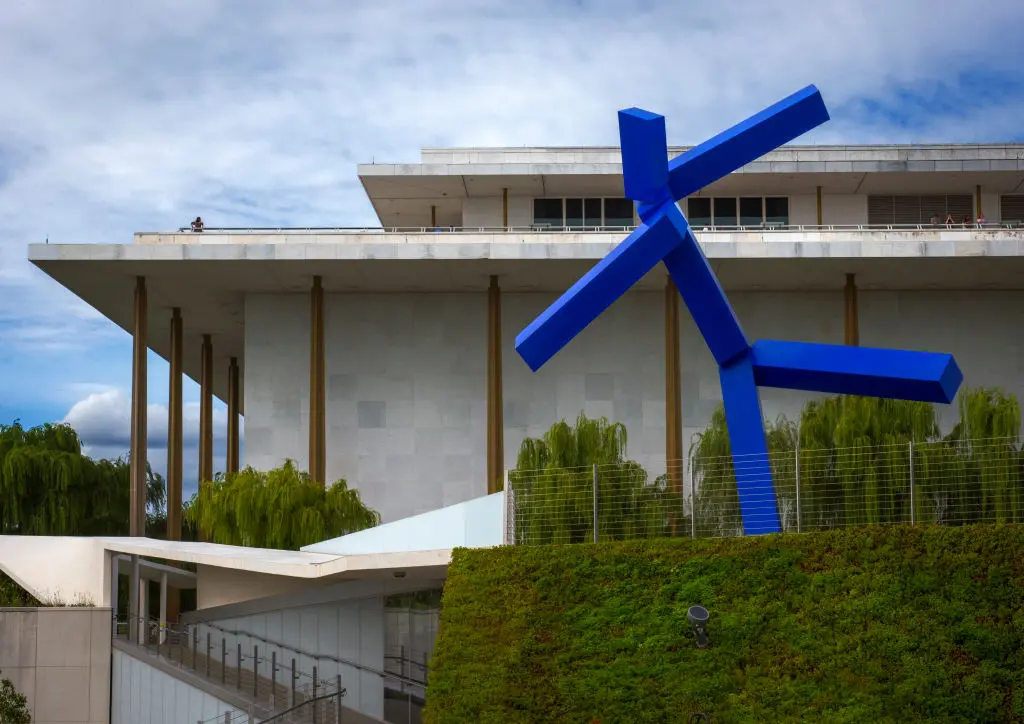
The sudden deinstallation of Joel Shapiro’s monumental 24-foot-tall sculpture Blue from the John F. Kennedy Center for the Performing Arts in Washington, D.C., has sent shockwaves through the American arts community. The removal of the striking, stick-figure-like abstract work—gifted to the institution by the artist in 2019—began quietly on a Tuesday, executed by laborers without any prior public announcement or official justification from Kennedy Center leadership. However, internal documents subsequently obtained by the New York Times indicate that the sculpture was deliberately targeted for removal following President Trump’s recent administrative takeover of the federal cultural landmark.
For artists who have exhibited at the Center, the quiet disappearance of Blue is far more than a routine administrative or curatorial rehang. It is viewed as a chilling harbinger of politically motivated censorship, ideological purging, and an authoritarian campaign to reshape national cultural institutions in the image of the executive branch. Across the country, sculptors, painters, and arts advocacy groups are speaking out, drawing stark parallels between the Kennedy Center’s shifting policies and historic culture wars. As institutional oversight gives way to partisan agendas, the unannounced removal of Shapiro’s work has ignited a fierce debate over the autonomy of public art, the sanctity of the artist-institution social contract, and the broader erosion of creative expression in the United States.
Detailed Chronology: The Removal of Blue and the Fallout
The unfolding crisis at the nation’s cultural center has a specific timeline, marked by stealthy operational maneuvers, leaked administrative documents, and an escalating wave of public outcry from the creative sector.
Read Also
Tuesday: The Disassembly Begins
On a Tuesday morning, maintenance and installation crews arrived at the REACH—the contemporary, open-air expansion of the Kennedy Center that opened to the public in 2019—to dismantle Blue. Standing nearly two dozen feet tall, Shapiro’s brilliant blue, minimalist figural sculpture had become a beloved landmark of the campus, interacting dynamically with the surrounding architecture and landscape. Workers systematically began taking the monumental structure apart piece by piece.
Despite the high-profile nature of the artwork and its prominent public placement, the Kennedy Center administration offered no immediate explanation to the public, visitors, or the media regarding the sudden deinstallation. Requests for comment sent to a Kennedy Center spokesperson regarding the rationale behind the removal went entirely unanswered.
Leaked Documents Reveal Political Motives
The vacuum of official explanation was swiftly filled by investigative reporting. According to documents reviewed and reported by the New York Times, the deinstallation of Blue was not a result of routine maintenance, structural deterioration, or a standard exhibition rotation. Instead, internal memoranda explicitly suggested that the artwork had been "targeted for elimination" as part of a sweeping ideological housecleaning following President Trump’s consolidation of control over the Kennedy Center board and its operational leadership.
The artist’s family immediately voiced deep concern. Ivy Shapiro, the sculptor’s daughter, stated publicly that her father—an internationally renowned post-minimalist sculptor whose work is housed in major museums worldwide—would have been profoundly "alarmed" by the preemptive and opaque removal of his gift to the American people.
Mobilization and Planned Protests
As news of the deinstallation spread across social media and professional arts networks, resistance began to organize. Advocacy groups such as "Hands Off the Arts," which monitors political interference at the Kennedy Center, took to digital platforms to denounce the action.
"The removal of Blue is simply the latest example of Trump’s authoritarian tendencies," the group wrote in an Instagram statement. "Not content to only deface a memorial, Trump is continuing to censor art and use taxpayer dollars to suit his own taste. As John F. Kennedy said, ‘art is not a form of propaganda; it is a form of truth.’"
In response to what they perceive as an escalating assault on institutional independence and free expression, the advocacy group announced plans for a major public demonstration and protest outside the Kennedy Center.
Supporting Context & Metrics: A Broader Cultural Chill
The removal of Blue does not happen in a vacuum. It is part of a systemic transformation affecting federal arts funding, public university faculties, cultural programming, and museum boards across the United States. Observers and artists note that the Kennedy Center’s pivot mirrors a broader political strategy aimed at narrowing the boundaries of acceptable cultural discourse.
The Erosion of Federal Support and the NEA
To understand the gravity of the moment, veteran artists point to historical precedents. Deborah Butterfield, a celebrated sculptor whose equine work Milk River is currently on view in the REACH, drew parallels to the culture wars of the late 20th century. Butterfield, who served on a National Endowment for the Arts (NEA) grant application panel in 1983, recalled the efforts of figures like the late Montana Congressman Pat Williams, who fought fiercely to defend public arts funding against partisan attacks.
Today, however, the landscape has deteriorated significantly. Grant-making capabilities at the NEA have faced severe cutbacks, while federal and state pressures target academic institutions, public libraries, and cultural centers.
"They’re firing professors, cutting grants, they’re trying to shut people up, you know, taking over networks, trying to control what we hear, what we read, what we look at," Butterfield told ARTnews. "It’s very scary."
The Evaporation of Institutional Trust: The Case of Watershed III
The atmosphere of apprehension extends far beyond sculpture gardens into exhibition halls and galleries. Artist Mokha Laget, who split a portion of her distinguished career in Washington, D.C., and is now based in New Mexico, experienced firsthand the administrative paralysis and chilling effect that accompanied the transition to the second Trump administration.
In 2023, Laget exhibited Watershed III at the Kennedy Center—a sweeping, 35-foot-long abstract painting created in direct dialogue with a historic drape painting by D.C. art legend Sam Gilliam, who passed away in 2022. Laget’s work was shown as a loan under the Biden administration, an arrangement that officials had previously indicated would be renewed.
However, following the shift in administration, channels of communication with the Kennedy Center abruptly dried up.
"What was previously a well-oiled machine was [now] a ghost," Laget recalled, describing months of silence and administrative dead-ends as she attempted to secure the renewal or safe return of her monumental canvas.
It took persistent effort during the latter half of the preceding year—precisely when executive intervention in Kennedy Center programming was accelerating—for Laget to successfully reclaim her painting. Though Watershed III is now safely back in the artist’s possession, the Kennedy Center’s official website and digital archives have yet to be updated to reflect its departure, maintaining a facade of institutional continuity that masks a reality of cultural withdrawal.
Official Statements and Institutional Perspectives
The institutional silence from the Kennedy Center contrasts sharply with the vocal dismay expressed by the artistic community. While PR representatives decline to address internal policy shifts, the cultural stakeholders who built their reputations alongside the institution are speaking candidly about the fractured relationship between artists and the state.
The Artist’s Perspective: Fear and Reverence
Sculptor Deborah Butterfield reflected on the psychological impact of politically driven artistic curation. While her own horse sculpture, Milk River, currently remains in the REACH—a piece she describes as "almost a Buddha" and a "reverential, reflective piece" that she hopes authorities do not find threatening—she harbors deep anxieties for the future of public art in the nation’s capital.
"It’s the insidious malevolence behind this decision," Butterfield remarked, addressing the removal of Blue. "To control our thoughts and what we see, it’s really frightening to me."
Her sentiments echo the core philosophy articulated by the institution’s namesake, President John F. Kennedy, who famously noted that art must remain independent of state dogma to serve as an honest mirror of society.
Breaking the Social Contract
For Mokha Laget, the removal of Shapiro’s sculpture symbolizes a catastrophic breach of trust between creators and the custodians of culture.
"There’s a kind of social contract between artists and cultural institutions, and that goes with a trust that the institution will care for the work and provide a stable context for it," Laget explained. "And so, when that contract is broken, for whatever reason, in whatever way, it’s very hard to piece it back together."
By transforming a historically bipartisan, non-ideological beacon of the performing and visual arts into an instrument of partisan aesthetic preference, the administration risks alienating the very community of creators that sustains its programmatic vitality.
Future Outlook: What Lies Ahead for the Kennedy Center?
As the date for the planned public demonstrations approaches, the broader implications of the Shapiro deinstallation continue to reverberate across the American cultural landscape. The incident raises urgent questions about the legal and ethical protections afforded to public art gifts, the autonomy of institutional boards, and the vulnerability of national monuments to political whims.
- Heightened Scrutiny of Public Collections: Curators, watchdogs, and legal scholars are expected to closely examine the stewardship agreements governing donated works at federal institutions. The arbitrary removal of a major gift like Blue may deter future philanthropists and blue-chip artists from entrusting their creations to public spaces compromised by political interference.
- Continued Advocacy and Resistance: Grassroots organizations, museum professionals, and artist coalitions are mobilizing to create formal networks of accountability. These groups aim to document instances of censorship, pressure governing boards for transparency, and protect public spaces from ideological scrubbing.
- A Polarized Cultural Future: The Kennedy Center now stands at a historic crossroads. Whether it can restore its reputation as an open, inclusive home for diverse American artistic expression—or whether it will remain an arena for partisan culture wars—will depend heavily on public pressure, institutional resilience, and the unwavering defense of creative freedom by the nation’s artists.
Ultimately, the vanishing of Joel Shapiro’s Blue serves as a sobering reminder that the preservation of culture requires constant vigilance. As artists like Butterfield and Laget have emphasized, once the mechanisms of state censorship are turned toward art, the foundational truths that democratic institutions are built to protect are immediately placed in jeopardy.

Comments
Facebook App ID not configured. Please add it in the Customizer.