
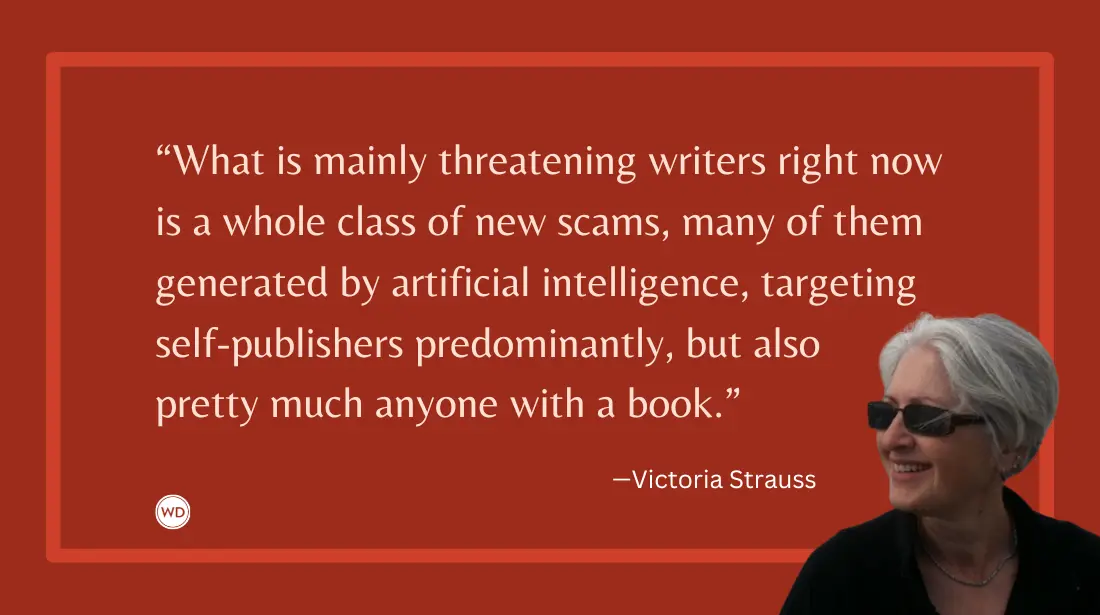
For nearly three decades, author Victoria Strauss has stood as a vigilant sentinel against the predatory underworld of publishing. As the co-founder of Writer Beware—an industry watchdog group established under the Science Fiction and Fantasy Writers of America (SFWA)—Strauss has spent her career investigating and cataloging the evolving matrix of scams, schemes, and financial traps designed to exploit creative ambition.
In the modern digital era, the landscape of literary fraud has undergone a dramatic transformation. Driven by the rapid proliferation of artificial intelligence, increasingly sophisticated impersonation tactics, and high-volume, automated digital solicitations, modern scammers are finding it easier than ever to deceive aspiring and self-published authors. While the foundational mechanics of literary fraud—such as fee-charging literary agents and vanity presses—still exist, they have been amplified by cutting-edge technology.
Today, writers are targeted by international syndicates using generative AI to craft hyper-personalized, grammatically flawless outreach messages that bypass traditional warning signs. These operations prey upon a writer’s fundamental hunger for validation, recognition, and commercial success. However, as international law enforcement begins to crack down on large-scale publishing fraud—highlighted by recent high-profile federal prosecutions resulting in tens of millions of dollars in restitution—industry experts emphasize that education, community vigilance, and rigorous vetting remain an author’s best defense.
Read Also
Detailed Chronology: The Evolution of Writer Beware and Literary Fraud
To understand how contemporary literary scams operate, it is necessary to examine how the digital publishing landscape has evolved since the late 1990s.
1998: The Discovery of the Industry’s Underbelly
When Strauss first ventured into online writers’ groups in 1998, the modern internet was still in its infancy, and the publishing industry was generally perceived by outsiders as a trustworthy, closed ecosystem. Within these online communities, however, Strauss encountered startling firsthand accounts of fee-charging literary agents, predatory editing services, and fraudulent vanity publishers. This underground economy of deception operated largely on static, predictable models.
The Shift to Self-Publishing and Digital Scale
As the publishing industry transitioned into the 21st century, the rise of digital and self-publishing democratized book production. While this created unprecedented opportunities for independent authors, it also generated a massive commercial market for self-publishing services. Unlike traditionally published authors—who rarely pay out-of-pocket for production—independent writers actively seek out cover designers, editors, and formatters, inadvertently opening the door to predatory service providers.
2018–2022: The Overseas Boiler Room Era
By the late 2010s, a significant portion of publishing scams had shifted to overseas boiler rooms, predominantly operating out of regions like Nigeria and the Philippines. During this phase, a primary indicator of a scam was linguistic: overseas operators, while fluent in English speakers, often struggled with grammar, syntax, and colloquial phrasing. Writers could frequently spot fraudulent emails by identifying awkward phrasing or unnatural sentence structures.
Post-2022: The Artificial Intelligence Tsunami
The release of generative AI tools like ChatGPT in late 2022 fundamentally altered the threat landscape. Scammers rapidly integrated large language models into their operations. Overnight, the telltale grammatical errors vanished, replaced by fluent, colloquial, and psychologically tailored outreach messages. Furthermore, AI agents enabled scammers to scrape the internet, harvest personal contact details from online bookstores and author directories, and launch high-volume automated campaigns capable of generating hundreds of thousands of personalized solicitations daily.
Supporting Context & Metrics: The Scale of Modern Publishing Fraud
The misconception that literary scammers target only small-time writers with negligible financial impact has been repeatedly dismantled by federal law enforcement actions.
- The Scale of Operations: Modern publishing scams function as high-volume automated businesses. By casting a wide net across global author databases, syndicates can extract small-to-moderate sums from thousands of victims, aggregating massive illicit revenues.
- Multi-Million Dollar Fallout: The financial reality of these operations is staggering. Recent federal investigations—such as an FBI-led bust targeting a Philippines-based publishing scam—demonstrate the sheer magnitude of these enterprises. In that specific case, the CEO pleaded guilty to fraud schemes that victimized over 800 authors, culminating in a federal restitution order exceeding $48 million.
- Distinction of Threats: Writer Beware categorizes threats into three distinct operational tiers to help authors accurately assess risk:
- Scams: Outright financial fraud where perpetrators collect fees under false pretenses, deliver zero legitimate services, and vanish.
- Schemes: Predatory operations that technically deliver a service—such as high-entry-fee writing contests with dozens of subcategories designed solely to maximize participant fees—yet profit primarily off the backs of hopeful entrants rather than honoring literary merit.
- Pitfalls: Well-intentioned failures, such as inexperienced entrepreneurs launching independent presses without adequate financial capitalization or operational knowledge, resulting in unpaid royalties, sudden bankruptcies, and stranded authors.
Official Statements and Expert Analysis
During an in-depth discussion on the state of modern literary fraud, Victoria Strauss broke down the psychological mechanisms and behavioral markers that define today’s scams.
The Psychology of Validation
"Anyone in a creative industry is similarly vulnerable, because the odds of success are slim, and there are so many people clustered at the gate trying to get through," Strauss explains. "There’s a high level of frustration and rejection. It’s wearing on the psyche. Scammers promise success. They promise validation. You’ll make a million dollars. Your book will be a bestseller. It’s targeting that hunger for recognition and validation."
The Rise of Subtle, Multi-Stage Manipulations
While traditional scams rely on blunt force—such as fake emails promising a $250,000 traditional book deal out of nowhere—modern AI-driven scams utilize sophisticated, roundabout tactics. Scammers frequently deploy AI to generate glowing, detailed praise of a writer’s specific book, posing as enthusiastic independent marketers or well-known literary figures (with instances of scammers impersonating prominent authors like John Grisham).
"They’ll end the email with an open-ended question—if this interests you, please reach out—so they don’t seem to be pushing," Strauss notes. "The idea is to draw the writer in over many emails, on the theory that the deeper they can involve you in this flattering interchange, the harder it will be to back out when they finally get to the money part, which often takes several email exchanges to reveal."
Key Markers of Deception
To assist authors in navigating suspicious outreach, Strauss highlights several definitive red flags:
- Cold Solicitations: Reputable traditional publishers and established literary agents do not cold-call or cold-email authors out of the blue offering representation or major deals.
- Amateur Infrastructure: Business entities operating through generic webmail providers (such as
@gmail.com) while claiming to represent major international marketing or publishing firms are universally fraudulent. - The Direction of Money: In traditional publishing and literary representation, money always flows to the author via advances and royalties. If a purported traditional publisher or agent demands upfront fees, the arrangement is fundamentally non-traditional and warrants intense skepticism.
Future Outlook: A United Front for the Publishing Ecosystem
The proliferation of AI-generated impersonation schemes has forced a structural shift across the entire literary ecosystem. Historically, the shadow world of publishing scams operated entirely detached from mainstream publishing houses and literary agencies. Today, because scammers routinely impersonate major publishing houses, media outlets, and high-profile authors, mainstream organizations are routinely forced to post prominent fraud alerts on their official websites.
Despite the growing sophistication of automated threats, industry advocates remain optimistic that collective awareness can mitigate the damage. Writers are increasingly encouraged to abandon the culture of shame that frequently follows falling victim to online fraud. By speaking openly on social media, reporting bad actors to organizations like Writer Beware, and treating encounters with scammers as educational milestones rather than personal failures, authors can build a resilient, united defense.
As Strauss concludes, while scams will undoubtedly continue to evolve alongside emerging technologies, the fundamental power of community education remains an effective shield: "Scamming isn’t going away, but as writers, we can help take care of each other."


Comments
Facebook App ID not configured. Please add it in the Customizer.