
Executive Overview
Twenty-five years have passed since the crisp September morning that shattered the New York skyline, claimed the lives of nearly 2,700 innocent people, and permanently altered the geopolitical and physical landscape of Lower Manhattan. The destruction of the twin World Trade Center towers was not only a human tragedy of unprecedented scale; it was also the catalyst for one of the most complex, politically fraught, and symbolically charged urban reconstruction projects in human history.
As the dust settled on the immediate aftermath of the 2001 attacks, the international architectural community responded with an extraordinary outpouring of visionary proposals. From mournful, contemplative grottos to wildly speculative techno-utopian supertructures, the world’s most prominent designers sought to heal a bleeding urban fabric. Yet, this idealistic momentum quickly collided with the jagged realities of local politics, bitter property disputes, insurance litigation, and bureaucratic gridlock between municipal authorities in New York City and state officials in Albany.
Today, the rebuilding process at the World Trade Center site is essentially complete. A towering skyscraper pierces the skyline, flanked by reflecting pools that trace the footprints of the fallen towers, a world-class memorial and museum, a cutting-edge transportation hub, and a gleaming performing-arts center. But beneath the polished glass and gleaming steel lies a more complicated legacy.
Read Also
As we mark a quarter-century since the tragedy, critical questions remain: What lessons can New York City draw from this twenty-five-year saga? What does the contemporary site reveal about the trajectory of Lower Manhattan, the efficacy of governance across city and state lines, and the shifting identity of contemporary architectural culture? Is modern Ground Zero a functional, thriving neighborhood, a sacred zone of perpetual mourning, or some uneasy, fragmented combination of the two?
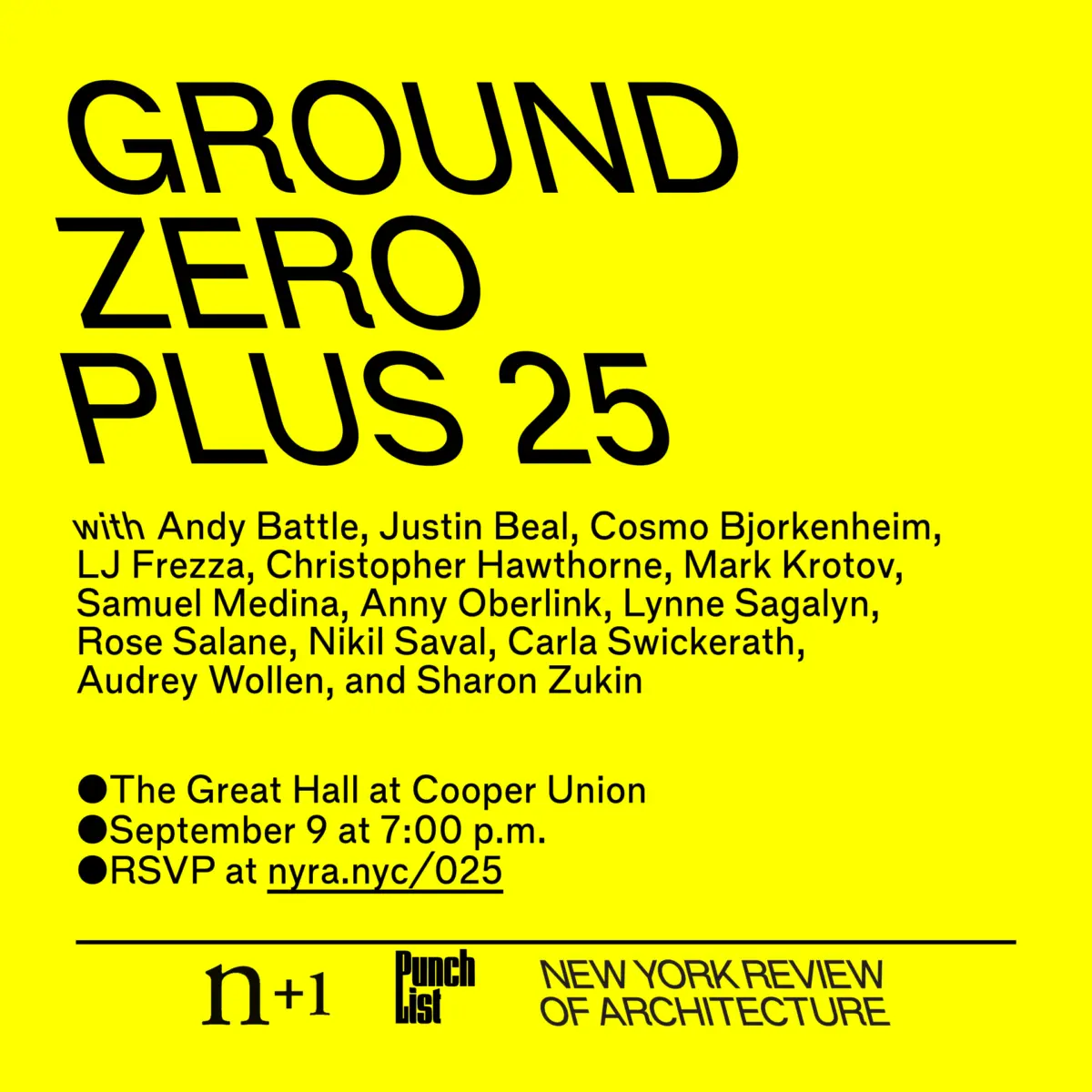
To unpack these pressing issues, n+1, the New York Review of Architecture, and Punch List are convening a major public discussion to evaluate the twenty-five-year rebuilding saga—and to explore the roads not taken.
Detailed Chronology: A Quarter-Century of Conflict and Construction
To understand the modern World Trade Center site, one must trace the winding, often contentious timeline of its resurrection. The path from pulverized concrete to a multi-billion-dollar mixed-use complex was defined by distinct phases of grief, political maneuvering, design contests, and eventual pragmatism.
Phase I: The Immediate Aftermath and Debris Removal (2001–2002)
In the final months of 2001, the immediate focus of Ground Zero was search, rescue, and recovery, followed by an unprecedented logistics operation to clear 1.8 million tons of steel, concrete, and debris. Led by the Lower Manhattan Development Corporation (LMDC), established by Governor George Pataki and Mayor Rudy Giuliani in November 2001, planning authorities faced the agonizing dual mandate of honoring the dead while plotting the economic survival of a devastated downtown business district.
Phase II: The Battle of Master Plans and Architectural Visions (2002–2004)
By 2002, the debate over what to do with the 16-acre site burst into public view. The LMDC launched a series of highly publicized design exhibitions, inviting avant-garde proposals from global architectural titans. Daniel Libeskind’s master plan, "Memory Foundations," ultimately won the commission in 2003, championing a dramatic wedge of light, a soaring 1,776-foot spire (originally dubbed the Freedom Tower, now One World Trade Center), and a deep, subterranean memorial space.
However, Libeskind’s vision immediately clashed with the commercial ambitions of Larry Silverstein, the leaseholder of the World Trade Center complex, who demanded millions of square feet of commercially viable office space to satisfy his insurers and financial stakeholders. The resulting compromises created years of tension between soaring architectural symbolism and hard-nosed real estate economics.
Phase III: Political Gridlock and Financial Realities (2004–2011)
The mid-2000s were characterized by intense friction among stakeholders. Disputes between the Port Authority of New York and New Jersey, developer Larry Silverstein, the City of New York, and the State of New York repeatedly brought construction to a halt. Costs skyrocketed, timelines slipped, and public skepticism deepened.
The turning point began to materialize with the opening of the National September 11 Memorial on the tenth anniversary of the attacks in 2011. Designed by Michael Arad and Peter Walker, "Reflecting Absence" offered a quiet, profound space for communal grief that instantly resonated with the public, helping to heal some of the friction that had plagued the surface-level planning process.
Phase IV: Gradual Realization and Commercial Infill (2011–Present)
Over the subsequent decade and a half, the remaining pieces of the puzzle fell into place—though rarely without controversy.
- One World Trade Center opened in November 2014, establishing itself as a commanding presence in the skyline, even if its heavily fortified base and defensive setbacks drew critique from urbanists.
- The World Trade Center Transportation Hub (The Oculus), designed by Santiago Calatrava, opened in 2016. While praised for its cathedral-like interior and striking skeletal ribs, it became notorious for massive budget overruns, ultimately costing upward of $4 billion—making it one of the most expensive transit stations ever built.
- The Perelman Performing Arts Center (PAC NYC) opened its doors in late 2023, injecting much-needed cultural vibrancy into the commercial monolith.
- Surrounding office towers—Three, Four, and Seven World Trade Center—successfully drew major corporate tenants, gradually repopulating the financial district with a diversified mix of media, tech, and financial firms.
Supporting Context & Metrics: Lower Manhattan Transformed
The physical transformation of the World Trade Center site cannot be viewed in isolation; it occurred alongside a broader, tectonic shift in the demographics and economy of Lower Manhattan.

Demographic Evolution
Prior to September 11, 2001, Lower Manhattan was primarily a nine-to-five financial monoculture. Aside from pockets like Battery Park City and Chinatown, the area largely emptied out after the closing bell at the New York Stock Exchange.
In the wake of the attacks, federal and local governments injected billions in tax incentives and infrastructure funding to spur residential conversions. The strategy worked beyond expectations. Over the past twenty-five years, Lower Manhattan’s residential population has more than doubled. Office buildings that were rendered obsolete by changing technology and corporate consolidation were transformed into luxury and mixed-income apartment complexes, turning a transient business district into a vibrant, 24/7 residential neighborhood complete with schools, supermarkets, parks, and daycare centers.
Economic and Infrastructure Metrics
- Total Project Cost: Estimates for the total rebuilding of the World Trade Center complex exceed $25 billion, making it one of the most expensive capital projects in modern history.
- Commercial Square Footage: The master plan restored roughly 10 million square feet of Class-A office space to the downtown market.
- Memorial Visitors: The National September 11 Memorial & Museum has welcomed tens of millions of visitors from across the globe, cementing the site as one of the most visited cultural and historical landmarks in the United States.
Yet, these metrics mask underlying tensions. The heavy reliance on public-private partnerships, complex lease structures, and bi-state authorities left taxpayers vulnerable to immense financial overruns, particularly regarding transit infrastructure and security enhancements.
Official Statements and Critical Discourse
As the twenty-five-year milestone approaches, urban planners, architectural historians, and civic leaders are taking stock of what was achieved—and what was lost in translation between the drawing board and reality.
In early conceptual phases, architects championed the idea that rebuilding Ground Zero could pioneer a new paradigm for twenty-first-century urbanism—one that prioritized ecological sustainability, psychological healing, and radical democratic transparency. Figures like Libeskind argued that the site should remain an open, living wound that acknowledged history while reaching upward in defiance.
Conversely, real estate interests and government officials argued with equal conviction that the ultimate rebuke to terrorism was immediate, aggressive economic vitality. For Larry Silverstein and state officials, building taller, safer, and more lucrative towers was the only responsible path to restoring New York’s economic engine.
Critics from organizations like the New York Review of Architecture have consistently interrogated the outcome of these competing philosophies. They point out that the security apparatus required to protect the contemporary World Trade Center site has often resulted in a fortress urbanism—bollards, blast-walls, and subterranean checkpoints that create an uneasy barrier between the memorial precinct and the surrounding street grid.
Furthermore, architectural critics have frequently lamented the "corporate genericism" of several commercial towers built during the latter phases of the master plan, arguing that the initial spirit of architectural experimentation was systematically suffocated by risk-averse developers and paranoid security consultants.
Future Outlook: A Neighborhood or a Monument?
As we look toward the next quarter-century, the central identity crisis of Ground Zero persists: Can a single 16-acre plot successfully reconcile the contradictory demands of a solemn national cemetery, a bustling corporate hub, a major tourist destination, and a residential neighborhood?
The completion of the Perelman Performing Arts Center has gone a long way toward humanizing the site, infusing the concrete plazas with human scale, artistic expression, and evening foot traffic. Similarly, the ongoing evolution of the surrounding streets into pedestrian-friendly corridors suggests that the site is slowly integrating into the organic fabric of Lower Manhattan.
However, the lessons of the twenty-five-year saga extend far beyond the borders of New York City. As urban centers around the world grapple with climate resilience, security threats, and shifting commercial real estate markets post-pandemic, the World Trade Center rebuilding process serves as a massive, imperfect case study in crisis-era urban governance.
To explore these themes further, interrogate the roads not taken, and debate the future of the downtown skyline, the public is invited to join the upcoming panel discussion hosted by n+1, the New York Review of Architecture, and Punch List.
Event Details:
- Date: Wednesday, September 9
- Time: 7:00 PM
- Location: The Great Hall at Cooper Union, 7 East 7th Street, New York, NY
- Admission: $14 for n+1 subscribers and their guests; $24 for non-subscribers.
Tickets and additional information can be secured online through the official ticketing portal. As New York enters its second quarter-century post-9/11, conversations of this caliber are vital to ensuring that our cities remember their past while intelligently charting their future.




Comments
Facebook App ID not configured. Please add it in the Customizer.