
Executive Overview
Nestled in the breathtaking mountain landscape of Snowmass, Colorado, just nine miles outside the high-priced enclave of Aspen, lies the Anderson Ranch Arts Center. Spanning a five-acre campus of modern studios, workshops, and artist housing, Anderson Ranch is frequently celebrated as a utopian sanctuary for makers. Upon arrival—assuming one quickly adjusts to the sweeping 8,000-foot elevation—visitors are met with an intoxicating blend of crisp alpine air, panoramic views dotted with trembling aspens, and an immediate, almost tactile urge to create.
Yet, during the institution’s diamond anniversary celebrations in mid-July, this idyllic paradise carried an underlying tension. The air was perilously dry, pushing regional wildfire danger ratings into the extreme red zone and forcing artists to secure special permits simply to fire up their kilns. This elemental vulnerability served as a fitting metaphor for the unique balancing act defining Anderson Ranch today: navigating the delicate equilibrium between preserving its rustic, egalitarian roots and managing a rapidly professionalizing, increasingly corporate art-world ecosystem.
With an operating budget of $7.6 million, an endowment touching $17 million, and record-breaking student enrollment exceeding 1,200 participants annually, the Ranch has evolved far beyond its humble origins as a solitary kiln in a field. Under the leadership of President Peter Waanders, who is now six years into a tenure that has outlasted nearly all of his predecessors, the institution is aggressively investing in advanced technological infrastructure, expanded programming, and facilities updates. Yet, even as it courts major donors, expands its endowment, and participates in elite international arts associations, Anderson Ranch remains fiercely protective of its foundational ethos: a radical, cross-disciplinary freedom where master sculptors, Turner Prize winners, and weekend hobbyists share studio space on entirely equal footing.
Read Also
Detailed Chronology: From Concentration Camp Charcoal to Colorado Clay
The philosophical bedrock of Anderson Ranch is inextricably linked to the trials of history and the enduring human compulsion to create. The institution was founded in 1966 by Paul Soldner, a trailblazing ceramicist whose artistic awakening was catalyzed by the horrors of World War II. Serving as a young medic in the United States military, Soldner entered the Mauthausen concentration camp in Austria upon its liberation. There, amidst unimaginable devastation, he witnessed charcoal drawings scrawled onto the prison cell walls by an inmate—a poignant testament to the resilience of the human spirit through artistic expression.
Although Soldner had initially planned on pursuing a career in medicine upon returning to the United States, those haunting cell-wall sketches redirected his trajectory toward the arts. He dove headfirst into ceramics, studying under legendary sculptor Peter Voulkos. Together, they shattered the conventional boundaries of the medium, liberating clay arts from the traditional constraints of functional pottery to pioneer an American adaptation of Japanese raku firing—a movement that forever altered the landscape of contemporary craft.
In its infancy, Anderson Ranch was little more than a primitive outpost. Veterans of the early eras recall an era of radical resourcefulness, famously anchored by a makeshift hot tub jerry-rigged by Soldner on the property. As artist Lee Lyon noted in a 2012 retrospective, “There was a lot going on in the hot tub other than hot tubbing.” Early visitors famously slept in their cars and showered using garden hoses outside rudimentary wooden sheds.
As the decades progressed, the Ranch underwent a gradual professionalization. During the 1970s and 1980s, the bohemian chaos was slowly reined in—mandatory dress codes were introduced, and the infamous hot tub was ultimately dismantled. Even so, the institution remained a magnet for colorful outliers. Early director Caleb Bach, for instance, operated with a biography straight out of a Cold War thriller; as historical accounts note, he had previously served as a CIA agent in Argentina, using his role as an artist as deep-cover while he waited for a Russian director who never materialized.
By the 1980s, the campus hosted roughly 175 summer students. Today, that number has surged past 1,200, with operations running year-round. What began as a solitary kiln in an open field has expanded into a sophisticated, multi-disciplinary campus equipped with high-tech digital fabrication labs, state-of-the-art 3D printers, and robust fellowship opportunities.
Supporting Context & Metrics: Navigating the Aspen Economic Reality
The transformation of Anderson Ranch cannot be viewed in isolation from the broader economic transformation of the Roaring Fork Valley. Today, the average home price in Aspen and its surrounding environs sits at a staggering $14 million. Local lore suggests that residents generally fall into one of two categories: those who maintain three multi-million-dollar residences across the globe, or those who must work three local jobs simply to afford rent.
This hyper-gentrification has profoundly impacted the regional creative community. Richard Carter, a veteran Aspen-based artist who witnessed the early days of Anderson Ranch, lamented in a local interview the displacement of his peers. The soaring cost of living forced his studio assistants and a master carpenter he had collaborated with for years to abandon the valley entirely.
Against this backdrop of astronomical real estate values, Anderson Ranch occupies a fascinating, paradoxical position within the contemporary art apparatus. While it actively seeks intellectual and professional dialogue with the global art world, the qualities that contemporary arts figures cherish most about the Ranch are precisely its separation and insulation from that world’s cutthroat politics.
Curator Helen Molesworth has frequently praised the institution for lacking the bureaucratic toxicity often found in major museums, describing the campus as possessing a “Utopian summer-camp vibe of ‘we’re all just here making stuff together.’” Molesworth emphasizes that the Ranch’s greatest strength is its heterogeneity:
“You have everyone from Simone Leigh to a Sunday painter. If you put art-making at the center… all of those divisions fall away, and we can have different kinds of conversations.”
This sentiment is echoed by institutional leadership. President Peter Waanders routinely expresses his affinity for the Ranch’s radical inclusivity—where a tech billionaire and a scholarship-supported undergraduate might find themselves seated side-by-side, learning the fundamentals of watercolor from the same instructor.
Official Statements: Balancing Professionalization with Grassroots Spirit
When Peter Waanders assumed the presidency of Anderson Ranch in 2019, coming from a distinguished tenure as director of the Society of Fellows at the Aspen Institute, he inherited an institution at a critical crossroads. Unlike many of his predecessors, Waanders is not a practicing artist, but his deep 25-year immersion in Aspen’s intellectual and cultural spheres provided him with an intimate understanding of the Ranch’s unique heritage.
Reflecting on his first six years in office—a tenure that has already outlasted all but two of the Ranch’s 13 previous directors—Waanders articulates a clear vision: building a sustainable institutional foundation while safeguarding the interpersonal relationships and counter-cultural spirit that built the organization.
“We’ve grown, which was one of my goals when I came,” Waanders noted from his office, a space that manages to feel simultaneously sophisticated and rustic.
That growth is reflected clearly on the balance sheet. Over the past five years, the Ranch’s endowment has expanded by roughly $7 million, reaching a total of $17 million. While market forces have contributed significantly to these gains, strategic philanthropy has played an equally vital role. Earlier this year, the institution established the Marie Figge Wise Master Printer-in-Residence fund, securing the long-term future of its Printmaking and Editions program through a generous endowment from the William and Marie Wise Family Foundation.
Furthermore, the Ranch achieved a major institutional milestone by securing membership in the International Fine Print Dealers Association (IFPDA). Andrea Jenkins Wallace, the Ranch’s Vice President of Artistic Affairs who has steered the institution’s programming for 18 years, emphasizes that despite this rising professionalism, the organization retains its foundational agility.
“We’re still very nimble… It’s not so big that we can’t just say, okay, let’s just do this or that program,” Wallace observed.
Future Outlook: Technology, Infrastructure, and the Annual Gala Paradox
Looking toward the next decade, Waanders is charting a strategic path that bridges material modernization with intellectual leadership. His dual mandate focuses on upgrading aging physical infrastructure while keeping the campus at the bleeding edge of technological integration.
Modernizing Infrastructure and Embracing Technology
Much of the physical campus was constructed during the expansion booms of the 1980s and 1990s. Consequently, much of the foundational utility infrastructure—including primary heating boilers—is approaching four decades of continuous service. Waanders notes that comprehensive campus redevelopment plans are already underway, with major capital investments earmarked for modernizing photography and new-media facilities, which will likely entail the complete replacement of existing structures.
Simultaneously, the institution remains deeply committed to technological innovation in art-making. Pointing to archival photographs of actor Dennis Hopper experimenting with early Photoshop software at the Ranch in 1995, Waanders underscores that technological fluency has always been central to the center’s identity. Today, that commitment is literal and costly: the Ranch operates advanced Computer Numerical Control (CNC) milling machines, high-tech 3D printers, and digital fabrication tools that cost upwards of a quarter-million dollars per unit, seamlessly integrating digital craft with traditional fine arts.
Thought Leadership and Critical Discourse
Beyond material upgrades, Waanders aims to expand the Ranch’s footprint as a center for critical thought leadership. Plans are currently underway to construct dedicated seminar spaces designed to host rigorous academic and public symposia. These programs will interrogate pressing contemporary issues within the art world, including the evolving sociology of public art, the intersections of race, class, and gender in creative spaces, and the philosophical friction between art as pure aesthetic intention versus art as a speculative financial commodity.
The Gala Paradox
No discussion of Anderson Ranch’s financial sustainability is complete without examining its signature summertime gala week. Generating slightly less than a third of the institution’s annual operating revenue—with the remainder sustained by major gifts and national council contributions—the gala serves as a vital economic engine.
Yet, the gala exposes the sharpest paradox within the institution. For one week out of the year, the rustic campus—ordinarily populated by dusty artists in overalls, seniors shuffling between studios, and students pushing supply carts—is flooded by affluent patrons draped in high-end couture, teetering in vertiginous heels across gravel pathways.
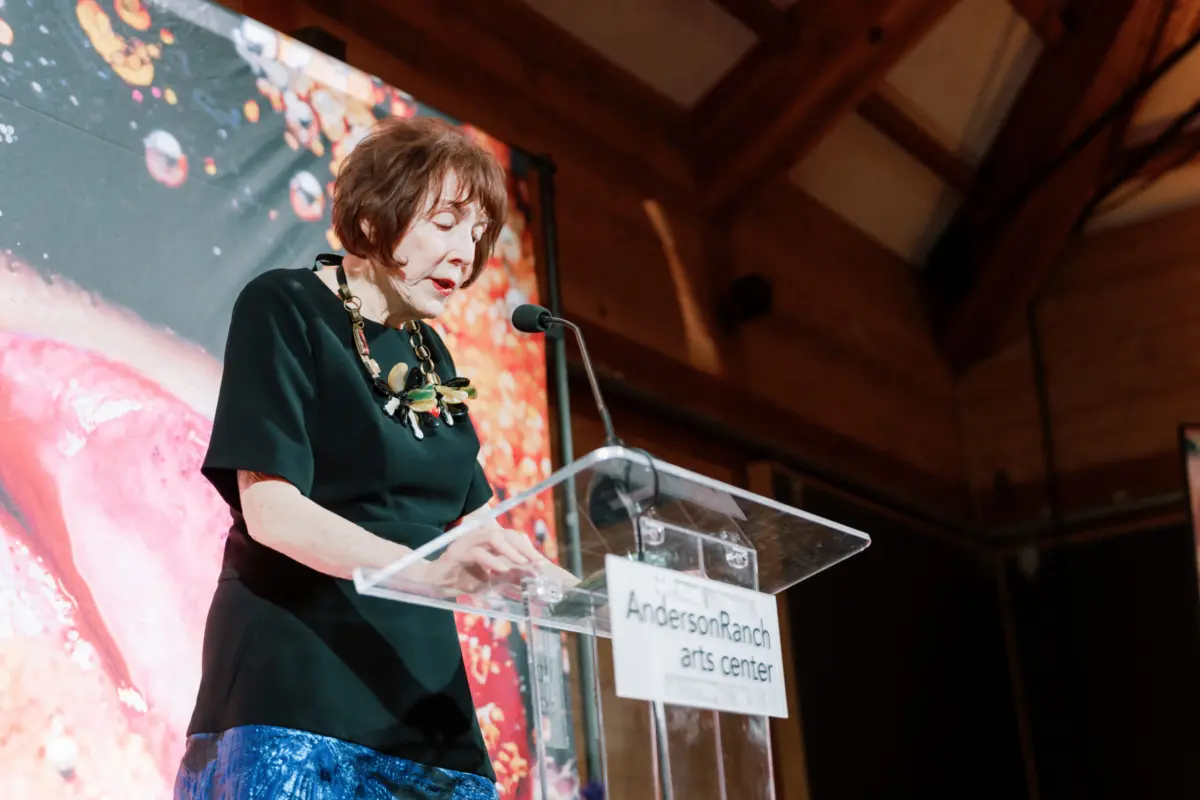
While Waanders draws a sharp contrast between the Ranch’s down-to-earth culture ("you walk around in flats in the gravel and drink beer out of a bottle") and the diamond-heavy, champagne-drenched galas characteristic of nearby Aspen, the annual fundraiser remains a high-glam affair. During this year’s live auction, generous supporters raised more than $1.6 million for student scholarships and programmatic funding. Generosity reached its peak when artist honoree Marilyn Minter donated two exclusive portrait sessions to winning bidders.
Observing the proceedings from the margins—artists dressed in stark defiance of the event’s "Sparkle" dress code—one is reminded of the fundamental alchemy that defines Anderson Ranch. Perhaps the most fitting symbol of the evening was found on the dessert menu: humble doughnuts, sliced in half and arranged into colorful rainbows. It was a sweet, unpretentious nod to the institution’s enduring ethos: the ability to take raw, everyday materials and transform them into something truly extraordinary.

Comments
Facebook App ID not configured. Please add it in the Customizer.