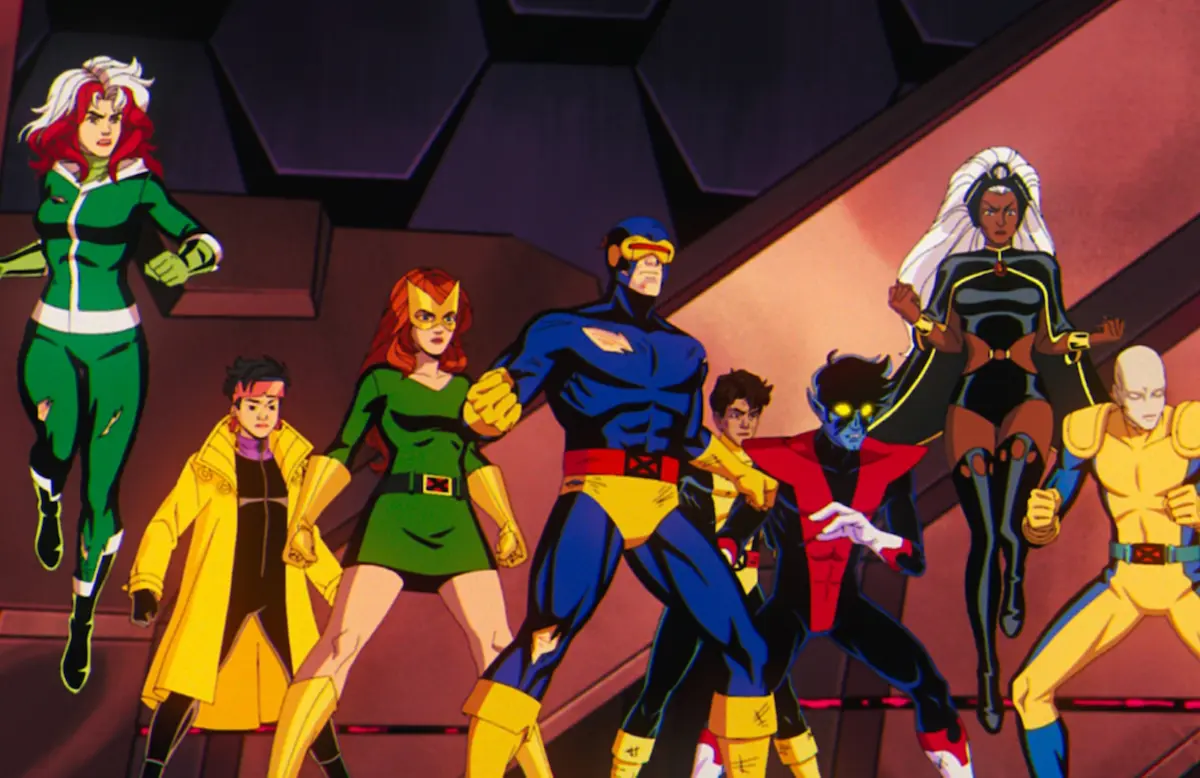
Reviving a cultural touchstone that defined an entire generation’s Saturday mornings is no small undertaking. When Marvel Animation greenlit X-Men ’97, the creative team faced a paradoxical challenge: honor a beloved, instantly recognizable musical identity that fans hold fiercely in their hearts, while simultaneously breathing fresh, modern life into the sonic landscape.
Enter the Newton Brothers—the celebrated composing duo consisting of John Andrew Grush and Taylor Newton Stewart. Known for their intricate psychological horror scores and extensive collaborations with filmmaker Mike Flanagan, as well as their work on MCU projects like Daredevil: Born Again, the composers approached the animated mutants with rigorous dedication.
Rather than resting on nostalgic laurels, Grush and Stewart spent months experimenting, developing nearly a dozen iterations of the iconic theme song alone, and completely reimagining how a television score intersects with evolving animation pipelines. Across the first two seasons of X-Men ’97—both of which are now streaming on Disney+—the Newton Brothers transformed emotional moments into grand cinematic sweeps, utilizing everything from sparse piano arrangements to sweeping, mournful choirs. In the following deep-dive interview, Grush and Stewart pull back the curtain on the creative alchemy that fueled two blockbuster seasons of mutant turmoil, tragic losses, and triumphant fan-service.
Detailed Chronology: Crafting the Sound of a Relics-and-Rebels Universe
1. The Genesis of the Theme: Ten Angles on a Classic
The primary hurdle for any composer stepping into the world of X-Men is the immutable opening theme song. Composed originally by Ron Wasserman, the soaring, synth-heavy anthem is permanently burned into the collective consciousness of 1990s kids.
According to Grush, the process always begins with fundamental mimicry:
"The first thing we always do, whether it’s covering something or being inspired by something, is to learn it—just straight up learn how to play it, so that we can play the whole thing exactly as is. From there, it becomes this process of trying a variety of things."
Rather than tweaking the original track casually, the duo pushed the conceptual envelope into the double digits. They recorded upwards of ten or eleven distinct versions of the tune, treating each like an emotional hypothesis:
The Piano Elegance: A slow, devastating, piano-only rendition that was ultimately cataloged for emotional devastation—specifically utilized in Season 1 following Gambit’s tragic death.
The Hyper-Synth Prototype: A faster, aggressively electronic variation driven purely by classic synthesizers like the legendary Yamaha CS-80.
The Orchestral Sweep: A symphonic, brass-heavy adaptation that leaned into classical grandiosity.
The Choral Anthem: A soaring, all-vocal exploration of the melodic line.
The Hybrids: Three or four experimental fusions, one of which ultimately became the familiar springboard for the series’ opening titles.
When presenting these to the Marvel Animation team, the composers offered a comprehensive spectrum of sound rather than a single safe bet, fully committing to the artistic integrity of every rejected trial.
2. Animation vs. Live Action: Scoring to a Moving Canvas
Transitioning between live-action prestige television and high-end animation introduces distinct technical hurdles. Unlike traditional live-action scoring where cues lock into completed picture edits, animation often relies on early-stage animatics and evolving conceptual sketches.
Grush explains the volatility of scoring to moving lines:
"Even though there are parallels with live action, animation can be very specific, and a lot of times we’re scoring to sketches, these animatics that don’t show all the animation, and then when we get the animation, things change. It informs things like, ‘Oh, the eye blink that’s telling you something, happened like a second later or earlier than we thought it would,’ and that affects what we’re doing."
This fluidity creates an iterative relationship between visual artists and musicians. Last-minute adjustments—such as darkening the digital shading under a tree during a playback session—can radically alter the psychological gravity of a sequence, prompting the Newton Brothers to recalibrate tonality on the fly.
Stuart highlights a prime example in the swamps during the surreal sequence featuring Rogue and Dark Gambit:
"We went dark, but I think being out near the swamps and just the fact that there was all these different creatures, and the goddess—all these different things are influencing the scene, and that affected the color a little bit and also even the dynamics. We were a lot more quiet. We had fiddle players and slide guitar…"
3. Micro-Adjustments and Heartbreak: The End of Season Two
Few moments in recent animation rival the emotional gut-punch of the Season 2 finale, particularly the sequence surrounding Nightcrawler’s agonizing choice and ultimate demise.
Initially, the Newton Brothers scored the sequence using a chamber ensemble—a compact string section designed to maintain an intimate, heartbreaking atmosphere. However, testing alternative paths led them to strip away the instrumentation entirely.
"One of the versions that really resonated with the creatives was just piano by itself, and it seemed to really bring this emptiness, and so that’s what we went for," Stewart recalls.
Working within the narrow time constraints of modern animation—where massive character arcs must find resolution in a matter of seconds, unlike the leisurely pacing of live-action dramas like Daredevil—the composers had to make every micro-choice count. In the final mix stage, notes were surgically adjusted down to the chord:
Grush: "And that scene with Nightcrawler, even though it was such a short period of time… even at the mix stage, they hit us up to adjust like one chord, right? Taylor, was it one chord?" Stewart: "No, it was like two notes." Grush: "Two notes, yeah, just to give a slightly different nod to where they wanted to go."
Rather than letting the musical phrase resolve downward into utter despair, the duo engineered a slight, deliberate upward lift on the final chord—a micro-real estate choice that subtly bridges the tragic present into the narrative unknown of the next season.
Supporting Context & Metrics: The Architecture of Marvel’s Soundscapes
To contextualize the scale of the Newton Brothers’ work on X-Men ’97, it is vital to examine the mechanical and structural framework behind the music:
Yamaha CS-80 and period-appropriate analog synthesizers.
Vocal Assets
Collaborative recordings with a professional choir alongside internal sopranoist performances by assistant Lily Marlovits.
Long-Form Character Arcs
Extended leitmotifs (such as the Nathan Cable "Destiny" theme) mapped out via months of foundational script analysis.
Cross-Platform Experience
Drawing upon 13 distinct collaborations with horror auteur Mike Flanagan and Marvel’s Daredevil: Born Again.
The use of human vocals forms a cornerstone of this structural integrity. As Taylor Stewart notes:
"The thing about vocals is they really evoke a lot of intimacy and personal connection… We use a choir or solos, depending on the scene. It tends to make scenes a little more epic, and when you’re using a full choir it can be more mournful if you’re making it soft and gentle."
Official Statements & Creative Insights
The collaborative ethos between the Newton Brothers and Marvel Animation relies heavily on deep fan appreciation coupled with clinical compositional precision. Below are highlighted perspectives from the creators regarding their standout moments across the two seasons:
On Long-Term Motif Planning:
"For me that would be the whole Nathan Cable ‘Destiny’ theme and that arc over the season. We spent a lot of time on that music when we got the scripts, to make sure that it would land for the season, because we didn’t want to be chasing what that sound would be." — John Andrew Grush
On Fan-Favorite Action Sequences:
"I love it when Nightcrawler became possessed by Dark Gambit or Apocalypse… and he was literally just killing all the X-Men, just like just destroying them in this one action sequence. For that, we played with elements of his theme and his character, and it was just so wild…" — Taylor Newton Stewart
Future Outlook
As X-Men ’97 continues to captivate audiences on Disney+, the impact of the Newton Brothers’ musical landscape cannot be overstated. By treating animation not as a secondary medium requiring simplified sonic wallpaper, but as a canvas demanding sophisticated, emotionally resonant counterpoint, Grush and Stewart have set a new benchmark for comic book adaptation scoring.
The meticulous balance struck between 1990s synthesizer nostalgia and modern orchestral grief proves that the franchise’s musical DNA is endlessly adaptable. With major narrative threads left hanging in the wake of the Season 2 finale—and the emotional residue of Nightcrawler’s departure still echoing through the halls of the Xavier Institute—fans can rest assured that whatever future trials await Marvel’s mutants, the Newton Brothers are prepared to compose their swan songs with unmatched precision and heart.
The first two seasons of X-Men ’97 are currently streaming on Disney+.






Comments
Facebook App ID not configured. Please add it in the Customizer.