
Executive Overview
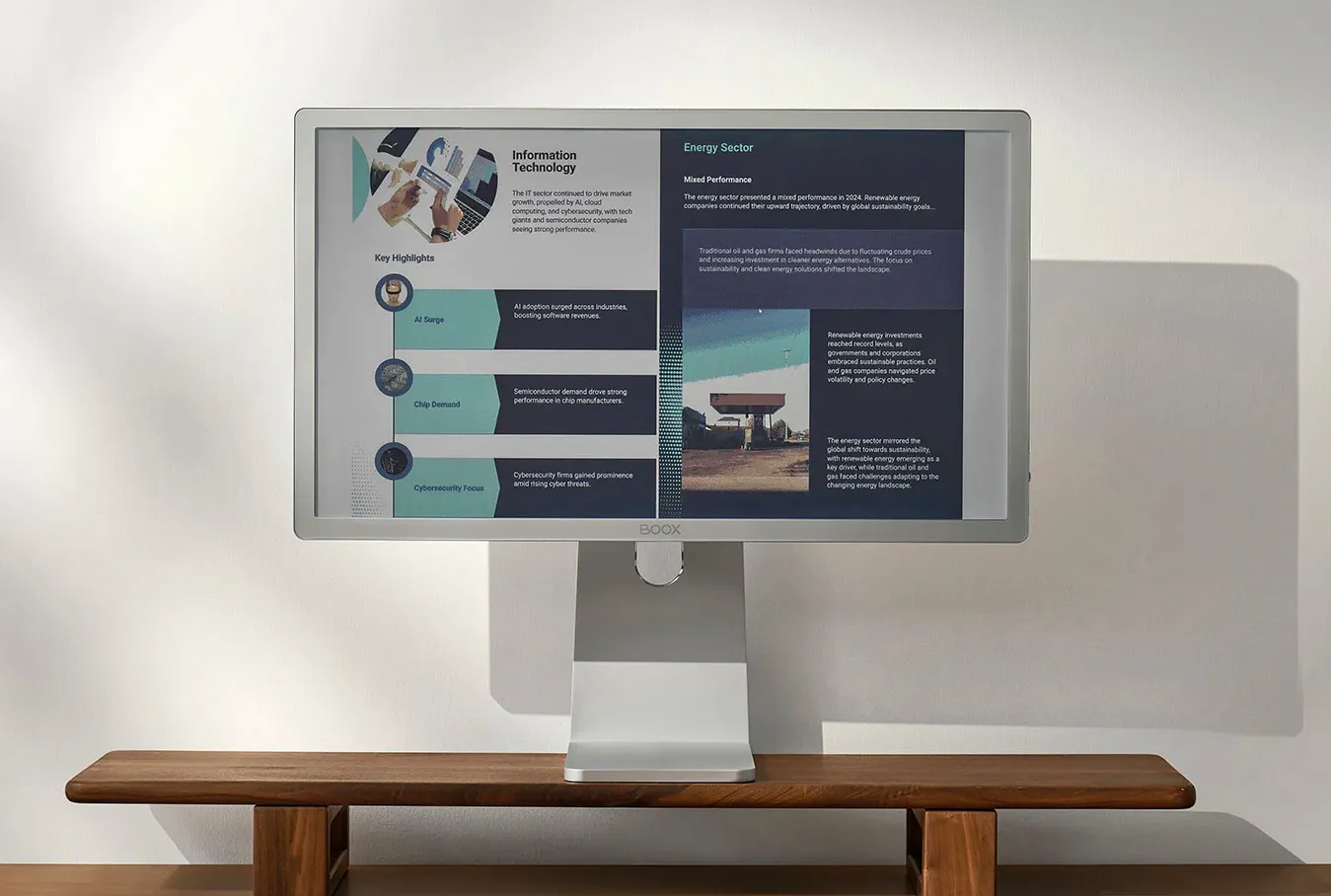
The landscape of professional desktop productivity peripherals has experienced a quiet but notable contraction. Onyx Boox, a dominant force in the global e-reader and e-paper tablet market, has officially discontinued its critically acclaimed line of desktop E Ink monitors. The Onyx Boox Mira and Mira Pro series—spanning both the compact 13.3-inch iteration and the expansive 25-inch flagship—are no longer in active production.
A thorough audit of the official BOOX storefront reveals that both monitors have been marked as permanently unavailable for the better part of the last six months. While sporadic, leftover inventory has occasionally surfaced via third-party vendors or as factory-certified refurbished units directly on the company’s website, the product lifecycle for these specialized eye-care monitors has officially drawn to a close.
Read Also
Launched with much fanfare in late 2021, the Mira series represented Onyx’s ambitious bid to conquer the burgeoning market for eye-strain-free desktop displays. However, high manufacturing costs, steep retail prices, and a niche consumer base created an uphill battle for the hardware line. As Onyx steps back from the desktop monitor sector, the vacuum left in its wake forces a critical re-examination of the E Ink desktop ecosystem—a market where competitors like Dasung and Bigme continue to innovate, adapt, and fight for market dominance.
Detailed Chronology: The Rise and Fall of the Onyx Boox Mira Line
To understand the sudden exit of Onyx Boox from the desktop monitor arena, it is essential to trace the trajectory of the Mira series from its genesis to its quiet phase-out.
2021–2022: Global Launch and High Expectations
The journey of the Mira series began in late 2021. Following initial beta releases and regional rollouts across domestic markets in China, Onyx expanded distribution to North America and Europe. The strategy was clear: capture the growing segment of remote workers, programmers, copyeditors, and individuals suffering from digital eye strain, photophobia, or chronic migraines triggered by traditional liquid-crystal display (LCD) and light-emitting diode (LED) backlighting.
The original 13.3-inch Mira offered a portable, paper-like sub-display, while the 25-inch Mira Pro targeted power users who wanted an immersive, full-sized desktop canvas. Early reviews praised the paper-like clarity, exceptional contrast ratios, and lack of blue-light fatigue. Yet, early adopters were quick to point out the inherent technological limitations of E Ink at scale—chiefly, ghosting during high-speed motion and the steep learning curve required to master refresh-rate settings for daily computing tasks.
2024: Minor Refreshes and Front-Light Iterations
Recognizing the limitations of the original models, Onyx attempted to breathe new life into the aging lineup in mid-2024. The company introduced updated hardware variants featuring adjustable front-lit warm and cool lighting. This addition addressed one of the primary criticisms leveled against the original Mira monitors: their reliance on ambient room lighting to remain legible in dimly lit office environments.
2025: The Last Gasp with Color
In a final push to stay competitive against aggressively evolving rivals, Onyx launched the Mira Pro Color in April and May of 2025. Leveraging newer color e-paper technologies, the color variant aimed to bridge the gap between monochromatic document editing and multi-media workflows. Unfortunately, the timing proved too late and the price point too prohibitive to reverse lagging sales momentum. By late 2025 and into early 2026, production lines had ground to a halt, transitioning the product line from active retail to obsolescence.
Market Realities: Why the Mira Series Faced an Uphill Battle
The discontinuation of the Onyx Boox Mira and Mira Pro raises a broader question about the viability of large-format E Ink displays in a marketplace dominated by cheap, high-refresh-rate 4K LCD and OLED panels. Several compounding factors contributed to the demise of Onyx’s desktop monitor division.

Prohibitive Pricing and Workflow Uncertainty
Chief among the hurdles was the sheer cost of manufacturing large-scale E Ink panels. The 25-inch Mira Pro commanded a staggering retail price of $1,899.99. For most enterprise buyers and home consumers, parting with nearly $2,000 for a monochromatic—or even an early-generation color—secondary monitor was a difficult financial pill to swallow.
Furthermore, E Ink technology behaves fundamentally differently than traditional display tech. Consumers purchasing a Mira Pro often found themselves navigating a steep learning curve regarding how the device fit into their daily software workflows. Video playback, fast-paced web scrolling, and mouse cursor latency required constant adjustment of refresh modes (such as Regal, Normal, or Speed modes). For many, the friction outweighed the ergonomic benefits.
Direct Competition from Established Pioneers
Onyx was not operating in a vacuum. While the company enjoyed household-name status in the e-reader space, its footprint in the desktop monitor market was heavily contested by hardened competitors.
- Dasung: Serving as the undisputed industry leader, Dasung has dedicated nearly a decade exclusively to perfecting E Ink monitors. Their flagship model, the Dasung Paperlike Color Revolutionary, offers a massive 25-inch screen and retails at a competitive $1,698.00. Alongside their flagship, Dasung maintains a robust lineup of 13.3-inch black-and-white and color e-paper monitors that have earned fierce brand loyalty among software engineers and writers.
- Bigme: Operating in the monitor space for roughly four years, Bigme has aggressively expanded its portfolio to include three distinct models that directly target the gaps left by Onyx’s departure.
Supporting Context & Metrics: The Current State of E Ink Monitors
With Onyx exiting the sector, the burden of driving E Ink desktop monitor innovation falls squarely onto the shoulders of Dasung and Bigme. A closer look at current market offerings reveals a technological race to solve E Ink’s historical Achilles’ heel: low refresh rates and muddy color reproduction.
Bigme’s Counter-Offensive
Bigme currently anchors its monitor lineup with two standout devices that showcase how far the technology has progressed:
- The Bigme B13: Retailing at $679.99, the B13 is marketed as the world’s first 13.3-inch color e-paper desktop monitor. Utilizing a Kaleido 3 color e-paper panel, it delivers a glare-free, paper-like viewing experience tailored explicitly for long hours of coding, reading, and text processing without inducing eye fatigue.
- The Bigme B251 Pro: Representing a historic milestone for large-format e-paper displays, the B251 Pro is a 25.3-inch color E Ink monitor capable of achieving a refresh rate of up to 60 FPS (Frames Per Second). This marks a monumental leap forward from its predecessor, the original B251, which capped out at a sluggish 24Hz. By pushing the boundaries of frame rates, Bigme has successfully narrowed the fluidity gap between E Ink and traditional LCD monitors while preserving the unmatched eye-comfort properties of reflective display technology.
| Model / Brand | Screen Size | Technology Type | Key Feature / Milestone | Approximate Retail Price | Status |
|---|---|---|---|---|---|
| Onyx Boox Mira | 13.3-inch | Monochromatic / Front-lit | Compact secondary display; sleek aluminum chassis | ~$799.00 (At launch) | Discontinued |
| Onyx Boox Mira Pro | 25.3-inch | Monochromatic & Color variants | Large-format desktop canvas; high-end build | $1,899.99 | Discontinued |
| Dasung Paperlike Color | 25.0-inch | Color E-Paper | Industry-pioneered large color e-paper workflow | $1,698.00 | Active |
| Bigme B13 | 13.3-inch | Kaleido 3 Color | World’s first 13.3-inch color e-paper desktop display | $679.99 | Active |
| Bigme B251 Pro | 25.3-inch | Color E-Paper | Groundbreaking 60 FPS refresh rate capability | Premium Pricing | Active |
Official Statements and Industry Insights
While Onyx Boox has not issued a formal, emotional press release mourning the loss of the Mira series, the silent inventory purge on their global web portal speaks volumes. Industry analysts point out that Onyx’s core profitability remains heavily anchored in its runaway success with Android-powered e-readers (such as the Note, Tab, and Palma series) and portable note-taking devices.
By pulling back from capital-intensive, low-volume hardware categories like desktop monitors, Onyx is strategically reallocating research and development (R&D) budgets toward consumer electronics categories that yield higher margins and broader consumer adoption.
Industry insider Michael Kozlowski, Editor-in-Chief at Good e-Reader, notes that the high financial barrier to entry for large-scale E Ink glass panels makes the desktop monitor market a high-risk gamble for companies whose primary bread and butter is handheld hardware. Without government-backed subsidies or massive enterprise contracts, retail pricing will inevitably remain high, limiting sales to niche professionals willing to pay a heavy premium for health-conscious ergonomics.
Future Outlook: Where Does the E Ink Monitor Market Go From Here?
The exit of Onyx Boox from the desktop monitor space does not spell the death of the E Ink monitor; rather, it signifies a healthy pruning of a nascent market. As specialized display technology matures, the survival of e-paper monitors depends entirely on three critical evolutionary vectors:
- Price Democratization: For E Ink monitors to graduate from ultra-niche luxury items to standard office peripherals, component costs must drop. Until a 25-inch color e-paper monitor falls below the psychological $1,000 threshold, adoption will remain restricted to medical-necessity buyers and tech enthusiasts.
- Refresh Rate Optimization: Technologies pioneered by Bigme (pushing 60 FPS via advanced driver algorithms) must become the baseline industry standard. Ghosting and motion blur remain the primary deterrents for mainstream adoption.
- Enhanced Color Fidelity: While technologies like Kaleido 3 and Gallery 3 have pushed color e-paper forward, the muted pastel palettes still fall short of satisfying creative professionals who rely on accurate sRGB or Adobe RGB color gamuts for graphic design and video editing.
As Dasung and Bigme continue to iterate on their respective product lines, the legacy left by the Onyx Boox Mira and Mira Pro serves as both a cautionary tale and a foundational stepping stone. Onyx proved that consumer demand for eye-strain-free desktop environments exists, even if the financial and technical economics ultimately proved unsustainable for their specific business model. For now, users seeking an ink-based workspace must look toward remaining pioneers who continue to champion the paper-like revolution on the desktop.

Comments
Facebook App ID not configured. Please add it in the Customizer.