
Executive Overview
In the latest installment of the ongoing interview series hosted by First Things contributing editor Mark Bauerlein, political theorist and author Patrick Deneen sits down for an extensive discussion centered on his recent book, American Odyssey: What an Ancient Story Reveals about Our Divided Souls. Against the backdrop of profound political polarization, cultural fragmentation, and an ongoing identity crisis within the United States, Deneen turns to one of the foundational texts of Western civilization—Homer’s Odyssey—to diagnose the spiritual and civic malady afflicting the modern American republic.
Deneen, a professor of political science at the University of Notre Dame and a prominent voice among contemporary traditionalist critics of liberalism, argues that the trajectory of the American experiment mirrors the long, perilous, and often disorienting journey of Odysseus trying to return to Ithaca. Rather than viewing contemporary political divides merely as policy disagreements over taxation, regulation, or foreign intervention, Deneen posits that the nation is suffering from a deeply rooted "divided soul." This fracture, he suggests, is the logical outcome of a hyper-individualistic ethos that systematically untethers citizens from the foundational pillars of family, locality, tradition, and place.
This comprehensive report examines the core themes of the Bauerlein-Deneen dialogue, contextualizes Deneen’s broader intellectual contributions to contemporary conservative and traditionalist thought, explores the structural metrics of America’s current sociological divide, and projects the long-term cultural implications of returning to classical paradigms to make sense of modern political turmoil.
Read Also
Detailed Chronology: The Intellectual Genesis and Ongoing Dialogue
The Roots of the Crisis: From Why Liberalism Failed to Regime Change
To understand the arguments presented in American Odyssey, it is necessary to trace the arc of Patrick Deneen’s recent intellectual output. Over the past decade, Deneen has emerged as one of the most provocative critics of the post-Cold War political consensus.
- 2018: Deneen published Why Liberalism Failed, a critique arguing that liberalism’s very success—specifically its liberation of the individual from traditional constraints—eroded the social capital required to sustain a free people. The book struck a nerve across the political spectrum, earning praise from traditionalists and drawing sharp retorts from defenders of the classical liberal order.
- 2023: He followed up with Regime Change: Toward a Future of Common Good, which advocated for a reorientation of state power to protect the working class from the depredations of a self-dealing managerial elite.
- Late 2024 / Early 2025: With the publication of American Odyssey, Deneen shifts from purely structural and political critique to a more literary and psychological framework. In his conversation with Mark Bauerlein, Deneen explains that political systems do not exist in a vacuum; they are downstream of the desires, longings, and disordered loves of the human heart.
The Bauerlein-Deneen Exchange
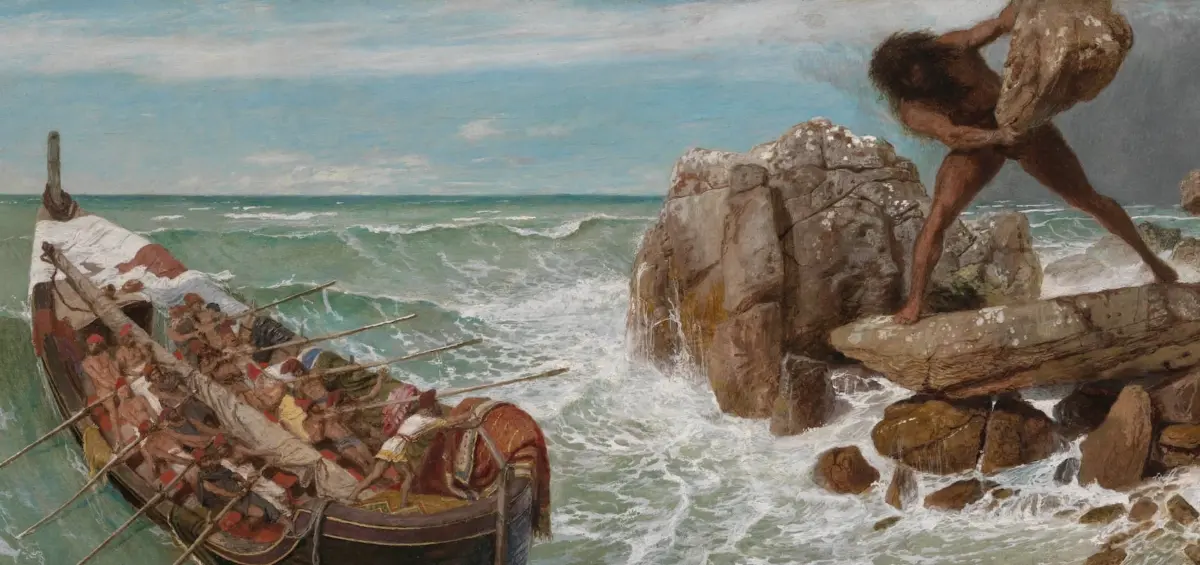
During their recent interview, Bauerlein and Deneen unpacked how Homer’s epic poem serves as an uncanny mirror for contemporary American life. Odysseus’s prolonged voyage is not merely a physical trek across the Mediterranean; it is a spiritual trial marked by the temptation of forgetfulness (the Lotus-Eaters), the seduction of boundless appetite (Circe), the threat of homogenization and loss of distinct identity (the Cyclops and the Sirens), and the ultimate challenge of reclaiming a rightful home.
Deneen argued during the session that modern Americans have become modern-day lotus-eaters, lulled into a state of digital and consumerist distraction that dulls the pain of rootlessness. The discussion moves systematically through the narrative arcs of the Odyssey to map them onto contemporary socio-political phenomena:
- The Suitors in Ithaca: Deneen draws a parallel between the predatory, consumption-driven suitors who overrun Odysseus’s home in his absence and the contemporary managerial, technocratic elite who consume the cultural and economic patrimony of working-class Americans without stewardship or care.
- Penelope’s Shroud: The tactical weaving and unweaving of Penelope’s web is framed as a metaphor for the desperate attempts of ordinary citizens to preserve local traditions and community bonds against the relentless, unraveling forces of globalized modernity.
- The Return: The ultimate homecoming requires recognition, reclamation of identity, and the painful restoration of order—a task Deneen suggests America must face if it is to heal its internal fractures.
Supporting Context & Metrics: Mapping the American Divide
To contextualize Deneen’s philosophical diagnoses, it is essential to examine the empirical realities of contemporary American polarization. The "divided soul" of which Deneen speaks manifests daily in stark sociological, economic, and geographic metrics.
1. Political Polarization and Affective Sorting
According to data compiled by the Pew Research Center and other leading social science institutions, political polarization in the United States has moved beyond mere ideological divergence into the realm of affective polarization—where citizens not only disagree with political opponents but harbor deep personal animosity toward them.
- The Partisan Chasm: Over the past three decades, the percentage of Republicans and Democrats who view the opposing party unfavorably has surged from roughly 60% to over 80%.
- Geographic Sorting: Americans are increasingly sorting themselves into ideological enclaves. Urban centers have grown progressively more progressive, while rural and exurban regions have consolidated as conservative strongholds, deepening the cultural alienation between different segments of the population.
2. The Crisis of Social Capital and Community Roots
Deneen’s diagnosis heavily relies on the concept of rootlessness—the idea that modern economic imperatives demand a mobile, placeless citizenry willing to uproot themselves for career advancement at a moment’s notice.
- Declining Civic Engagement: Data from the Survey Center on American Life indicates a continuous drop in membership in traditional civic organizations, labor unions, religious institutions, and fraternal lodges—the very mediating structures that political philosophers from Alexis de Tocqueville to Robert Putnam identified as the lifeblood of American democracy.
- The Loneliness Epidemic: In 2023, the U.S. Surgeon General issued an advisory declaring loneliness and isolation a public health epidemic, noting that nearly half of American adults report experiencing measurable levels of loneliness. This sociological reality mirrors Deneen’s literary claim that modern individuals, freed from binding obligations, find themselves drifting on a vast, hostile sea without a spiritual anchor.
Official Statements & Intellectual Perspectives
The ideas advanced by Deneen in American Odyssey and elaborated upon in his conversation with Mark Bauerlein have generated substantial discussion within intellectual and journalistic circles.
Mark Bauerlein, reflecting on the thematic depth of the series, emphasized the urgency of looking beyond standard political talking points:
"When we look at the daily news cycle, we are trapped in the immediate—the poll numbers, the legislative fights, the rhetorical volleys. What Patrick Deneen achieves in this work is an elevation of our gaze. He reminds us that the crisis of the American experiment is fundamentally a crisis of the human imagination. If we do not understand what we desire, we will never understand why we are tearing ourselves apart."
In response to critics who argue that his traditionalism romanticizes an idealized past that never truly existed, Deneen has consistently maintained that his project is not nostalgic, but diagnostic. In various forums accompanying his book tour, Deneen has clarified his stance:
"To recognize that we are lost is not an expression of despair; it is the absolute prerequisite for finding our way back. The sirens of autonomy, hyper-mobility, and unbridled self-creation have promised us godlike freedom, but they have delivered isolation, demographic stagnation, and civic decay. Like Odysseus, we must eventually recognize that our true home is found not in boundless wandering, but in the acceptance of limits, obligations, and the sacred duties we owe to our neighbors and our land."
Mainstream liberal critics, however, have raised concerns regarding the policy prescriptions implied by this traditionalist framework. Reviewers in publications such as The Atlantic and The New York Times have argued that Deneen’s skepticism toward individual autonomy risks undermining the legal and civil rights protections that modern pluralism relies upon. They contend that a return to older paradigms risks imposing a singular moral vision on a diverse and multicultural society.
Future Outlook: Navigating the Post-Liberal Horizon
As the United States looks toward the middle of the 21st century, the debate over the nation’s foundational identity shows no signs of abating. The dialogue between Mark Bauerlein and Patrick Deneen underscores a growing intellectual movement that refuses to accept political polarization as a permanent, immutable condition, choosing instead to interrogate its deeper metaphysical roots.
Key Questions for the Decade Ahead:
- Can Mediating Institutions Be Rebuilt? The future stability of the American regime will likely depend on whether communities can successfully cultivate new local institutions—such as classical charter schools, hyper-local cooperative economies, and faith-based community networks—that counteract the corrosive effects of digital atomization.
- The Economic Imperative of Place: As remote work models and changing industrial landscapes redefine labor, policymakers from across the political spectrum are beginning to grapple with the economic revitalization of post-industrial and rural towns. Reconnecting economic policy to the preservation of stable communities may prove to be the defining domestic challenge of the coming decades.
- The Role of Narrative in Civic Renewal: As Deneen’s work demonstrates, political arguments alone are often insufficient to heal cultural fractures. Reclaiming a shared national narrative—one that acknowledges historical flaws while honoring enduring principles—will require imaginative and literary engagement of the highest order.
For those seeking to delve deeper into these profound questions, the full interview between Mark Bauerlein and Patrick Deneen remains available for streaming via major platforms including Apple Podcasts and Spotify, offering listeners an indispensable guide to understanding the soul of contemporary America.



Comments
Facebook App ID not configured. Please add it in the Customizer.