In 1943, as Europe crumbled under the devastation of the Second World War, modernist architects and historians Siegfried Giedion, Jean-Luc Sert, and Fernand Léger gathered to publish Nine Points on Monumentality. Written amidst rubble and ruin, the manifesto posited that monuments were vital social instruments meant to anchor a sense of historicity for traumatized populations. They argued that monuments served a dual purpose: reminding communities of a pre-war wholeness while translating collective aspirations into coherent, enduring symbols. Crucially, the manifesto asserted that monuments require a "unifying consciousness and unifying culture" to exist, forming an uninterrupted bridge between the past and the future.
However, when applied to post-colonial landscapes and the complex historical realities of the Global South, this Eurocentric premise fractures. Nowhere is this rupture more visible than in San Basilio de Palenque, Colombia—recognized by UNESCO in 1995 as the "first free people of the Americas."
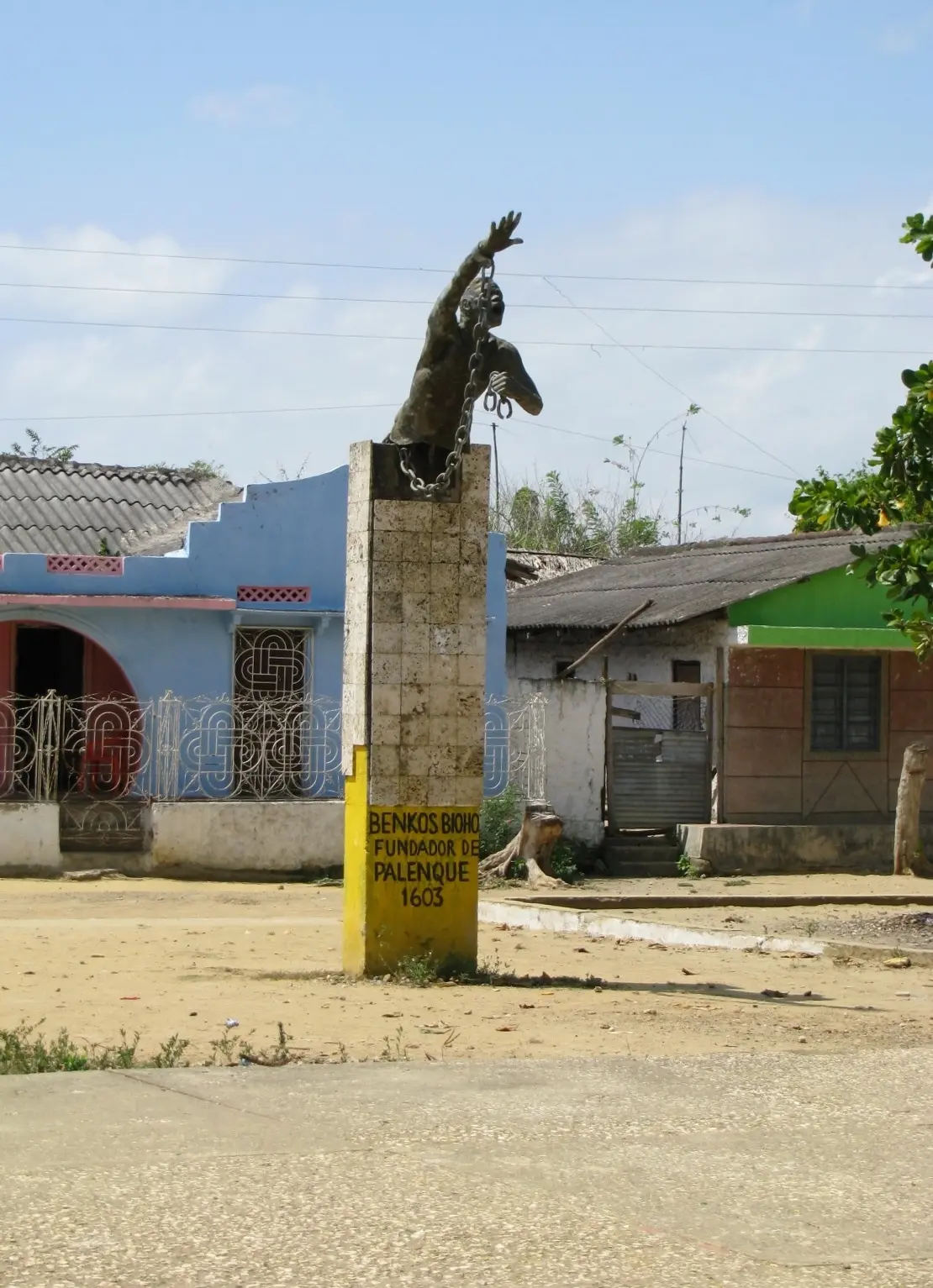
At the center of this historic town stands a monument dedicated to its mythical founder, the legendary maroon leader Benkos Biohó. Sculpted by Luis Guillermo Vallejo and installed in 1997 with the backing of UNESCO’s Routes of Enslaved Peoples initiative, the bronze figure has spent decades at the center of an intense, community-driven contestation. Rather than embodying a static, unified symbol of historical continuity, the monument has been continuously altered, rechristened, recarved, and stripped of its shackles by the Palenqueros.
This deep investigative report traces the turbulent biography of the Benkos Biohó monument, exploring how a community’s physical and conceptual manipulation of a public sculpture challenges traditional Western frameworks of monumentality, memory, and Black freedom.
Detailed Chronology: The Evolution and Re-creation of the Benkos Biohó Monument
The physical alterations of the Benkos Biohó monument over the past three decades reveal a continuous negotiation between state-sanctioned historical narratives and local, autonomous practices of remembrance.
[1997] Initial Installation ──> [2009] Second Epigraph ──> [2012] Cenotaph Phase ──> [2015] Urban Integration ──> [Present] Chiseled Resistance
  • Bronze figure on 4m base    • Epigraph revised to "Founder"     • Pedestal covered by steps      • Heliocentric plaza tiling     • Plaque removed, pedestal
  • Handwritten "Palenke"       • Kikongo "ke" changed to "que"     • Converted into a cenotaph      • Formalized tourist paths      • Shackle fragments visible
1. The 1997 Installation and the "Palenke" Paradox
When the bronze sculpture of Benkos Biohó arrived in San Basilio de Palenque in 1997, it was temporarily housed inside the town’s small church for nearly two years while awaiting a pedestal. During this pre-monumental phase, the locals treated the unmounted bronze not as a secular artwork, but as a miraculous image—akin to a saint.
When finally mounted on a four-meter-high concrete base built by the community, the monument immediately presented a stark contradiction. The sculpture depicted the great maroon leader naked, shouting upward with his body strained, yet physically bound by the heavy chains of slavery. At the base, a handwritten inscription read:
Palenke Fundado por BENKOS BIOHO en 1603 ("Palenke Founded by Benkos Biohio in 1603")
This initial iteration was radical in two ways: it predated the town’s official 1713 recognition by the Spanish Crown, and it spelled "Palenke" with a k—a subtle yet profound act of resistance against Hispanic linguistic norms. In this moment, Benkos was Palenke, and Palenke was Benkos.
2. The 2009 Epigraph Revision and the Removal of Chains
As the years progressed, the community sought to reconcile the glaring contradiction of portraying a freedom fighter in physical chains. The bronze figure’s pose—originally modeled on allegories of slave ships and captive runs favored by international heritage frameworks—became untenable for a community celebrating self-determination.
By the late 2000s, the epigraph was amended to remove the k in favor of the Spanish "que," and the text was altered to read:
BENKOS BIOHO fundador de Palenque. 1603
Finding the presence of the shackles unbearable, members of the community intervened directly with the sculpture, removing the chains from the bronze figure. Stripped of the chains, however, the sculpture’s frantic, upward-reaching posture transformed into a confusing, mute cry. To resolve this aesthetic impasse, the community covered the contentious epigraph entirely with a series of white-tiled steps, turning the base into a nameless cenotaph—a tombstone without a body.
3. The 2015 State Intervention and the Heliocentric Plaza
In 2015, government funds flowed into San Basilio de Palenque to institutionalize the town’s heritage infrastructure. Major urban renewals transformed the central plaza:
The local church was expanded, and new paving stones were laid down.
A vibrant, heliocentric pattern of red and yellow tiles was radiated outward from the base of the monument, visually anchoring Benkos as the geometric and spiritual epicenter of the town.
A new, elaborate epigraph was installed on a colonial-style scroll, detailing Benkos’s royal African lineage in Guinea-Bissau, his seventeenth-century rebellions, and his execution in Cartagena de Indias on March 16, 1621.
A secondary, smaller pedestal was erected nearby, bearing the inscription: “Palenque: primer pueblo libre de América.”
4. Present-Day Contestation
The state’s attempt at a permanent, definitive historical marker proved short-lived. Today, the 2015 commemorative plaque has been removed, and the secondary pedestal has been deliberately chiseled down. Remnants of the original chains, once filed away or broken, remain visible only as jagged scars on the bronze. The monument today exists in a state of perpetual unfinishedness—a monument continually sculpted by the very people it seeks to honor.
Supporting Context & Metrics: History, Myth, and Historiography
To understand the friction surrounding the monument, one must examine the split historiography of San Basilio de Palenque. According to foundational historical research by Nina de Friedemann and María Cristina Navarrete, the reality of maroon resistance (cimarronaje) in the Colombian Caribbean was complex, violent, and collective, rather than driven by a single heroic savior.
Historical Phase / Event
Date
Significance to Palenquero Identity
La Matuna Guerrilla Warfare
Late 16th Century
Maroons utilized dense jungle terrain to repel Spanish military expeditions from Cartagena de Indias.
Benkos Biohó’s Concession
1603
Biohó and his fighters forced the Spanish Crown to grant them legal freedom of movement and the right to bear arms.
The Execution of Biohó
March 16, 1621
The Spanish Crown violated the pact, trying and hanging Biohó in Cartagena.
The Entente Cordiale
1713
Official legal reduction and recognition of the town of San Basilio, tied with restrictive caveats (Spanish schooling, reserve army status).
UNESCO Intangible Heritage Recognition
1995
Global designation of San Basilio de Palenque as the "first free people of the Americas," sparking institutional tourism and monument construction.
Navarrete’s research demonstrates that the popular myth conflates two distinct historical moments separated by a century: Benkos Biohó’s fierce 1603 jungle fighters and the 1713 Entente Cordiale that legally established the town under strict Spanish oversight.
When international bodies like UNESCO sponsor monuments using European-canon aesthetics—such as the phallic, vertical, isolated hero standing above the crowd—they impose a sanitized, pacified narrative. This aesthetic framework reduces the militant, anti-colonial war strategy of the cimarrones into digestible, folkloric heritage.
Official Statements and Academic Perspectives
The theoretical implications of the Benkos Biohó monument have drawn intense scrutiny from cultural critics, anthropologists, and art historians.
Ludmila Ferrari, Art Historian and Author:
"The successive rewritings of the epigraph sought to reframe the memorial as a symbol of liberation… but ultimately, Benkos’s distressing portrait seems to make it unattainable. The community’s collective sculpting invites us to seek an understanding of freedom that does not depend on slavery to define itself."
The Palenquero Community’s Practical Stance:
Rather than viewing the monument through a pristine museological lens, the residents of San Basilio de Palenque treat public memory with a pragmatic, living intimacy. Archival photographs captured by Richard Cross during the 1970s—long before UNESCO’s arrival—reveal a community whose daily life effortlessly integrated spaces of memory, such as the Kasariambé (cemetery), where children played boxing matches against tombs. For the Palenqueros, the dead are active participants in community life, rendering Western notions of solemn, untouchable monuments culturally alien.
Critique of UNESCO’s Aesthetic Framework:
Scholars argue that international heritage programs frequently rely on trauma-laden allegories of the slave ship (seen in monuments from Guinea-Bissau to the Caribbean) to commemorate Black emancipation. By freezing the maroon warrior in a state of bondage and perpetual struggle, these monuments inadvertently perpetuate a neocolonial narrative where Black freedom can only be visualized in relation to white enslavement.
Future Outlook: Beyond Representation
The ongoing metamorphosis of the Benkos Biohó monument poses critical questions for the future of public art, historic preservation, and post-colonial communities across the globe:
The Shift from Static to Dynamic Heritage: As communities increasingly reject top-down, state-mandated historical markers, public art must account for participatory, iterative vandalism and community remodeling as legitimate acts of cultural authorship.
Decolonizing Public Space: The case of San Basilio de Palenque demonstrates that true autonomy requires severing the conceptual umbilical cord that ties Black liberation narratives to the iconography of European slavery.
The Limits of Institutional Recognition: While global designations like UNESCO bring economic resources and tourist visibility, they risk flattening dynamic, revolutionary histories into static museum pieces.
Ultimately, the monument to Benkos Biohó stands not as a finished artifact, but as a living battlefield of memory. Through continuous chiseling, rewriting, and unchaining, the people of San Basilio de Palenque are proving that a true monument to freedom is never unified, never silent, and never settled—it remains forever in motion.







Comments
Facebook App ID not configured. Please add it in the Customizer.