
Executive Overview
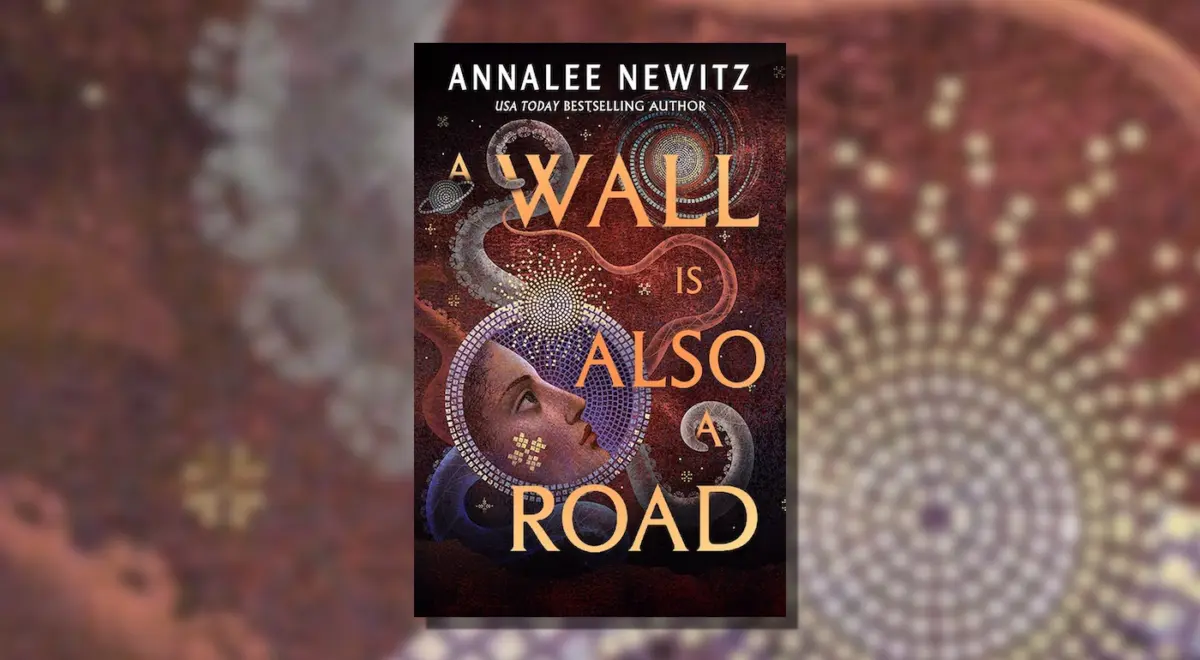
In the vast literary landscape of speculative fiction, few authors push the boundaries of alien perspective quite as radically as Annalee Newitz. Known for blending rigorous sociological inquiry with imaginative world-building in works like Autonomous and The Future of Another Timeline, Newitz returns this fall with a daring new science fiction novel: A Wall Is Also a Road, published by Tor Books.
At the center of this narrative is Gardenpath, a graduate student hailing from an ancient civilization of space-faring slime molds that inhabit the silent expanses between the stars. When Gardenpath’s academic pursuits lead them to a remote, uncharted spiral arm of the galaxy, they make an earth-shattering (or rather, Earth-shattering) discovery: a mysterious planet teeming with complex ecosystems, untamed biology, and strange, vibrant cultures.
More than just a standard alien-contact narrative, A Wall Is Also a Road uses Gardenpath’s outsider status—complete with a specialized "galaxysuit" to navigate crushing planetary gravity and atmospheric conditions—to satirize academic bureaucracy, reexamine the definitions of consciousness, and explore the messy realities of cross-species empathy. Blending high-concept astrobiology with an unexpected narrative stopover in a seaside tourist town called Pompeii—where an alien resident named Murtis introduces Gardenpath to local shopkeepers, immigrants, and a brothel known as "the lupanar"—the novel promises to be one of the most intellectually stimulating and whimsical releases of the literary season.
Read Also
Detailed Chronology of an Interstellar Discovery
The newly released excerpt from A Wall Is Also a Road chronicles Gardenpath’s harrowing descent onto the surface of an unnamed, high-gravity world colloquially dubbed "the Spigot." The chronology of their arrival unfolds as a masterclass in alien anthropology and empirical shock:
1. Planetary Landing and Environmental Shock
Equipped with a protective galaxysuit, Gardenpath fights intense dizziness and heavy radiation, deploying visual filters to bring the rocky landscape into focus. Stranded near the barren peak of an active volcanic mountain, they observe an ocean of staggering, "novel" size. Navigating a turbulent river of liquid water—a luxury to a creature accustomed to mining for hydration—they quickly transition into researcher mode, planting sensors and documenting the rugged, wrinkled topology of the landscape.
2. The Shock of Botany: Encountering Agriculture
What initially looks like random patches of moss soon reveals itself to be an organized network of flora. Gardenpath stumbles upon symmetrical fields of photosynthesizing plants laden with fluid-filled fruit sacs. Interacting with single-celled prokaryotes in the warm soil, Gardenpath attempts chemical communication, announcing their arrival from a university beyond the galactic plane, only to be met by the quiet respiration of biological maintenance.
3. The Horror and Fascination of Multicellularity
The true paradigm shift occurs when Gardenpath captures a long, pink, writhing animal. To their horror and fascination, the creature is multicellular—a massive cluster of thousands, perhaps millions, of life-forms functioning as a unified entity. While multicellular plants are documented within "Rational" space, complex multicellular animals operating with apparent autonomy challenge everything Gardenpath’s academic institution has taught them.

4. Behavioral Observations: Animal1, Animal2, and Social Syntax
Over the course of 180 planetary rotations, Gardenpath catalogs over 700 life-forms. They document "Animal1"—a four-armed creature propelling itself through plant stalks—and the much larger "Animal2" clusters. Composed of over twenty trillion joined eukaryotes, these creatures emit nonrandom vibrations through specialized apertures on hardened head bulbs. Despite lacking obvious centralized consciousness, these beings display social behaviors, call-and-response vocalizations, and communal interactions that leave Gardenpath questioning the rigid dogmas of galactic biology.
Supporting Context & Metrics: The World of A Wall Is Also a Road
To fully appreciate the scope of Newitz’s latest creation, it is helpful to examine the structural and thematic metrics framing the novel’s universe:
- Publication Details:
- Author: Annalee Newitz
- Publisher: Tor Books / Macmillan Publishers
- Release Date: October 6th (Upcoming)
- Format: Hardcover, Ebook, Audio
- The Protagonist’s Profile:
- Name: Gardenpath
- Species: Amoeba / Slime mold (ancient space-dwelling civilization)
- Academic Standing: Graduate student attempting to pass the rigorous "First" and "Fifth" examinations.
- Planetary Metrics (The Spigot):
- Geology: Tectonically active, liquid core beneath a solid shell; volcanic mountain ranges driven by generational eruptions.
- Atmosphere: Bracing blue skies, ice-cloud refraction producing dramatic orange and pink horizons, coupled with high-gravity constraints requiring specialized galaxysuits.
- Life Cataloged: Over 700 distinct life-forms identified within preliminary research phases, ranging from prokaryotic nitrogen-exchangers to trillion-celled eukaryotic clusters.
- The Cultural Intersection:
- Pompeii: A seaside tourist town populated by immigrants and shopkeepers.
- Murtis: An indigenous animal resident of Pompeii who takes Gardenpath under her care, exposing them to local social dynamics, labor, and life outside the ivory tower of academia.
Official Statements and Authorial Vision
Annalee Newitz’s approach to science fiction has always prioritized the reimagining of social systems through non-human lenses. In A Wall Is Also a Road, this philosophy is brought to life by casting an amoebic graduate student as the ultimate academic underdog.
While academic institutions in the novel’s universe—represented by figures like the imposing Professor Arch and competitive peers like Wainscot—demand clean, digestible data, Gardenpath is confronted with the messy, unquantifiable reality of a living ecosystem. The discovery of complex, multicellular life on a world previously thought to be chemically barren should be a triumphant ticket to passing the "Fifth Exam." Instead, it represents an administrative nightmare: an infinite cataloging project that threatens to overwhelm the lone researcher.
The inclusion of Murtis—a local inhabitant of the city of Pompeii who works in a lupanar—adds a layer of gritty, terrestrial realism that contrasts sharply with Gardenpath’s sterile cosmic origins. Murtis’s casual acceptance of an interstellar slime mold demonstrates a thematic core central to Newitz’s work: the capacity for empathy, mutual aid, and community across vast biological and cultural divides.
Future Outlook and Critical Reception
As the October 6th publication date approaches, A Wall Is Also a Road is positioning itself as a major literary event in speculative fiction. Early excerpts suggest a novel that successfully balances high-concept astrobiology with witty social commentary, making it a must-read for fans of Ursula K. Le Guin, Becky Chambers, and Arkady Martine.
Key Themes to Watch For Upon Release:
- The Critique of Academic Gatekeeping: How institutional metrics of success often punish genuine discovery in favor of safe, conformist research.
- The Definition of Sentience: Exploring consciousness not as a binary switch, but as a spectrum shared by slime molds, trillions-celled eukaryotic clusters, and bipedal animals alike.
- Radical Empathy: The unexpected bonds forged between radically different life-forms navigating the mundane struggles of work, community, and survival.
Whether Gardenpath will successfully navigate the gauntlet of academic examinations, survive the high gravity of the Spigot, or redefine the scientific consensus of the galaxy remains to be seen. What is certain, however, is that Annalee Newitz has constructed an unforgettable cosmic mirror—one that reflects our own messy, beautiful existence through the multibranched eyes of an alien amoeba.





Comments
Facebook App ID not configured. Please add it in the Customizer.