The landscape of international literature in translation continues to serve as an indispensable mirror for global crises, existential inquiry, and historical reckoning. In August 2026, a remarkable curation of translated works arrives to challenge readers, bridge geopolitical divides, and elevate marginalized perspectives. Curated by Tobias Carroll and highlighted through various critical platforms, this month’s literary watchlist features five distinct texts spanning Arabic, Danish, Spanish, and Dutch. From frontline testimonies of survival in Gaza and poetic indictments of healthcare bureaucracies in Peru, to contemplative examinations of astrophysics in rural Denmark, surrealist explorations of grief in Mexico, and pioneering feminist consciousness-raising from 1970s Amsterdam, these works underscore the vital urgency of cross-cultural exchange.
This report offers a comprehensive examination of the August 2026 translation releases. By analyzing publisher mandates, critical responses, and thematic resonances, we explore how these texts interrogate the human condition under duress. Far from being isolated artistic endeavors, these publications form a cohesive mosaic of witness, resistance, and literary innovation, proving that translated literature remains one of our most potent tools for global empathy and historical preservation.
Detailed Chronology: The Evolution and Release of the August 2026 Selections
The path from original manuscript to English-language publication is fraught with editorial challenges, translation hurdles, and geopolitical complexities. The August 2026 watchlist brings together books with vastly different origins, timelines of composition, and cultural trajectories.
1. Your Presence Is a Danger to Your Life: Voices of Survival and Witness in Gaza
Author: Samar Yazbek
Translator: Leri Price
Publisher: Other Press
Context: Drawn from active conflict and immediate historical trauma, this collection represents a rapid and crucial transmission of contemporary testimony. Samar Yazbek, a renowned Syrian author and journalist in exile, turns her perceptive eye toward the ongoing crisis in Gaza, capturing the voices of ordinary civilians ranging from 13 to 65 years old. Translated by Leri Price—a celebrated translator known for previous collaborations with Yazbek—the book transforms harrowing frontline accounts into a permanent historical archive. The title itself is a chilling direct quotation from warning flyers dropped by military forces moments before an aerial bombardment.
2. Range
Author: Dorthe Nors
Translator: Caroline Waight
Publisher: Graywolf Press
Context: Representing the contemporary European novelistic tradition, Dorthe Nors’s Range (translated from the Danish by Caroline Waight) continues the author’s exploration of sparse landscapes and complex internal psychological states. Nors, celebrated for her concise and atmospheric storytelling, shifts her narrative focus to Gunn, an astrophysicist navigating the vast intellectual expanse of the universe alongside the granular, often suffocating social boundaries of a tight-knit rural community.
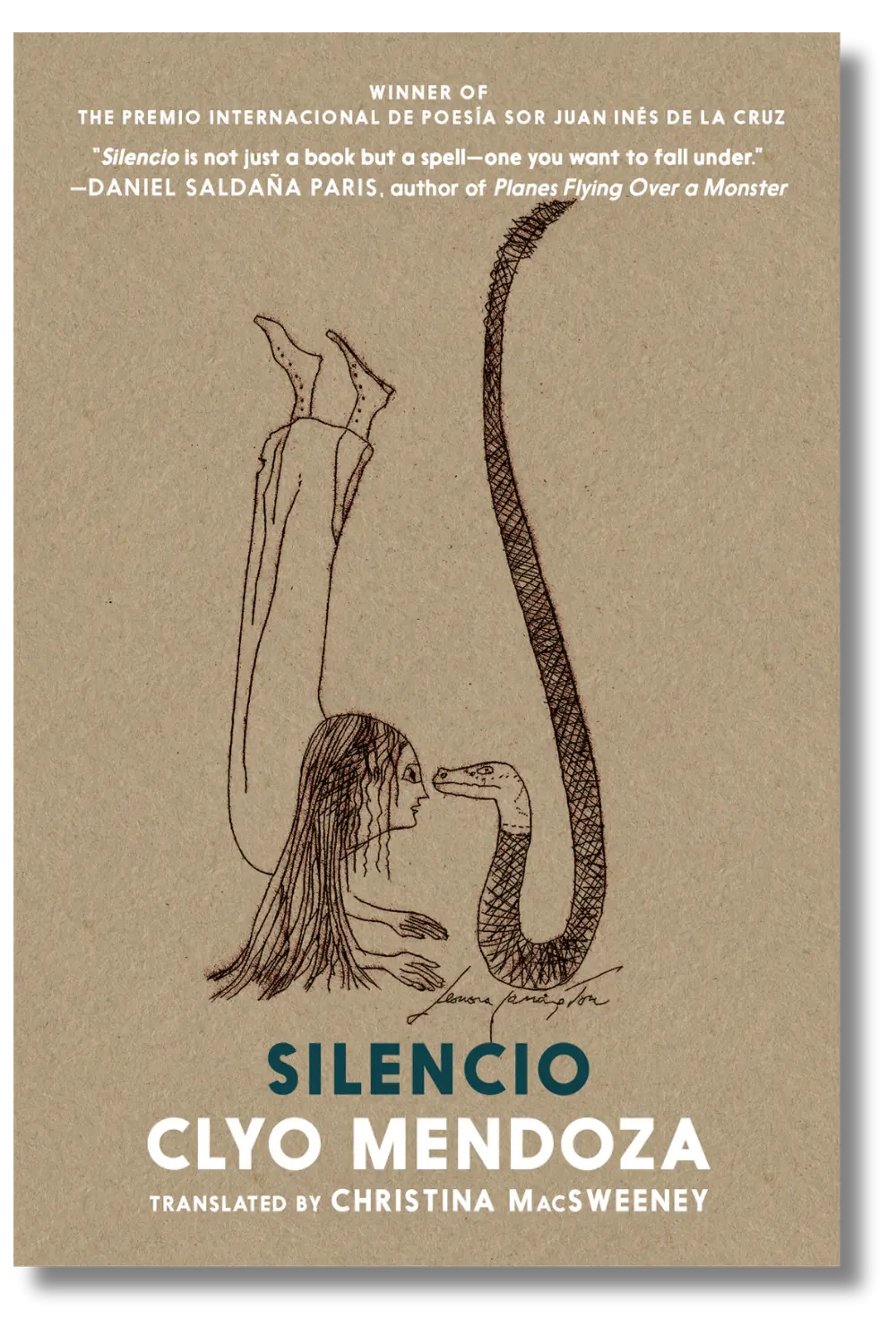
3. Silencio
Author: Clyo Mendoza
Translator: Christina MacSweeney
Publisher: Seven Stories Press
Context: Originally published within the vibrant ecosystem of contemporary Mexican literature, Silencio by Clyo Mendoza (translated by Christina MacSweeney) builds upon a burgeoning tradition of Latin American lyric prose that blends magical realism, animism, and stark social critique. The narrative follows Águeda, a young woman battling a patriarchal and oppressive family structure following her mother’s death, while simultaneously reaching outward to document the broader socioeconomic grief and exploitation experienced by Mexican communities.
4. And death shall have no dominion / Killing “The Mother”
Author: Victoria Guerrero-Peirano
Translator: Honora Spicer
Publisher: Tripwire Editions
Context: Standing at the intersection of poetry, theory, and institutional critique, Victoria Guerrero-Peirano’s work—translated from the Spanish by Honora Spicer—arrives as a slim yet monumental volume from Peru. Originally recognized within South American avant-garde circles, Guerrero-Peirano uses fragmentary poetic prose to expose the systemic dehumanization embedded within healthcare bureaucracies and neoliberal capitalism, interrogating the very nature of poetic creation amidst social decay.
5. The Shame Is Over: A Personal History
Author: Anja Meulenbelt
Translator: Ann Oosthuizen
Publisher: Astra Publishing House
Context: Offering a vital historical perspective, this publication brings back into circulation a foundational text of European second-wave feminism. First published in Dutch in 1976 and translated by Ann Oosthuizen, Anja Meulenbelt’s memoir-manifesto charts her evolution from a teenage mother trapped in poverty and domestic abuse to a prominent leftist activist in 1960s and 1970s Amsterdam, exposing the persistent misogyny within male-dominated revolutionary movements.
Supporting Context & Metrics
To fully understand the weight of these August 2026 releases, one must examine the quantitative and qualitative data surrounding their publication metrics, thematic distributions, and linguistic origins.
Book Title
Original Language
Translator
Genre
Page Count
US Retail Price
Publisher
Your Presence Is a Danger to Your Life
Arabic
Leri Price
Nonfiction / Testimony
336 pages
$17.99
Other Press
Range
Danish
Caroline Waight
Fiction
336 pages
$18.00
Graywolf Press
Silencio
Spanish
Christina MacSweeney
Fiction
192 pages
$18.95
Seven Stories Press
And death shall have no dominion / Killing “The Mother”
Spanish
Honora Spicer
Nonfiction / Poetry
70 pages
$12.00
Tripwire Editions
The Shame Is Over
Dutch
Ann Oosthuizen
Nonfiction / Memoir
320 pages
$22.00
Astra Publishing House
Linguistic Diversity and Geographic Spread
The August 2026 selection reflects a healthy linguistic diversity, drawing from the Middle East (Arabic), Scandinavia (Danish), Latin America (Spanish via Mexico and Peru), and Western Europe (Dutch). This distribution highlights the ongoing commitment of independent publishing houses—such as Other Press, Graywolf, Seven Stories, Tripwire, and Astra—to champion voices that traditional commercial publishing often overlooks.
Thematic Clusters: Trauma, Resistance, and Spatial Politics
A cross-reading of these five texts reveals striking thematic convergences:
The Body as a Site of Conflict: Whether through the physical wounds and amputations documented in Gaza (Your Presence Is a Danger to Your Life), the confinement of Águeda by her abusive father (Silencio), or the institutional dismantling of care in Peruvian hospitals (Killing "The Mother"), the human body serves as a primary battleground against oppressive political and social systems.
Geographies of Isolation: Nors’s Range utilizes the vast expanse of astrophysics against the claustrophobia of rural communities, while Meulenbelt’s The Shame Is Over navigates the alienation of women within both patriarchal households and patriarchal leftist political factions.
Official Statements and Critical Reception
The critical reception of these titles underscores their literary merit and cultural urgency. Reviewers and publishers alike have emphasized that these works demand not merely passive reading, but active intellectual and emotional engagement.
On Witness and Survival
Reflecting on Samar Yazbek’s Your Presence Is a Danger to Your Life, the publisher notes that the text captures "the raw, chilling accounts of ordinary civilians aged 13 to 65, who have witnessed what history may remember as one of the most savage military offensives of our time."
This sentiment is echoed by cultural commentary in publications like Buzz, which highlights the underlying resilience within the text:
"One fine thread through this work is the persistence of hope, and therefore resistance. Miraculously, the testimonies leave little room for hatred: instead, they focus on mourning the dead, preserving memory, and finding the strength to overcome unimaginable brutality."
Reviewers have further emphasized the devastating cumulative effect of these narratives. As noted in critical evaluations of the book, testimonies from individuals like Isra Muhanna crystallize the generational weight of the crisis: "We have inherited war and pain and oppression over the decades, and now we are living through genocide."
On Formal Innovation and Lyrical Precision
In fiction and poetry, critics have praised the formal daring of the translators and authors. Reviewing Dorthe Nors’s Range in The New York Times, Charlotte Wood described the novel as:
"An obliquely composed novel of advances and withdrawals and buried clues, and the reader, like the astronomer, must patiently ‘observe, note, conclude.’ As you watch and wait you’re sometimes rewarded with a narrative burst of fiery activity, or a subtler, more beautiful afterglow of revelation."
Similarly, Publishers Weekly praised Clyo Mendoza’s Silencio (translated by Christina MacSweeney) for its stylistic ambition, noting how the author "transcends the grim material in countless beautiful passages. Patient readers and lovers of poetry will delight in this demanding but dazzling project."
On Institutional and Political Critique
Victoria Guerrero-Peirano’s Killing “The Mother” has drawn praise from Asymptote Journal for its clinical yet passionate engagement with societal structures:
“[E]ven at its most grim, Guerrero remains clinically attentive to the social and political forces that determine embodied experience, her oscillation between passion and restraint serving to heighten the eeriness of her prose.”
In tandem, the republication of Anja Meulenbelt’s 1976 landmark work The Shame Is Over brings acute historical context to contemporary discussions of intersectional feminism. As Publishers Weekly points out, Meulenbelt’s unflinching critique exposes how mid-century Marxist and Maoist groups in Amsterdam were frequently "blind to misogyny" despite their rhetorical dedication to liberation.
Future Outlook: The Role of Translation in Global Literary Discourse
As we look beyond August 2026, the books highlighted in this watchlist point toward several vital trajectories in contemporary publishing and translation studies:
The Acceleration of Crisis Literature: The rapid translation and publication of frontline testimonies, such as Samar Yazbek’s work on Gaza, signal an evolution in how the global literary community responds to ongoing humanitarian catastrophes. Readers increasingly demand direct, unmediated accounts from conflict zones, bypassing traditional bureaucratic delays in literary exchange.
Revisiting Feminist and Political Histories: The resurgence of foundational texts like Meulenbelt’s The Shame Is Over demonstrates a growing appetite for historical self-reflection within social movements. By reissuing 20th-century manifestos through contemporary translation frameworks, publishers allow modern readers to trace the genealogy of current debates surrounding autonomy, labor, and systemic oppression.
The Expansion of Hybrid and Experimental Forms: The inclusion of works like Guerrero-Peirano’s poetry-prose hybrid and Mendoza’s animist fiction proves that boundaries between genres are increasingly porous. Translators are tasked not merely with linguistic substitution, but with recreating complex, multi-layered aesthetic experiences that defy rigid categorization.
Ultimately, the August 2026 literary watchlist affirms that translated literature is not a peripheral category, but the beating heart of global discourse. By listening to the voices of survivors in Gaza, astronomers in Denmark, grieving daughters in Mexico, dissident poets in Peru, and pioneering feminists in the Netherlands, readers are invited into an expansive, empathetic dialogue that transcends borders and defies silence.




Comments
Facebook App ID not configured. Please add it in the Customizer.