
Executive Overview
Few cultural icons command the global reverence, cinematic longevity, and perpetual fascination that legendary Bollywood actor Amitabh Bachchan continues to enjoy. Across a career spanning over half a century, the man universally hailed as the Shahenshah of Indian cinema has embodied every conceivable human archetype: the brooding, anti-establishment "Angry Young Man" of the 1970s, the tragic romantic lead, the dignified patriarch, and the razor-sharp quizmaster. Yet, even as he approaches his mid-eighties, the titan of the silver screen remains remarkably candid about his human vulnerabilities.
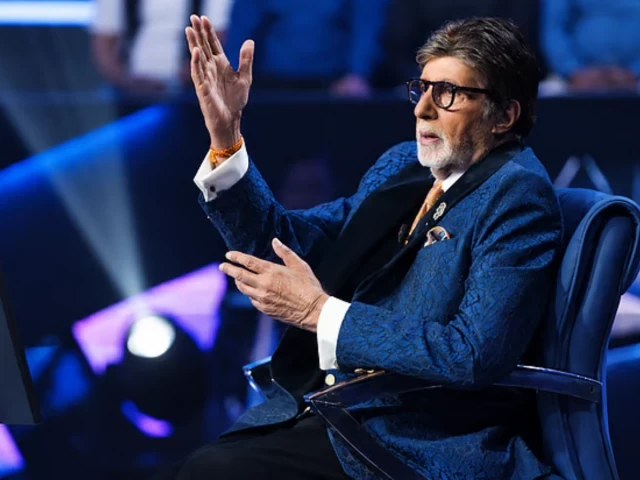
In a poignant and deeply revealing moment during an upcoming episode of the long-running, mega-hit television game show Kaun Banega Crorepati (KBC) Season 18, Bachchan pulled back the curtain on a deeply personal, lifelong regret. Speaking candidly with digital content creator Kritagya during a lighthearted segment of "This or That," the veteran actor confessed that despite a life saturated with artistic expression, a foundational pillar of the arts forever eluded him: the mastery of music.
While Bachchan’s baritone voice has lent gravitas to countless cinematic monologues and iconic playback tracks, his inability to play a musical instrument or formally study music remains his most persistent personal lament. Admitting that his home is stocked with idle instruments—waiting for a day of musical awakening that never materialized—Bachchan offered audiences a rare glimpse into the quiet, unfulfilled aspirations of a global icon. This extensive report explores the context of Bachchan’s candid confession, the rich intersection of music and Indian cinema, the psychological weight of lifelong unfulfilled dreams, and the enduring legacy of a man who, despite conquering acting, still looks upon musicians with a sense of quiet wonder.
Read Also
Detailed Chronology: The Evolution of a Cinematic Maestro and His Unstrung Instruments
To understand the depth of Amitabh Bachchan’s musical regret, one must trace the winding trajectory of his life, career, and enduring relationship with sound. Born in 1942 to the legendary Hindi poet Harivanshrai Bachchan and social activist Teji Bachchan, Amitabh was raised in an environment where the written and spoken word reigned supreme. His childhood home in Allahabad (now Prayagraj) was a nexus of India’s literary and cultural elite, where classical poetry, philosophical discourse, and artistic debate were daily occurrences.
However, the post-independence era in India offered few formal pathways for elite children to pursue eclectic artistic hobbies outside of traditional academics and career paths. Bachchan initially ventured into the corporate world as an executive for Bird and Co. in Kolkata before trading the ledger books for the celluloid dreamscape of Mumbai in the late 1960s.
The Cinematic Symphony
While Bachchan did not play instruments, his cinematic journey was inextricably bound to music. Through the golden age of Bollywood, his screen persona was defined by iconic musical numbers. From the foot-tapping rhythm of “Khaike Paan Banaraswala” in Don (1978) to the melancholic strains of “Kabhi Kabhie Mere Dil Mein” from Kabhi Kabhie (1976), Bachchan executed choreography and lip-synced with an intensity that made audiences believe he was the source of the melody.
Behind the scenes, legendary playback singers like Kishore Kumar and Mohammad Rafi lent their voices to his characters, cementing Bachchan’s image as a musical force. On rare occasions, Bachchan himself stepped behind the microphone, lending his unmistakable, gravelly baritone to tracks such as “Mere Angne Mein” (Laawaris, 1981) and “Rang Barse Bheegi Chunar Wali” (Silsila, 1981). These performances became cultural touchstones, celebrated during festivals and national gatherings alike.
[1942] Born in Allahabad to poet Harivanshrai & Teji Bachchan
  │
[1969] Debuts in Bollywood with "Saat Hindustani"
  │
[1970s–80s] Rises as the "Angry Young Man," cementing his legacy through iconic musical numbers
  │
[2000] Enters television as the host of "Kaun Banega Crorepati" (KBC)
  │
[Present (Age 84)] Admits on KBC Season 18 that his lifelong dream of learning instruments remains unfulfilled
The Gathering of Silent Instruments
Despite this deep immersion in the musical ecosystem of Indian cinema, the inner workings of melody—the structural mastery of scales, chords, and classical ragas—remained out of reach. According to Bachchan’s recent confessions on the set of KBC 18, this was not due to a lack of proximity, but rather the crushing demands of a relentlessly prolific career.
As Bachchan recounted to Kritagya and the studio audience, he consistently anticipated a future where his schedule would slow down, allowing him the bandwidth to sit down and master instruments such as the sitar or harmonium. To manifest this intention, he began collecting instruments over the decades, placing them around his residences as physical reminders of his unfulfilled ambition.
In a characteristically poetic flourish—likely inherited from his father—Bachchan revealed the extent of his deferred dreams: "I have kept all the musical instruments at home, hoping that one day I will learn. I even put garlands on them, thinking that day will come. Now I am 84 years old, and I still haven’t learned. That makes me very sad."
The image of a legendary actor placing ceremonial garlands on silent sitars and stringed instruments serves as a haunting metaphor for time passing, illustrating that even those who achieve the zenith of worldly success harbor quiet, domestic deferred dreams.
Supporting Context & Metrics: The Cultural and Psychological Dimensions of Late-Life Regret
Amitabh Bachchan’s public admission touches upon universal psychological and sociological phenomena: the nature of late-life regret, the unattainable pursuit of artistic perfection, and the unique pressure faced by cultural titans.
The Psychology of Unfulfilled Passions
In psychological research, late-life reflections often center around what social psychologists term "idealized self-discrepancies"—the gap between the person one became and the person one imagined becoming in youth. For individuals who achieve extraordinary success in one domain (such as global cinema), other latent interests can become magnified over time.
Dr. Alok Sharma, a cultural psychologist based in New Delhi, notes that Bachchan’s confession resonates deeply because it humanizes an untouchable figure. "When a man who has conquered every box-office metric and cultural barrier admits to feeling inadequate or regretful about a simple childhood wish, it validates the human experience," Sharma explains. "The musical instruments adorned with garlands are not just props in his home; they are physical monuments to time—a tangible proof that wealth and fame cannot automatically purchase discipline in a specialized, unrelated craft."
The KBC Phenomenon and Candid Television
That this revelation occurred on Kaun Banega Crorepati is no coincidence. For nearly a quarter-century, KBC (the Indian adaptation of Who Wants to Be a Millionaire?) has served as more than just a quiz show; it has functioned as Amitabh Bachchan’s personal confessional. Across 18 seasons, the hot seat has transformed into a space where the barrier between the star and the citizen dissolves.
| Metric / Attribute | Detail / Context |
|---|---|
| Current Age | 84 years old |
| Platform of Disclosure | Kaun Banega Crorepati (KBC) Season 18 |
| Interlocutor | Kritagya (Digital Content Creator) |
| Core Regret | Inability to play musical instruments (e.g., sitar) or formally study music |
| Symbolic Action | Collecting instruments at home and placing garlands on them in anticipation of learning |
| Career Longevity | Over 55 years in the entertainment industry |
By engaging with digital creators, young contestants, and everyday Indians, Bachchan consistently uses the KBC platform to reflect on his mortality, his upbringing, and his unfulfilled desires. The "This or That" segment, designed for rapid-fire, lighthearted banter, unexpectedly unlocked a door to a profound philosophical rumination when Bachchan bypassed easy choices about his cinematic past to confront his musical shortcomings.
Official Statements & Transcripts
To fully appreciate the nuance of Bachchan’s remarks, it is essential to examine the exchange in detail. Below is an excerpted transcript of the dialogue recorded during the taping of Kaun Banega Crorepati Season 18, featuring the interaction between content creator Kritagya and the veteran actor.
Kritagya: "Sir, moving into a quick round of ‘This or That’—if you had the choice, would you rather relive a single day from your glorious past, or step forward and live through an entirely new, unpredictable day?"
Amitabh Bachchan: "Life has given me so many days, so many moments of joy, struggle, victory, and companionship, that it becomes impossible to isolate just one day to relive. Every phase had its own beauty. But if we are talking about choices, perhaps my mind dwells less on what I have lived, and more on what I missed out on."
Kritagya: "And what would that be, sir? Surely there is very little left in this world that you haven’t experienced."
Amitabh Bachchan: (Sighing gently) "Music. I never learned music, although I always wished to. When I hear people sing so wonderfully, or when I watch someone gracefully handle instruments like the sitar, a deep sense of inadequacy washes over me. I look at them and I wonder: how do they possess that divine gift? I never learned any of this."
Kritagya: "But your voice, sir—millions consider your voice and your delivery to be musical in its own right."
Amitabh Bachchan: "Speaking lines is one thing; creating harmony through notes and strings is an entirely different universe. I have kept all the musical instruments at home, thinking, ‘One day, when things quiet down, I will sit down with a teacher and learn.’ I even put garlands on them, half-jokingly, half-hoping that the auspicious day to begin would finally arrive. Now I am 84 years old, and that day still hasn’t come. That makes me very sad."
This exchange underscores the humility that has kept Bachchan at the pinnacle of Indian popular culture for decades. Rather than dismissing his inability as trivial, he treats it as a genuine artistic loss, highlighting his lifelong reverence for classical and traditional Indian arts.
Future Outlook: The Enduring Legacy of an Eternal Student
As Amitabh Bachchan enters his mid-eighties, his work ethic shows no signs of abating. With multiple film projects in the pipeline, regular digital engagement through his blog and social media channels, and his ongoing stewardship of Kaun Banega Crorepati, he remains one of the busiest figures in global entertainment.
Yet, his recent confession on KBC 18 leaves fans and cultural commentators with a lingering, beautiful paradox. The man who defined the cultural rhythm of a nation for generations views himself as an outsider to the very world of melody that enriched his cinematic triumphs.
Will the sitars resting in his Mumbai residence ever be played? Statistically and practically speaking, at 84, the likelihood of Bachchan embarking on a rigorous classical music education diminishes by the day. Yet, the admission itself serves a greater purpose. It reminds a younger, hyper-accelerated digital generation—represented on the show by creators like Kritagya—that life is vast, artistic pursuits are infinite, and even the most accomplished individuals carry dreams that remain forever unfulfilled.
In sharing his regret, Bachchan has inadvertently composed a new kind of melody: one of vulnerability, self-awareness, and eternal curiosity. Long after the cameras stop rolling on the set of Kaun Banega Crorepati, the image of India’s greatest cinematic icon looking upon silent, garlanded instruments with longing will endure—a testament to an artist who, despite having conquered the world of film, remained forever captivated by the magic of music he never quite learned to play.





Comments
Facebook App ID not configured. Please add it in the Customizer.