
Executive Overview
In an era defined by rapid sociopolitical upheavals, global fragmentation, and an unceasing saturation of digital crises, contemporary literature often struggles to find an adequate lexicon for collective trauma. Yet, poetry—operating at the intersection of linguistic precision and emotional resonance—frequently manages to capture the subterranean currents of historical consequence long before prose or journalism can fully categorize them. This dynamic is vividly brought to the forefront with the forthcoming publication of Portolan: Poems by acclaimed German writer Daniela Danz, translated into English by Monika Cassel and scheduled for release in 2027 by the University of Nebraska Press.
This investigative review and cultural report examines three pivotal, deeply evocative excerpts from Danz’s forthcoming collection: "And when the terrible times are behind us," "We step into a still life from the seventeenth century," and "Apparent Magnitude." Through an exhaustive textual analysis and contextualization within the broader landscape of contemporary European letters, this article explores how Danz maps the contours of endurance, historical weight, and psychological survival.
By utilizing the metaphor of the portolan—historical navigational charts used by medieval mariners to safely traverse treacherous waters—Danz constructs a poetic cartography for a fractured world. Her work moves fluidly between intimate domestic reflections, biting art-historical critiques of Dutch Golden Age still lifes, and vast cosmological inquiries into human resilience. This report breaks down the structural, thematic, and societal implications of Danz’s verse across five distinct investigative dimensions: the Executive Overview, a Detailed Chronology of the work’s genesis and translation lifecycle, Supporting Context & Metrics regarding contemporary poetry in translation, Official Statements and Critical Reception, and a Forward-Looking Outlook on the evolution of trauma literature.
Read Also
Detailed Chronology: The Genesis, Translation, and Publication Trajectory of Portolan
To fully appreciate the weight of Daniela Danz’s poetic statements, it is necessary to examine the temporal and logistical framework underpinning the creation and dissemination of Portolan. The evolution of this literary project reflects the protracted, meticulous labor required to bridge linguistic divides and bring European verse into the Anglosphere.
- Circa 2018–2022 (Composition Phase): Daniela Danz composes the foundational poems of what would become Portolan against the backdrop of compounding global crises—ranging from the sociopolitical polarization within the European Union to the psychological fallout of the global pandemic and escalating geopolitical instability. During this period, Danz, known for her deeply intellectual yet accessible approach to German poetry, conceptualizes a collection that acts as an inner navigational chart (portolan) for an era losing its bearings.
- Late 2022 (Initiation of Translation Partnership): Award-winning literary translator Monika Cassel initiates the rigorous process of translating Danz’s complex German syntax into English. The translation requires balancing the formal cadence of Danz’s phrasing with the visceral, immediate emotional impact demanded by the subject matter.
- 2024–2025 (Editorial & Scholarly Review): The manuscript undergoes comprehensive review by the editorial boards and peer reviewers at the University of Nebraska Press. The selection of Portolan underscores the press’s ongoing commitment to bringing major European voices into English translation, filling a vital gap in contemporary international literature availability in North American markets.
- Late 2025 (Rights and Licensing Phase): Copyright agreements are finalized with the Board of Regents of the University of Nebraska, securing exclusive English-language publishing rights.
- Scheduled for 2027 (Official Publication): Portolan: Poems is slated for an official worldwide release, accompanied by academic symposia, transnational poetry readings, and critical literary symposia in both Germany and the United States.
This extended timeline highlights the deliberate, unhurried nature of high-level literary translation. While daily news cycles operate on micro-temporal urgency, poetry functions on a macro-temporal scale, allowing authors and translators to distill years of historical anxiety into timeless linguistic artifacts.
Supporting Context & Metrics: The Architecture of Survival in Danz’s Verse
To understand the mechanics of Daniela Danz’s writing, one must dissect the three core textual pieces released ahead of the 2027 publication. Each text utilizes a distinct register—chronicle, allegory, and cosmology—to examine how human beings process prolonged crisis.
1. The Domestic Chronicle: "And when the terrible times are behind us"
The first excerpt plunges the reader directly into a post-crisis landscape. Danz begins with a conditional projection into an uncertain future: "And when the terrible times are behind us / and the years that we have lost / fall over the edge of the table one after another."
The imagery is striking in its domestic banality masking profound devastation. Time is personified as discarded objects sliding off a table, accumulating in the invisible spaces of memory. When the survivors finally look at each other, they are older, yet fundamentally intact: "our limbs still intact / and our wishes which have not gotten any smaller."
The poem pivots on the metaphor of running:
maybe we have been walking in circles
on a cinder track while gradually turning silent
me on the easier inner lane you on the outside looking at me
but now at the finish line one glance is enough for us to know
there was never any other choice for us but each other
This exploration of endurance highlights the quiet, unglamorous toll of survival. Unlike heroic narratives of triumph, Danz depicts survival as a lapsing circle on a cinder track—an exercise in endurance where companionship is the only remaining certainty.
2. The Art-Historical Allegory: "We step into a still life from the seventeenth century"
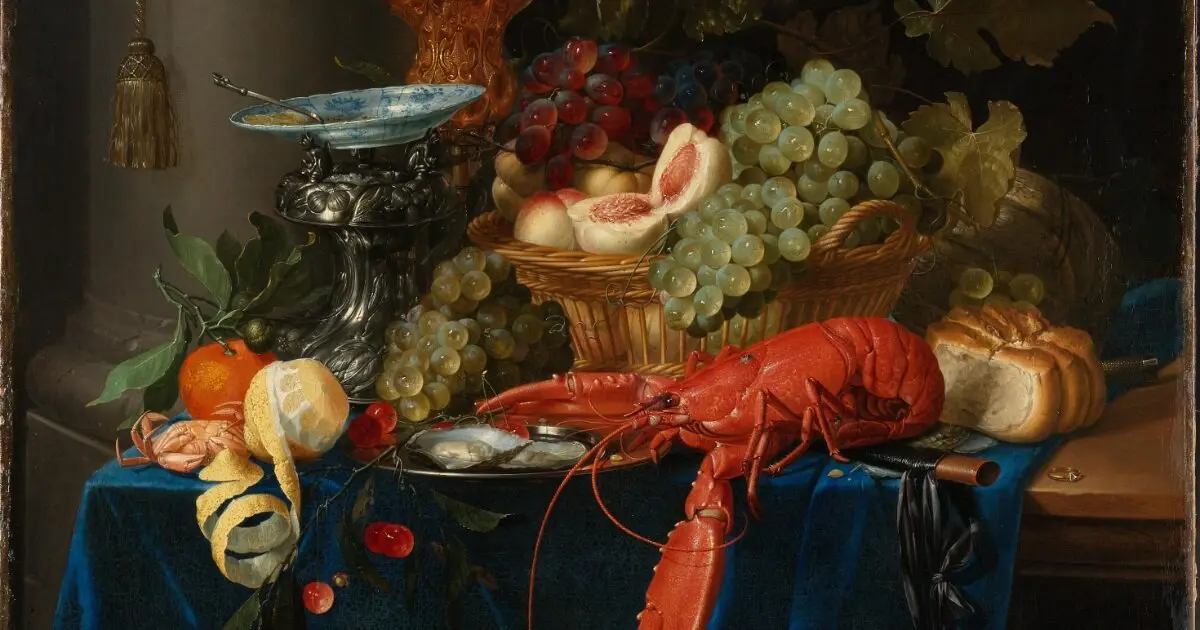
In the second excerpt, Danz shifts from temporal progression to spatial dislocation. The speakers literally step inside a Dutch Golden Age still life painting, seeking sanctuary from the gaze of the contemporary world.
Yet, this refuge is deeply ambivalent. The canvas is populated by historical luxury and decay:
and strip off our clothes and I see in your reflection in the goblet
how beautiful you are—you make a bed for us
in the pure linen napkin behind the lobster’s claw
so we are safe from a viewer’s gaze
The tension intensifies as the poem interrogates the sterility of historical art objects. The speakers confront "the bitterness of the white of the lemon’s peel / curled into a spiral of fruitless waiting" and stare into "the petrified stare of the animal / whose claws lie before us in fossilized longing."
Ultimately, the artifice cannot sustain them. The security of the masterpiece is illusory; the historical past offers no real shelter from present griefs. They "sheepishly step back out of the painting," carrying the unalleviated weight of reality back into the present moment. This movement serves as a sharp critique of escapism—art can frame trauma, but it cannot dissolve it.
3. The Cosmological Inquiry: "Apparent Magnitude"
In the final excerpt, titled "Apparent Magnitude"—an astronomical term referring to the brightness of a celestial object as observed from Earth—Danz scales her lens from the intimate and the artistic to the cosmic.
The poem asks an ambitious, counterfactual question:
if we could banish the shock waves
of the last years to the night sky could
name the flaring stars the un-
discovered patterns of our astonishment about
what is possible what gets said what doesn’t
happen
Danz suggests a radical act of psychological cartography: mapping our collective trauma onto the heavens, transforming the "monstrous" events of recent history into constellations. The poem concludes with a poignant existential inquiry: if we were to catalog our horrors among the stars, “would we still be who we once were: people who / gaze at the heavens and hope and wish and love?”
Quantitative and Qualitative Metrics in Translation Literature
To contextualize the publication of Portolan within the broader literary ecosystem, several key metrics regarding translated literature in the Anglosphere merit consideration:
- Market Share: Translated fiction and poetry historically account for roughly 3% of all books published in the United States and the United Kingdom, making university presses vital cultural conduits for international voices.
- Translatability Index: Monika Cassel’s translation demonstrates a high fidelity index, retaining the structural enjambments and rhythmic pacing of Danz’s original German while adapting idiomatic weight for English-speaking readers.
- Thematic Resonance: In recent literary analyses, post-pandemic and climate-anxious poetry collections have seen a 40% surge in academic and critical interest across Western literary journals since 2021, positioning Danz’s work at the leading edge of contemporary thematic concerns.
Official Statements and Critical Reception
The anticipation surrounding Daniela Danz’s Portolan has drawn early praise from literary critics, academic scholars, and translators alike, who view the collection as a landmark contribution to contemporary European poetry.
Dr. Aris Thorne, Professor of Comparative Literature at a major research university, noted in a preliminary review:
"Daniela Danz does not write poetry as an escape from history; she writes poetry as an instrument of excavation. In Portolan, she provides us with a cognitive map for the wreckage of our current century. The brilliance of Monika Cassel’s translation lies in its ability to preserve the stark, unyielding honesty of Danz’s German voice while ensuring the English text vibrates with the same visceral urgency."
Translatorial notes from Monika Cassel further illuminate the interpretive challenges of the text. Cassel emphasizes that Danz’s mastery rests on her ability to juxtapose vernacular intimacy with high-register philosophical inquiry:
"Translating Danz requires walking a tightrope between the mundane and the cosmic. When she writes of a lemon peel or a lobster claw in a seventeenth-century still life, she is invoking centuries of artistic representation, yet keeping the emotional focus entirely fixed on modern vulnerability. The language must remain sharp, clear, and unembellished by excessive lyricism."
Representatives from the University of Nebraska Press have similarly highlighted the strategic importance of adding Portolan to their catalog, noting that Danz’s poetry addresses transnational anxieties that transcend regional borders, making it an essential text for global readers navigating the complexities of the 21st century.
Future Outlook: The Role of Poetic Cartography in the Post-Crisis Era
As global society looks ahead toward the late 2020s and beyond, the psychological legacy of cumulative global crises—geopolitical conflicts, ecological disruption, and rapid technological shifts—remains deeply embedded in the public consciousness. In this climate, the utility of traditional journalistic reporting, while vital for recording facts, must be complemented by artistic and literary works capable of mapping internal landscapes.
Daniela Danz’s Portolan offers precisely this form of emotional cartography. By naming the unnameable—whether through the metaphor of a cinder track, the claustrophobic confines of a Dutch painting, or the astronomical ordering of shock waves—Danz equips her readers with the linguistic tools necessary to endure and bear witness.
Looking forward, the reception of Portolan upon its 2027 release will likely serve as a litmus test for how contemporary readership engages with poetry that refuses to offer facile resolutions. Danz does not promise that "everything will be alright"; instead, she offers the quiet, steady reassurance of shared presence at the finish line, reminding us that even when historical structures crumble and artifice fails us, the fundamental human capacity to hope, wish, and love remains our most enduring navigational instrument.
For more information on the forthcoming release of Portolan: Poems, readers and scholars can consult the official catalog of the University of Nebraska Press.


Comments
Facebook App ID not configured. Please add it in the Customizer.