
Executive Overview
In the pantheon of modern animation, few cinematic universes command the profound emotional resonance, cultural authority, and aesthetic purity of Studio Ghibli. Founded in 1985 by visionary directors Hayao Miyazaki and Isao Takahata, alongside producer Toshio Suzuki, the studio has consistently challenged Western hegemony over the medium of feature-length animation. Among its towering achievements, Hayao Miyazaki’s 1988 masterpiece, My Neighbor Totoro (Tonari no Totoro), stands as a monumental cultural touchstone.
While Western animation has historically relied on the anthropomorphization of animals for explicit moralizing or broad comedic effect—often categorized broadly under the umbrella of "Talking Animal" narratives—My Neighbor Totoro operates on an entirely distinct semiotic frequency. It is not merely a tale of fantastical creatures intersecting with human lives; it is a nuanced, deeply philosophical exploration of interspecies communication, the sentient landscape, and the psychological resilience of childhood.
This retrospective investigation examines the structural mechanics of My Neighbor Totoro, tracing its narrative anatomy from the mundane struggles of post-war Japanese domesticity to the dizzying heights of the spirit realm. By analyzing its thematic preoccupation with grief, ecological harmony, and the iconic iconography of the Catbus (Nekobasu), alongside its subsequent expansion in the short film Mei and the Kittenbus (2002), this report provides an authoritative assessment of how Studio Ghibli redefined the boundaries of animated realism and folklore.
Read Also
Detailed Chronology
The genesis, release, and enduring cultural trajectory of My Neighbor Totoro reflect a deliberate, auteur-driven process that prioritizes atmospheric immersion over frantic, plot-driven mechanics. The film’s internal chronology mirrors the rhythms of rural Japanese life, punctuated by moments of profound metaphysical intervention.
1. The Relocation and Domestic Realities
Set against the backdrop of 1950s rural Japan, the narrative initiates with a traditional nuclear family in a state of quiet displacement. University professor Tatsuo Kusakabe relocates his two daughters—ten-year-old Satsuki and four-year-old Mei—to a dilapidated, ivy-strangled country house on the outskirts of Tokorozawa. The move is strategically orchestrated to be proximate to a rural sanitarium where the girls’ mother, Yasuko, is undergoing prolonged treatment for a chronic, unspecified illness.
Far from presenting the decaying estate as a source of conventional Gothic dread, Miyazaki frames the property as a living ecosystem. The family embraces the home’s "haunted" status with joyous curiosity. The introduction of the Susuwatari (soot sprites)—small, carbon-like dust spirits that flee into the woodwork—establishes an immediate cinematic vocabulary: the invisible world is densely populated, fundamentally benign, and intricately connected to the domestic sphere.
2. The Threshold of the Forest and the Discovery of Totoro
The narrative accelerates through the eyes of the younger sibling, Mei, whose developmental stage predates rigid rationalism, positioning her as an unmediated vessel for the uncanny. While exploring the sprawling root system of an ancient, towering camphor tree—a landmark denoting a sacred Shinto boundary—Mei stumbles through a subterranean warren of foliage into the resting place of a titanic, sentient forest spirit: Totoro.
Unlike Western tropes of the monstrous or the purely didactic mentor, Totoro is characterized by an imposing yet profoundly comforting physicality. He is a massive, owl-cat hybrid whose communication bypasses human speech entirely. Through rhythmic roars, deep belly resonances, and shared silences, Totoro and Mei establish a cross-species dialogue. The famous bus-stop sequence under the pouring rain, where Satsuki and Mei share an umbrella with the towering spirit, codifies this relationship. The umbrella itself becomes a cultural artifact—a physical metaphor for human hospitality extended to the non-human realm.
3. The Crisis of the Missing Child
The narrative’s structural pivot arrives when the delicate balance between domestic stability and spiritual intervention is tested by earthly reality. Upon receiving a telegram indicating a delay in their mother’s anticipated homecoming due to a minor setback in her health, a distraught Mei attempts to walk to the hospital alone.
Her subsequent disappearance triggers a frantic rural search party. This sequence strips away the whimsical pastoral veneer, revealing the raw vulnerabilities of the characters. A parent can remain dangerously ill; the natural elements can prove overwhelming; and a four-year-old child can vanish into the vast, indifferent expanse of the Japanese countryside. The terror experienced by Satsuki and the local villagers grounds the fantastical elements in high-stakes dramatic tension, preventing the film from sliding into whimsical complacency.
4. The Intervention of the Catbus and Cosmic Resolution
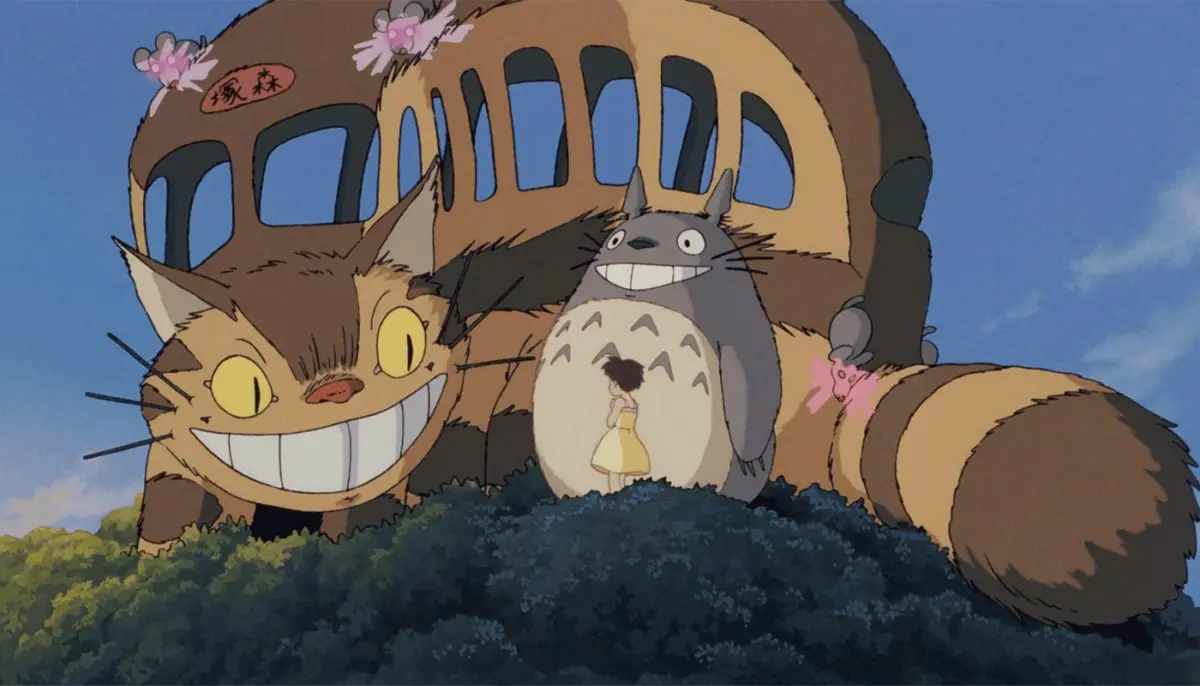
In the film’s emotional and structural climax, the resolution is achieved not through conventional police work or human ingenuity, but through the mobilization of the spirit infrastructure. Satsuki’s desperate appeal to Totoro summons the Catbus (Nekobasu)—a colossal, multi-legged feline vehicle equipped with glowing headlights and a destination sign flickering with impossible locations.
The Catbus serves as the ultimate synthesis of mechanical utility and biological wonder. It traverses telephone wires, skims across water surfaces, and gallops across rural rooftops with absolute impunity. Transporting Satsuki directly to her lost sister and subsequently to the hospital window where they safely observe their parents, the Catbus acts as a psychopomp and a vehicle of emotional restoration. The mother returns home in health; the lost child is recovered; and the world’s magic definitively embraces those open to its presence.
Supporting Context & Metrics
To fully comprehend the cultural weight of My Neighbor Totoro, one must analyze its production background, its relationship with Japanese folklore (Shinto and Animism), and its subsequent expansion within the Ghibli cinematic universe.
Demographic and Cultural Metrics
- Release Date: July 16, 1988 (released in a historic double-bill alongside Isao Takahata’s devastating war drama, Grave of the Fireflies).
- Box Office & Reception: Initially met with modest box-office returns upon its theatrical debut, Totoro achieved its legendary status through home video distribution, television broadcasts, and the relentless merchandising of its titular character, who subsequently became the corporate logo of Studio Ghibli.
- Critical Consensus: Consistently ranked among the greatest animated films of all time by international critics, holding a 94% approval rating on Rotten Tomatoes and frequent top-tier placements in Sight & Sound polls.
The Mythological Framework: Animism and Shintoism
Miyazaki’s universe is deeply rooted in Japanese animism (Kami), the belief that spiritual forces animate all things—trees, rivers, rocks, and houses. Unlike Western dualistic frameworks that separate the sacred from the profane, or the natural world from the technological, Totoro presents a seamless continuum.
| Western Narrative Trope (e.g., Narnia) | Studio Ghibli Approach (My Neighbor Totoro) |
|---|---|
| Talking Animals: Animals possess human speech and explicit moral codes. | Non-Verbal Interspecies Communication: Spirits communicate through vocalizations, posture, and environmental interaction. |
| Adult Skepticism: Adults deny magic; children must hide or fight it. | Adult Acceptance: Adults actively validate, understand, and respect spiritual encounters. |
| Binary Morality: Clear demarcations between good creatures and evil forces. | Ecological Neutrality: Spirits are protective and natural; darkness is simply a phase managed through community and joy. |
The Mechanics of the Catbus and Mei and the Kittenbus
The fascination with the Catbus did not conclude with the 1988 feature. Miyazaki returned to this specific piece of fantastical public transport in the 2002 short film Mei and the Kittenbus (Mei to Konekobasu), exhibited exclusively at the Ghibli Museum in Mitaka, Tokyo.
This 14-minute companion piece expands the internal lore of feline transport:
- Hierarchy of Scale: Catbuses age and grow; younger iterations (Kittenbus) manifest as swirling dust devils and exhibit erratic, high-velocity feline behaviors, while ancient entities like the Grandmother Catbus possess vast, building-sized proportions.
- The Dietary Anomaly: While real-world domestic felines lack the biological receptors to taste sweet carbohydrates (as confirmed by veterinary science), the magical ontology of the Ghibli universe permits these chimeric vehicles to consume and be pacified by human confections, specifically caramels. Mei’s ability to soothe a rampaging Kittenbus with a piece of candy underscores a central thesis of Ghibli’s ethos: kindness and shared sweetness bridge the gap between species.
Official Statements & Auteur Philosophy
Hayao Miyazaki has frequently articulated the philosophical underpinnings of his work, emphasizing that children possess a perceptual clarity that modern industrial society systematically erodes. In various retrospective interviews regarding the production of My Neighbor Totoro, key insights emerge:
"If you stay in the countryside long enough, you realize that nature is filled with things that cannot be explained. Totoro is not a monster; he is a manifestation of the forest itself—its patience, its ancient memory, and its quiet guardianship over those who respect it." — Hayao Miyazaki
Furthermore, Toshio Suzuki, Studio Ghibli’s producer, noted the financial and artistic risks associated with greenlighting a film about two young girls in the Japanese countryside without a traditional villain or high-octane conflict:
"When Miyazaki-san first pitched Totoro, distributors were skeptical. There was no enemy. There was no bomb threat, no dark lord, no dystopian empire. Just two sisters, a sick mother, and a large furry spirit in a tree. Yet, time has proven that humanity’s deepest craving is not for conflict, but for sanctuary."
Future Outlook
As Studio Ghibli navigates the post-Miyazaki transition—following foundational works by directors like Goro Miyazaki and Hiromasa Yonebayashi—the legacy of My Neighbor Totoro remains the anchor of the institution’s moral and aesthetic identity.
The successful opening of Ghibli Park in Aichi Prefecture, Japan, in late 2022 exemplifies the enduring commercial and cultural viability of the film’s universe. Featuring a full-scale, highly detailed recreation of Satsuki and Mei’s house (complete with authentic 1950s household goods, operable sliding doors, and meticulously designed environmental cues), the park prioritizes tactile exploration over high-thrill amusement rides, directly mirroring the spatial philosophy of Miyazaki’s films.
Key Forward-Looking Vectors:
- Preservation of Traditional Animation: Ghibli’s commitment to hand-drawn visual storytelling serves as a direct counterweight to the hyper-digitization and automated generation currently transforming the global animation market.
- Global Ecological Discourse: As contemporary global society grapples with climate anxiety and ecological degradation, the animist paradigm presented in Totoro—wherein human survival is inextricably linked to the veneration and protection of ancient natural landmarks like the camphor tree—gains renewed urgency.
- Institutional Archiving: Through international retrospectives, museum exhibitions, and physical media preservation, Studio Ghibli ensures that the complex interplay between grief, magic, and domestic warmth remains accessible to successive generations of global audiences.
In conclusion, My Neighbor Totoro transcends its categorization as a children’s film. It functions as an intricate anthropological and ecological artifact that advocates for a harmonious renegotiation of humanity’s place within the natural and spiritual world. Through the rustling leaves of the sacred camphor tree and the glowing amber eyes of the Catbus, Studio Ghibli established an enduring blueprint for cinematic empathy that will continue to resonate across cultural and generational divides indefinitely.





Comments
Facebook App ID not configured. Please add it in the Customizer.